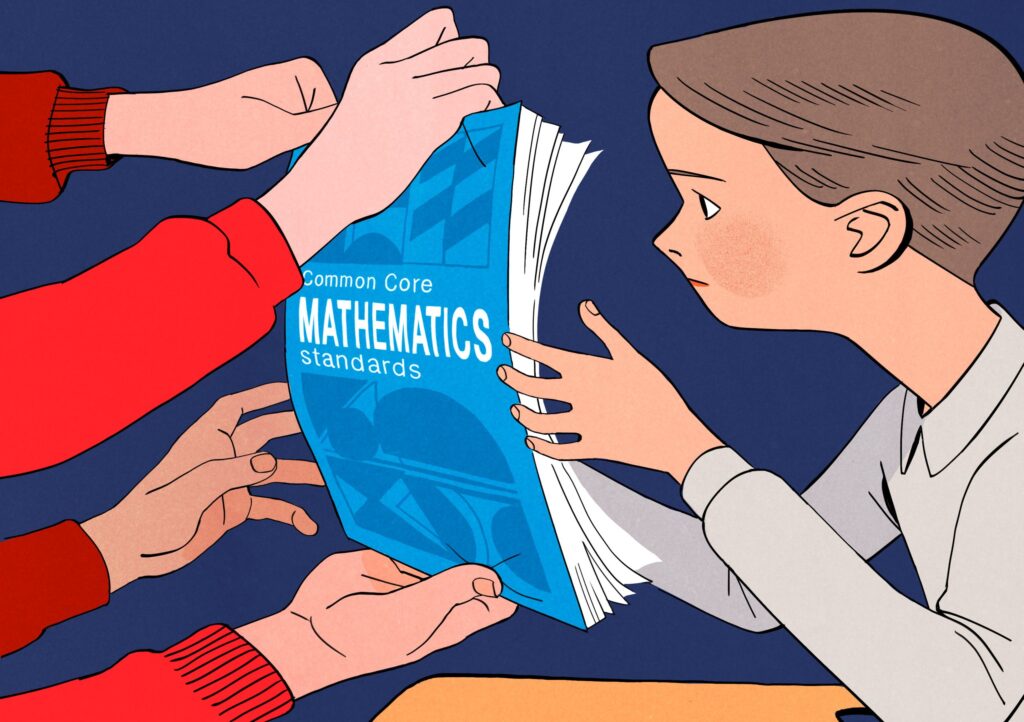
Susan Gilkerson, a math teacher and school bus driver, presented concerns to the South Dakota education board.
The board was examining new math standards, a mere 36 pages compared to the detailed 2018 version. Gilkerson noted that these new standards lack the depth needed for teachers to effectively use them. She emphasized the existing standards’ role in defining both the math concepts and the specific skills students must display, which is crucial for understanding concepts like the Pythagorean theorem.
Joseph Graves, South Dakota’s education secretary, argued that simplifying the standards is essential because the current ones are overly complex. “Our whole goal was to simplify, simplify, simplify,” Graves stated.
An exchange in October highlighted this debate over South Dakota’s math standards. The state consulted the Archimedes Standards by the National Association of Scholars, which promotes eliminating Common Core math. Since 2009, Common Core standards have faced criticism from those wary of federal influence over state education.
The National Association of Scholars claims that Common Core adds confusion and lacks rigor in math education. They advocate for a more straightforward approach, emphasizing memorization and reducing descriptive text in standards. However, critics argue that simplifying the standards might eliminate valuable guidance for teachers.
Jon Star, a Harvard education professor, remarked, “Simpler doesn’t necessarily mean more rigorous.”
Initially, almost all states adopted Common Core, but it soon drew criticism from various political spectrums. Parents in blue states objected to its heavy testing focus, while red-state politicians saw it as an overreach on state control, fueled by the Obama administration’s support.
The National Association of Scholars, in releasing the Archimedes Standards, seeks more states to revise their standards.
The group has shifted focus to revising state standards, releasing social studies guidelines in 2022, science in 2024, and math last year. Their Archimedes math standards aim for clarity and require more memorization, limiting calculator use until high school.
Jonathan Gregg, who authored these standards, says simplicity allows teachers more classroom freedom. “You can’t overprescribe,” he stressed, highlighting the need for all stakeholders to understand the standards.
In South Dakota, these simplified standards appealed to Graves, who found the Common Core-aligned versions too complex for parents and teachers. Using Archimedes as a model, the state crafted a concise rewrite.
However, this has intensified debates, especially with Hillsdale and the National Association of Scholars’ involvement in updating the state’s social studies standards. Critics say the focus on memorization undermines meaningful learning experiences.
Math teachers and university professors have largely criticized the new standards. Gilkerson noted a rewritten eighth-grade standard for scientific notation is overly brief, potentially hindering new teachers’ effectiveness.
Sharon Vestal, president of the state’s Council of Teachers of Mathematics, urged Graves to discard the rewrite, warning of lost content and oversimplification. Yet some educators, like Susan Fairchild from Watertown High School, appreciate the simplicity for new teachers.
Monte Meyerink, involved in the revision process, noted the lack of research linking simplified standards to improved student outcomes. The final version will include an expanded version with more detail, though concerns remain about their quality.
Ball State researcher Michael Steele criticized the Archimedes Standards’ simplification, saying it may oversimplify essential mathematics concepts.
The final decision on South Dakota’s standards will follow a public hearing. The National Association of Scholars aims to influence other states, advising Louisiana on its math standards review.
Contact editor Caroline Preston at 212-870-8965 or preston@hechingerreport.org.
This story about math standards was produced by The Hechinger Report, a nonprofit, independent news organization focused on inequality and innovation in education. Sign up for the Hechinger newsletter.
—
Read More Kitchen Table News