This story was produced in partnership with Work Shift and reprinted with permission.
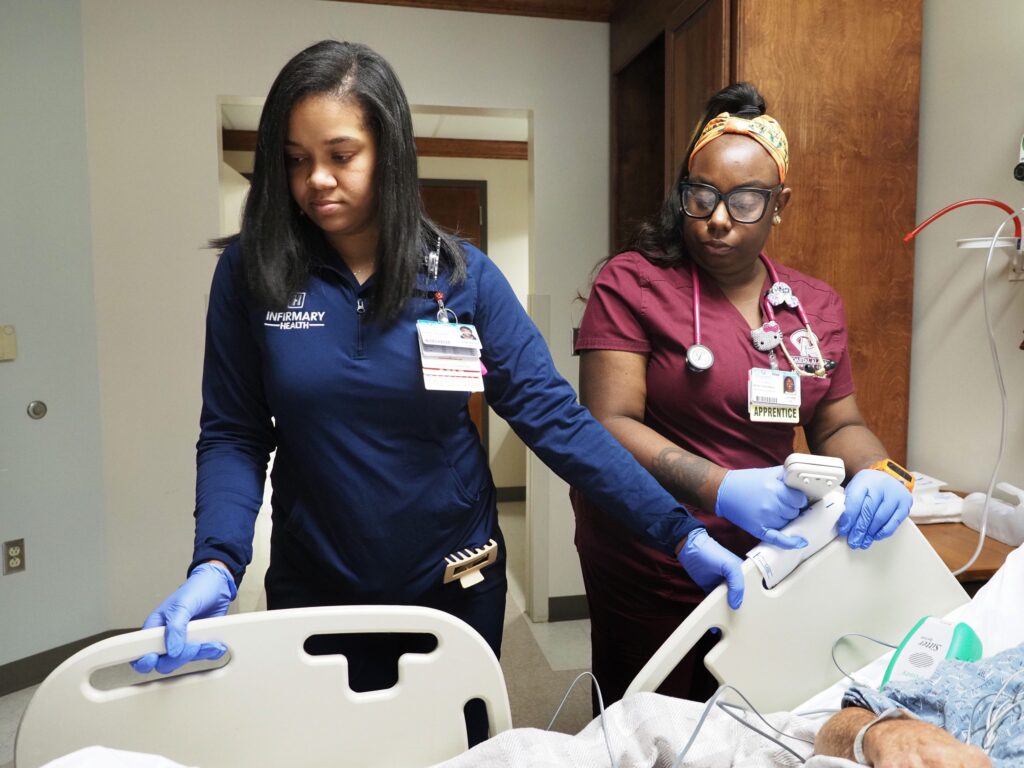
MOBILE, Ala. — At Mobile Infirmary hospital, LaTyra Malone, 37, starts her 12-hour shift at 6:30 a.m., working closely with patients. While she resembles a nurse in her duties, Malone is a registered nurse apprentice. Her practical skills, honed at Coastal Alabama Community College, are applied under the supervision of Ondrea Berry, her journeyworker. Unlike traditional nursing students, Malone earns a salary and benefits, gaining personalized, hands-on experience.
“It’s like having a little kid attached to your leg all day,” Berry joked.
Malone values the partnership, stating, “I learn so much more one-on-one.” The apprenticeship allows her to alternate duties with Berry, enhancing her observational and practical skills. With 16 years of experience as a certified nursing assistant and medical assistant, Malone benefits greatly, as does Berry, who appreciates the mutual learning opportunities.
Nursing apprenticeships, like Alabama’s, are emerging as solutions to the national nursing shortage, projected to reach crisis levels. Many aspiring nurses lack the prerequisites or resources to transition from roles like certified nursing assistants, typically earning $18 an hour, to registered nurses. The apprenticeship model bridges this gap by offering paid, supervised clinical experience.
Iris Palmer from New America highlights that the stringent nursing ethos might deter potential nurses. To combat this, several states, including Texas, are expanding registered nursing apprenticeships approved by the U.S. Department of Labor. Alabama stands out with its statewide nursing apprenticeship license, allowing students to earn while learning, which is crucial for those balancing work and education.
Since Alabama’s law passed, 80 employers and 28 colleges have developed LPN and RN apprenticeship programs. Almost 450 apprentices have completed the program, with over 500 currently enrolled. Mobile Infirmary alone has hosted over 90 nursing apprentices since 2022, with most graduates staying beyond their required year, noted by Stefanie Willis-Turner, director of nursing school partnership and programs.
The hospital’s tuition reimbursement program had limited uptake due to upfront costs and lack of guidance. Willis-Turner emphasizes the importance of mentorship in the apprenticeship program, which recruits individuals like Malone, who has long aspired to be a nurse. Thanks to the apprenticeship, she can support her family while advancing her career, contrasting with Berry’s experience of working at Dairy Queen to fund her education.
About 75% of Mobile Infirmary’s apprentices have prior hospital experience, while others switched jobs to join the program, which covers tuition and offers job security post-graduation. This support system is crucial for fostering economic mobility through successful apprenticeships. Yet, most health care apprenticeships focus on entry-level roles, limiting upward mobility, unlike Alabama’s model that prepares for higher-paying RN positions.
Alabama’s innovative approach, driven by collaboration among the nursing board, colleges, and employers, has inspired other states to consider similar models. Challenges remain, including the need for one-on-one mentorship and nursing school capacity issues. However, proponents like Jay Prosser from Massachusetts Nursing Council believe apprenticeships can produce more practice-ready nurses, essential for addressing the shortage.
States like Texas and Wisconsin are experimenting with nursing apprenticeships, but these often focus on those with existing degrees. Alabama’s comprehensive approach allows aspiring nurses to overcome educational barriers, with support from employers like Mobile Infirmary, which provides comprehensive support to apprentices.
Eric Dunker of the National Center for the Apprenticeship Degree anticipates significant growth in nursing apprenticeships, akin to the expansion of teaching apprenticeships. Despite regulatory complexities, he sees potential for nationwide adoption if stakeholders collaborate, as evidenced by Alabama’s success.
Coastal Alabama Community College’s Tyler Sturdivant acknowledges the challenges in establishing apprenticeship programs but notes improved completion rates, which contribute to addressing the nursing shortage. Apprentices like Malone, who balances patient care and professional growth, exemplify the program’s impact. Malone, who aspires to be a nurse practitioner, reflects, “I won’t feel complete until I actually become a nurse. If it wasn’t for the apprenticeship, I probably wouldn’t be here now.”
Contact editor Lawrie Mifflin at 212-678-4078 or on email at mifflin@hechingerreport.org.
This story was produced in partnership with Work Shift and reprinted with permission.
Since you made it to the bottom of this article, we have a small favor to ask.

We’re in the midst of our end-of-year campaign, our most important fundraising effort of the year. Thanks to NewsMatch, every dollar you give will be doubled through December 31.
If you believe stories like the one you just finished matter, please consider pitching in what you can. This effort helps ensure our reporting and resources stay free and accessible to everyone—teachers, parents, policymakers—invested in the future of education.
Thank you.
Liz Willen
Editor in chief
—
Read More Kitchen Table News