Article Summary –
Gov. Tony Evers signed “Gail’s Law,” named after Gail Zeamer, which mandates insurance coverage for additional breast screening exams for high-risk individuals, emphasizing the importance of early detection, especially in those with dense breast tissue. The law’s passage was driven by advocacy and personal stories, particularly from Gail’s family, highlighting her battle with late-stage breast cancer due to a lack of awareness about the risks associated with dense breast tissue. Despite initial legislative challenges, the law was passed to improve early detection and potentially save lives, underscoring the influence of grassroots advocacy and the power of personal stories in legislative change.
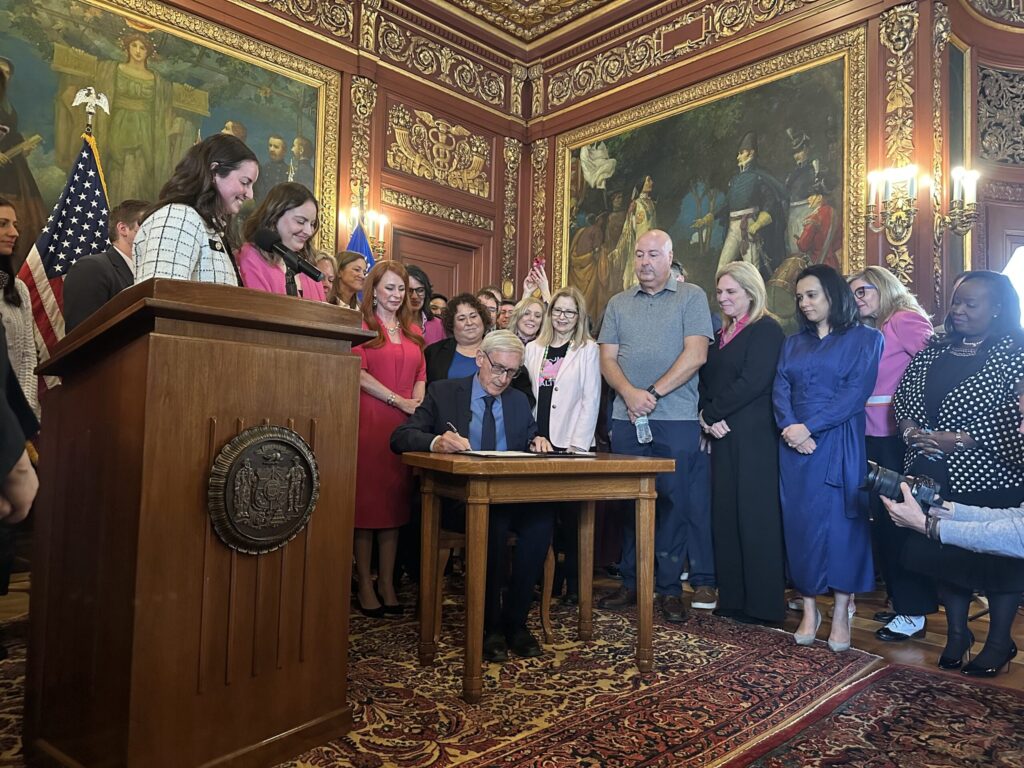
Amidst a gathering of lawmakers, advocates, and Gail Zeamer’s family, Gov. Tony Evers signed a new law on March 19 to enhance access to breast cancer screenings.
The event, with attendees in pink for breast cancer awareness, took place at the state Capitol, marking the signing of Gail’s Law. Named after Neenah resident Gail Zeamer, this law mandates health insurance coverage for supplemental breast screenings for individuals at higher cancer risk, notably those with dense breast tissue.
Supporters at the ceremony celebrated this life-saving law while reflecting on the delays and lives lost in the process.
“The system failed her,” Evers stated. “Gail’s influence has led to critical changes in state law. Losing her so soon was a tragedy.”
In 2016, Zeamer was diagnosed with advanced breast cancer. Despite regular mammograms, she was unaware of the heightened risks associated with dense breast tissue until her cancer reached Stage III. Tragically, she passed away on June 2, 2024, at age 56.
Her daughters, Claudia and Sophie, spoke during the bill signing.
“I feel grateful knowing my mom is now part of history,” Claudia remarked. “Though I miss her dearly, she’s surely smiling down on us for completing this.”
Sophie expressed gratitude towards supporters who helped honor Gail.
“This was an emotional journey for our family,” Sophie said. “But perseverance has brought us to this day. I know my mom is proud of everyone.”
The American Cancer Society estimates about 6,000 Wisconsin women will be diagnosed with breast cancer in 2026, with 670 fatalities. Breast cancer treatment costs are the highest among cancers, as per the CDC.
The Mayo Clinic notes that cancer detection in dense breast tissue is challenging, as both appear similar on mammograms. Nearly half of women over 40 have dense breasts, according to the Breast Cancer Research Foundation.
“As a cancer survivor, my family and I were fortunate to detect it early,” Evers said. “Getting ahead of this disease is crucial, which is why stories like Gail’s are so tragic.”
‘It’s just us and our voices’
Dawn Anderson, with 30 years at the Wisconsin Breast Cancer Coalition and a decade as executive director, recounted Gail’s work with the coalition’s policy committee after helping pass a 2017 law mandating density notifications in mammograms.
“Gail knew notifying women of dense breast tissue wasn’t enough if they couldn’t afford supplemental screenings,” Anderson explained.
The law’s journey was tough, Anderson noted. Initially proposed in 2021, it was sidelined until the Early Detection Saves Lives Coalition pushed for its legislative reconsideration in 2023. The bill progressed through health committees but didn’t reach a floor vote.
Lawmakers amended the bill, excluding MRIs from coverage protocols.
“MRIs are most recommended for high-risk women with dense breasts,” Anderson said. “We withdrew support to avoid passing a flawed bill.”
Without support, the bill stalled, Anderson recounted. However, a revised version passed through the Senate in 2025 and was unanimously approved by the Assembly last month.
“Unlike professional lobbyists, we at WBCC are volunteers. We rely on our voices and stories,” Anderson said. “It’s challenging, knowing its importance firsthand.”
“It was a long journey,” she added. “We accomplished it.”
Anderson, well-acquainted with Gail, remembered her as a charming friend dedicated to making the world better for her daughters.
She hopes others follow Gail’s example.
“One voice, one woman shared her story with legislators and persisted,” Anderson remarked. “It showcases the power of voices to manifest change. Keep voicing, and good things will happen.”
—
Read More Wisconsin News