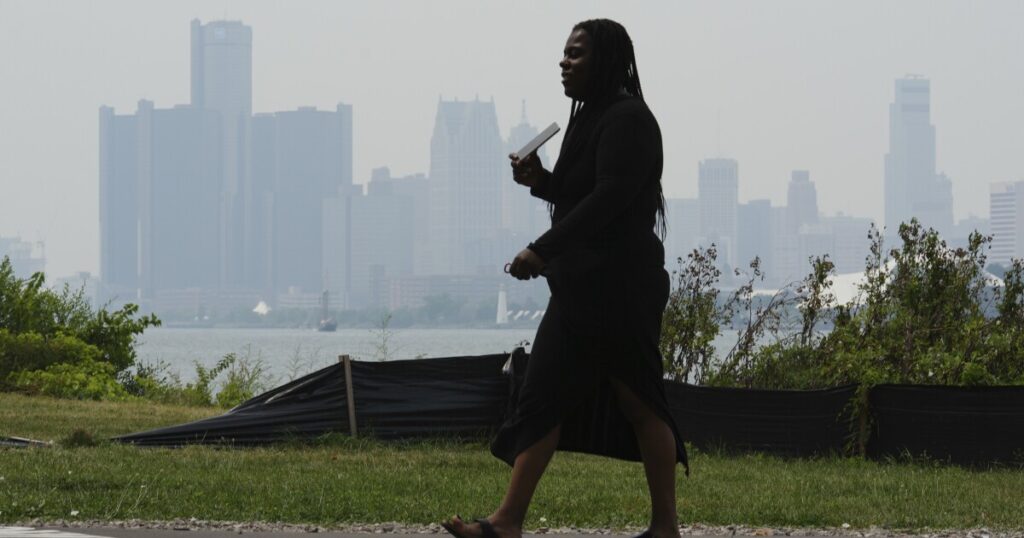
The skies above Michigan are beginning to clear as the state emerges from another bout of air quality alerts caused by smoke from Canadian wildfires. However, according to experts, climate change suggests these conditions might become a recurring issue, similar to the summer of 2023, affecting even those in good health.
Dr. Ike Okereke, chief of thoracic surgery at Henry Ford Health, emphasizes that wildfire smoke impacts everyone, not just individuals with pre-existing health conditions. He advises avoiding outdoor activities during poor air quality periods, as increased breathing during exercise or work can lead to more smoke inhalation. The Michigan Department of Health and Human Services also advises limiting time spent outside to reduce exposure.
Certain groups are particularly sensitive to wildfire smoke, including those with heart disease, asthma, COPD, children, teenagers, older adults, and pregnant individuals. A study showed that asthma-related emergency room visits in New York soared by 80% during severe wildfire smoke events in 2023.
Dr. Daniel Ouellette, chief of pulmonary and critical care medicine at Henry Ford Health, notes that when air quality deteriorates significantly, everyone is at risk. Detroit has experienced times recently when the air was unsafe for all, necessitating precautions.
Even for the healthy population, fine smoke particles, known as particulate matter 2.5 (PM2.5), can irritate the lungs and potentially alter gene activity, leading to health issues. Dr. Okereke warns of both immediate and long-term health risks, including an increased likelihood of developing diseases like lung cancer, which claims an estimated 25,000 non-smokers’ lives annually. He highlights that living in polluted areas can heighten the risk of developing lung cancer over time.
Emerging research also links poor air quality with mental health issues, including depression.
What steps can you take?
To mitigate risks, Dr. Okereke advises limiting outdoor activities during poor air quality days. Dr. Ouellette reminds that indoor environments should be smoke-free and equipped with clean air, using high-efficiency filters in air conditioning systems. The MDHHS offers guidance on filter selection, and do-it-yourself air filter tips can be found here, here, and here. Symptoms like coughing, wheezing, or eye and throat irritation should be monitored.
However, individual measures alone are insufficient. Dr. Okereke emphasizes the need for policy changes and collective action, as the situation is expected to worsen. In Detroit, the wildfires add to existing air quality challenges, exacerbated by factors such as traffic density, industrial activity, and population density.
Some Michigan lawmakers have pointed fingers at Canada for the wildfires, while the White House seeks to reduce the government’s climate change combat abilities. Dr. Okereke stresses the importance of addressing air quality issues in the context of broader environmental threats, hoping that collective voices can drive change, even if only at the state level.
—
Read More Michigan News



![Botched Ad Mix-Up: Super PAC Error in Arizona Congressional Race[embed]https://www.youtube.com/watch?v=bEMgIlCkHz0[/embed]](https://www.kitchentablenews.org/wp-content/uploads/2026/10/Botched-Ad-Mix-Up-Super-PAC-Error-in-Arizona-Congressional-RaceembedhttpswwwyoutubecomwatchvbEMgIlCkHz0embed.com2F0e2F962Fe971102f49e7a4f2a64fd3cc60a22Fjonatha.png "Botched Ad Mix-Up: Super PAC Error in Arizona Congressional Race[embed]https://www.youtube.com/watch?v=bEMgIlCkHz0[/embed]")