Scott Thybony, in his recent Canyon Commentary, shares his explorations on the Arizona Strip’s rugged terrain. He finds beauty in the wind-sculpted Navajo sandstone near the Utah border, choosing to appreciate the enigmatic allure of these geologic formations rather than label them.
With a series of storms behind us, the path north to the Utah-Arizona border opens up, revealing a terrain ripe with exploration opportunities.
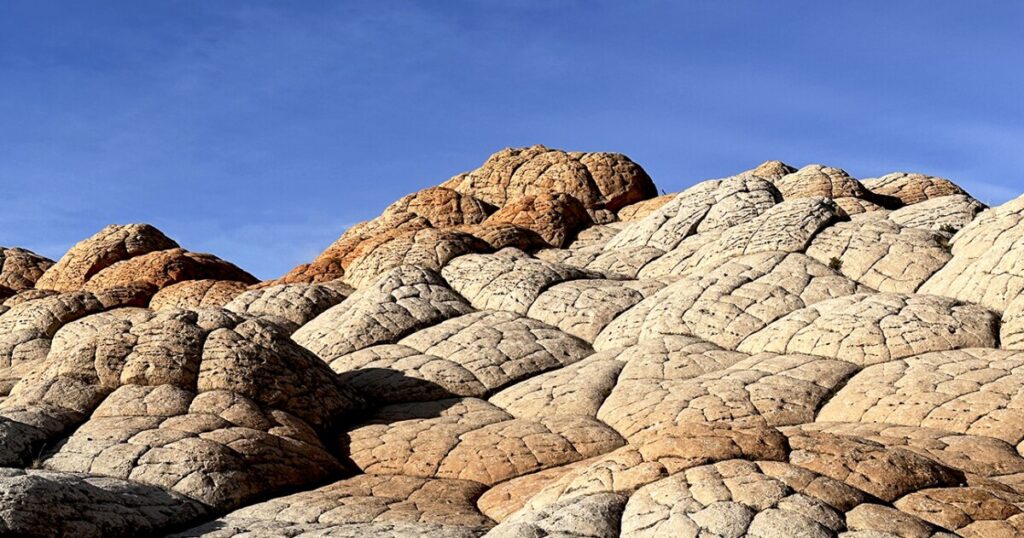
We soon find ourselves traversing a sandstone landscape where pale, knobbly mounds appear as if clouds have settled on the earth.
Geologists have devised creative descriptions for these rocks, whose formations remain debated. Terms like “tortoise-shell weathering” and “bulbous cauliflower relief” have been used.
Some even liken them to “pans of giant bread muffins.”
Interestingly, similar polygonal designs have been observed on Mars. I once considered calling a nearby alien-like landscape Planet X but held back, knowing names carry weight.
Many recall the days when Coyote Buttes was a hidden gem. As it gained fame, the mesmerizing sandstone pocket became “The Wave,” attracting large crowds. Tragically, several have perished in the summer heat on the three-mile trek, prompting the Bureau of Land Management to introduce a permit system. Today, with a slim chance of winning the lottery, we opt for a longer, more challenging journey to lesser-known plateau areas.
Prepared for the treacherous sand, we pack shovels, recovery boards, and tow straps. Our navigation tools include a National Geographic map, topo apps, and satellite imagery. In the past, I’d venture here with only a two-wheel drive pickup and a basic 15-minute quad map.
However, drier conditions and increased traffic have deepened ruts and softened sand traps.
To ensure safety, each of us carries a satellite-linked emergency locator.
The journey takes us past Navajo Sandstone outcrops, with sweeping layers from a vast Jurassic desert 195 million years ago. Once a sand sea, it’s the hallmark rock of the Four Corners region, forming cliffs over 2,000 feet at Zion Canyon.
On the plateau, the sandstone weathers into countless unusual shapes resembling turtle shells, toadstools, beehives, and even human brains. In some spots, it forms parallel ridges like ripples on a washboard road.
Beyond an unnamed mesa, down miles of sand-choked roads, lies a breathtaking rock formation. A perfect cone, sculpted by swirling winds, rises 25 feet to a point topped with a flat rock.
Its smooth sides, layered in soft reds and yellows, combine the form of a classic tepee rock with a hoodoo. The first sight of it is striking, as it stands alone, an outlier with nothing similar nearby.
When encountering such a unique rock feature, it’s natural to compare it to something familiar. Often, the name reflects its resemblance.
Standing beside the smooth cone, I imagine a vaquero in a colorful poncho.
Yet, naming it detracts from the rock’s true essence.
Simply appreciating the beauty of a wind-carved rock is enough.
Leaving it unnamed, we turn back, following a path deeper into the Sand Hills.
Scott Thybony is a writer based in Flagstaff. His Canyon Commentaries are produced by KNAU Arizona Public Radio and air on the last Friday of each month.
In the midst of the holiday season, Scott Thybony reflects on a few crucial life lessons. He’s learned it pays to jump headlong into an endeavor, even though one might be wholly unprepared for what they’re about to face.
—
Read More Arizona News

![Jody White’s Unconventional Michigan Supreme Court Candidacy Explored[embed]https://www.youtube.com/watch?v=8NfxFIPE4ac[/embed]](https://www.kitchentablenews.org/wp-content/uploads/2026/10/Jody-Whites-Unconventional-Michigan-Supreme-Court-Candidacy-Exploredembedhttpswwwyoutubecomwatchv8NfxFIPE4acembed.com2F842F0e2Fc7223daa43c9876b36a4e00773a42Fme-supc.png "Jody White’s Unconventional Michigan Supreme Court Candidacy Explored[embed]https://www.youtube.com/watch?v=8NfxFIPE4ac[/embed]")