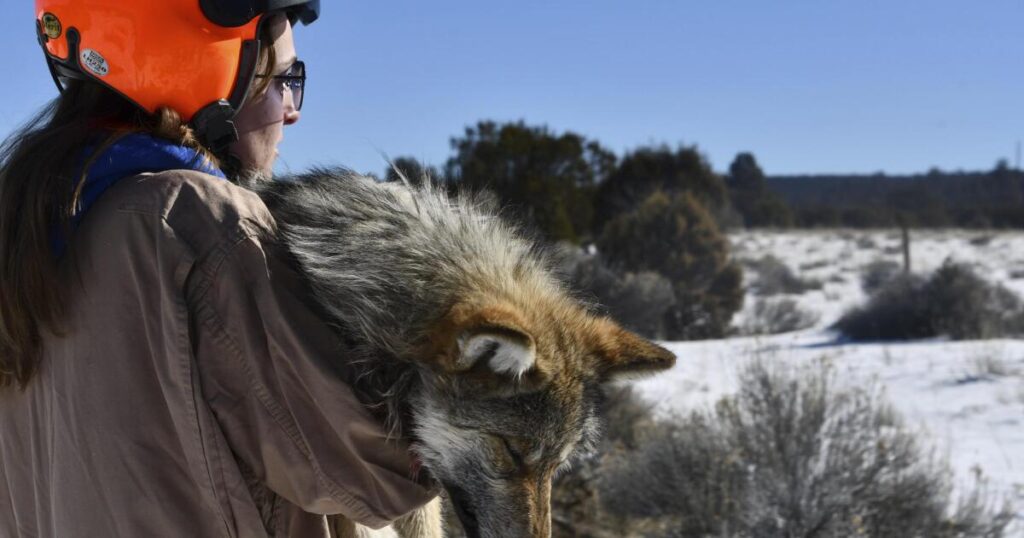
Debate Intensifies Over Protection Status of Mexican Gray Wolves
As the population of Mexican gray wolves continues to grow in the wild, the House Committee on Natural Resources has moved forward with a controversial bill that would remove the species from the Endangered Species List. Advocates of the Enhancing Safety for Animals Act argue that the wolves, having recovered from near extinction, now pose a threat to livestock.
Rep. Paul Gosar, the Republican lawmaker behind the bill, argues that the measure is necessary to safeguard rural communities and mitigate economic impacts on ranches. “Since being reintroduced to the wild in Arizona, Mexican wolves have preyed on cattle, livestock, and even family pets, causing significant financial losses and economic hardship on family-run ranches,” Gosar noted in his newsletter.
Despite Gosar’s assertions, he declined to provide further comments in an interview. Current estimates indicate there are at least 286 Mexican gray wolves roaming wild in eastern Arizona and New Mexico, marking a recovery since their reintroduction in 1998.
However, the proposed legislative changes have sparked opposition from conservationists, with seventy groups urging Congress to reject the bill. Sandy Bahr, director of the Sierra Club’s Grand Canyon Chapter, contends, “Representative Gosar doesn’t seem to understand that these animals are still endangered, they are not recovered, and that they belong, they belong here in Arizona and New Mexico, in the Southwest.”
Bahr highlights genetic diversity as a significant challenge in the wolves’ recovery, emphasizing that the current wild population descends from only six wolves captured in the 1970s. “The numbers are moving in the right direction, but again, there are the genetic issues that have to be addressed,” she explains.
Alongside the federal bill, state-level legislation in Arizona is also putting pressure on the species. One such bill, spearheaded by state Sen. David Farnsworth, seeks to stop the Arizona Game and Fish Department from participating in the release of wolf pups into wild dens—a practice known as cross-fostering, which biologists deem essential for boosting genetic diversity.
Even with the population increasing for nine consecutive years, conservationists warn that without addressing genetic bottlenecks, the recovery program for the Mexican gray wolves may face significant setbacks.
—
Read More Arizona News

![Jody White’s Unconventional Michigan Supreme Court Candidacy Explored[embed]https://www.youtube.com/watch?v=8NfxFIPE4ac[/embed]](https://www.kitchentablenews.org/wp-content/uploads/2026/10/Jody-Whites-Unconventional-Michigan-Supreme-Court-Candidacy-Exploredembedhttpswwwyoutubecomwatchv8NfxFIPE4acembed.com2F842F0e2Fc7223daa43c9876b36a4e00773a42Fme-supc.png "Jody White’s Unconventional Michigan Supreme Court Candidacy Explored[embed]https://www.youtube.com/watch?v=8NfxFIPE4ac[/embed]")