In 2010, a rare cluster of tornadoes swept through northern Arizona, leaving a mark visible even from space. Intrigued by these persistent tracks, author Scott Thybony embarked on a journey to uncover the story behind this unusual meteorological event. His investigation led him to a conversation with the meteorologist who witnessed it all unfold.
The spectacle of natural disasters often draws us in, whether they’re close to home or far away. Recently, I’ve been delving into the paths of tornadoes that tore through Northern Arizona in the fall of 2010. This event marked the largest tornado outbreak ever documented west of the Continental Divide, with at least eleven confirmed tornadoes. At the time, I somehow managed to miss most of it.
To gain deeper insight, I arranged to meet with Brian Klimowski, the Meteorologist in Charge, on the last day of his three-decade career. We convened at his office at the National Weather Service forecast center in Bellemont, just west of Flagstaff.
On the morning of October 6, an urgent call from the meteorologist on duty jolted Brian awake. “’It’s a tornado! It’s probably going to hit the office. I’m taking shelter now!’ Click.” The call abruptly ended, and Brian sprang into action, rushing to his computer. “There were multiple tornadic supercells,” he recalled, “heading right toward the office.” Without delay, he drove across Flagstaff, moving toward the impending storm.
Despite being as susceptible to the whims of weather as anyone else, meteorologists like Brian are committed to their duty. “It’s what you do,” Brian remarked. “One of the most frightening parts for a meteorologist is when you’re actually issuing a tornado warning or flash flood warning for your own house.”
Two days before the storm, forecasts predicted thunderstorm activity with a possibility of tornadoes, an uncommon occurrence in Arizona. However, the state experiences several tornadoes yearly. Meteorologists stayed vigilant, providing updates to local emergency services as the situation developed.
When the tornadoes neared, Interstate 40 was closed by the highway patrol. While motorists expressed their frustration, the tornado cut across the highway. Brian reached the closure and, using his weather service badge, was allowed to pass. The highway was littered with debris, forcing him to navigate carefully to reach his office.

As the tornado approached, meteorologists sought refuge in the kitchen area, designed to withstand significant winds. After the storm passed, a more potent tornado, with wind speeds reaching 161 mph, swept through just a third of a mile away. This long-track tornado tore through the forest, leaving a trail of destruction from the rim country to 30 miles north of the San Francisco Peaks. In Bellemont, the tornadoes derailed trains, overturned trucks, and destroyed homes.
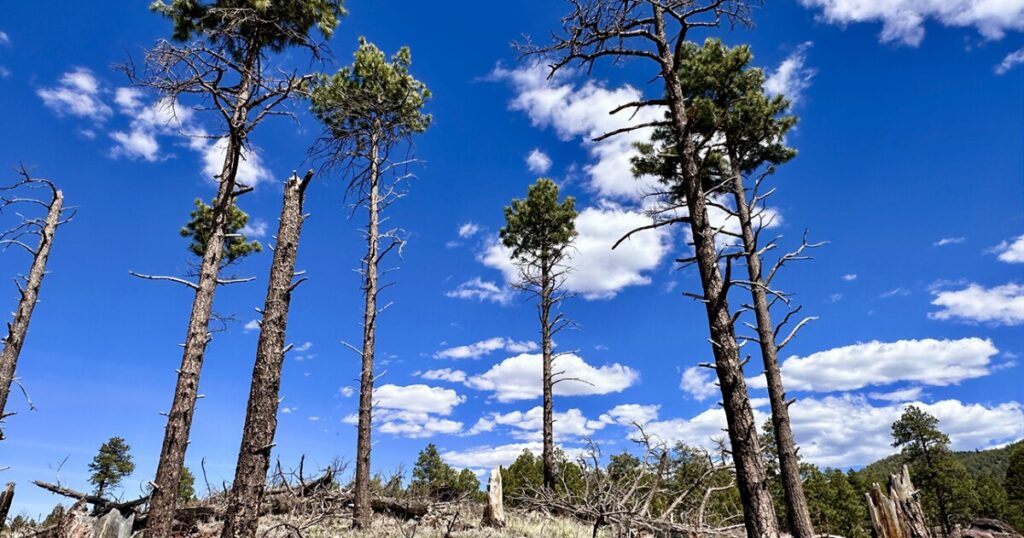
Surprisingly, remnants of this devastation are still visible on satellite images. As I walked along the tornado tracks, I encountered piles of uprooted trees and broken trunks standing like gravestones. Some ponderosa pines, stripped of all but a few branches at the top, resembled a ship’s crow’s nest.
Before parting ways, I asked Brian what he would miss most in retirement. “The sense of purpose,” he said, “of making a meaningful contribution to people’s lives, and just being a part of this family. This is a great team here.” He added, “It’s a part of my fiber. I love the science, I love the forecasting, I love being involved with the weather and involved with the impacts that can happen. Simply put, it’s the foundation of my life . . . and it’s something I enjoy.” After a pause, he concluded, “I’ll miss that, I’ll miss that.”
As I set off to explore another segment of the tornado track, I instinctively checked the weather app on my phone. After our conversation, it felt more essential than ever.
Scott Thybony is a writer based in Flagstaff. His Canyon Commentaries are produced by KNAU Arizona Public Radio and air on the last Friday of each month.
In this month’s Canyon Commentary, author Scott Thybony takes us into the remote Lukachukai Mountains on the Navajo Nation to explore a 1,500-year-old ruin with rock art that features hundreds of mysterious painted handprints.
—
Read More Arizona News



![Jody White’s Unconventional Michigan Supreme Court Candidacy Explored[embed]https://www.youtube.com/watch?v=8NfxFIPE4ac[/embed]](https://www.kitchentablenews.org/wp-content/uploads/2026/10/Jody-Whites-Unconventional-Michigan-Supreme-Court-Candidacy-Exploredembedhttpswwwyoutubecomwatchv8NfxFIPE4acembed.com2F842F0e2Fc7223daa43c9876b36a4e00773a42Fme-supc.png "Jody White’s Unconventional Michigan Supreme Court Candidacy Explored[embed]https://www.youtube.com/watch?v=8NfxFIPE4ac[/embed]")