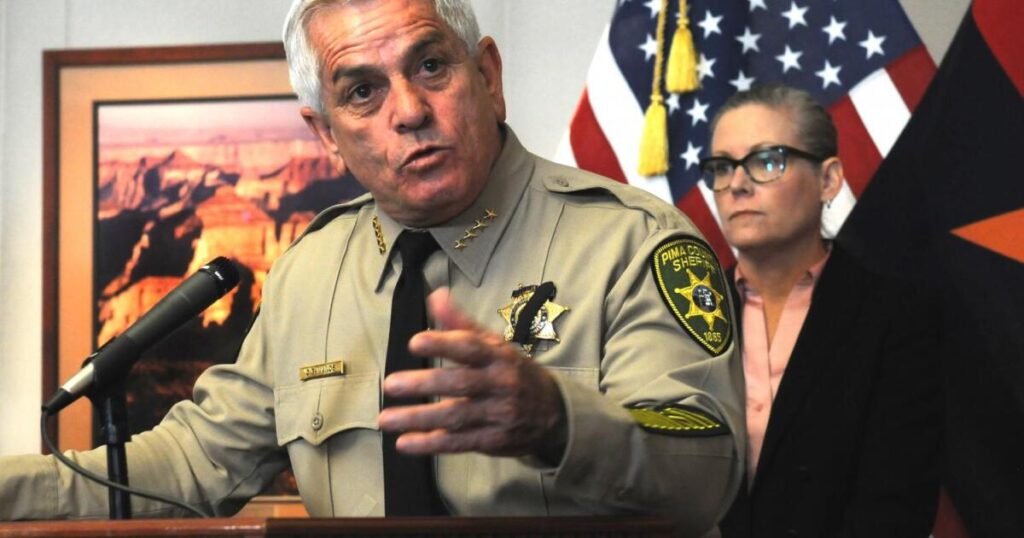
Under a cloud of controversies, Pima County Sheriff Chris Nanos is facing increasing scrutiny. Allegations range from his inadequate response to the case of Nancy Guthrie’s disappearance to the omission of past disciplinary actions from his professional record, causing an uproar among the public and his colleagues.
The Pima County deputies’ union recently expressed their discontent through a no-confidence vote, with nearly half its members demanding Nanos’ resignation. Read more about the vote.
Adding to the turmoil, the ACLU of Arizona has initiated legal proceedings against the Pima County Sheriff’s Office to gain access to records detailing interactions with federal immigration bodies. Details of the lawsuit are available through KJZZ.
The ACLU’s filing in the Pima County Superior Court follows a request made last summer for incident reports where sheriff’s deputies had contact with ICE and Border Patrol. Some records show deputies notifying federal agents during traffic stops.
Sheriff Nanos maintains that his department does not collaborate with immigration enforcement, yet evidence points to deputies contacting Border Patrol under certain circumstances. John Mitchell, an immigrants’ rights attorney with the ACLU of Arizona, notes that the department formerly tracked such interactions, but ceased this practice abruptly last year.
Full conversation
JOHN MITCHELL: “As far as we knew at the time, these were isolated incidents, but we did go into the publicly posted policies of the Pima County Sheriff’s Department and saw that there was a policy requirement to track communications between the deputies and what they call federal immigration authorities.”
LAUREN GILGER: Right.
JOHN MITCHELL: “We later learned that they just interpreted federal immigration authorities to mean Border Patrol. To our knowledge, we don’t have any records of them tracking communications with ICE, but we did uncover a set of records that indicate when and for what purpose Pima County sheriff’s deputies will call Border Patrol, and those records stopped somewhat abruptly in 2024 despite the policy continuing up until the point at which we had requested the records.”
Shortly after the ACLU’s request, the sheriff’s office quietly changed its policy, no longer mandating this tracking, which has fueled ongoing litigation to uncover the extent of these interactions.
LAUREN GILGER: So you’re suing for the release of those documents in light of that change that seems to have happened. You’ve already obtained some documents from PCSO related to incidents that seem to have resulted in some interaction with federal immigration authorities. You said not particularly with ICE, but with Border Patrol. What did those records show? It looks like there are some cases in which you see sheriff’s officers call Border Patrol?
JOHN MITCHELL: “Yes, absolutely. That’s not in question. In general, it’s hard to categorize or say overarching findings about such a broad number of records, a large number of records over such a broad time frame. Of course, you know, there’s — you can’t say that every single instance is constitutionally problematic or potentially unlawful. Of course, there are just thousands upon thousands of interactions and reports and data points.”
Mitchell emphasized the importance of examining these interactions to ensure they do not infringe on constitutional rights, particularly those involving prolonged detentions until Border Patrol’s arrival.
LAUREN GILGER: Right. It’s what’s available to the public, yeah.
JOHN MITCHELL: Exactly.
LAUREN GILGER: So, so let me ask you about why now, right? Like as you’re digging up these records, this obviously comes at a moment in which we’re seeing, you know, increased immigration enforcement around the country from the Trump administration. We’re seeing a real ramping up of agreements between local law enforcement agencies and federal immigration authorities. These 287(g) agreements have really exploded in the last year or so.
The Pima County Sheriff’s Office does not have that kind of agreement. The sheriff, Chris Nanos, has said, you know, “We do not enforce immigration law. We’re not interested in your immigration status.” I wonder why now in terms of the ACLU looking into these kinds of incidents and patterns?
JOHN MITCHELL: “Yeah, well, that’s chief concern for us is to ensure that in a broader sense public officials are held accountable to their constituents. When a sheriff touts their agency’s commitment to non-cooperation, you know, in one isolated sense it means they don’t enforce immigration law, right? They can’t arrest someone for a suspected lack of status. But in our view it also means they would not call Border Patrol just because they’re unsure of someone’s immigration status. And certainly that they would not call Border Patrol to the scene of — I think in one incident report just a description of people who are not of the United States without any further context.”
Mitchell’s concerns echo those of community organizations worried about the chilling effect on emergency calls. Residents may hesitate to seek help if they fear law enforcement might involve immigration authorities.
LAUREN GILGER: Lots to watch for. John Mitchell, immigrants rights attorney for the ACLU of Arizona, joining us. John, thank you for coming on, appreciate you taking the time.
JOHN MITCHELL: “Thank you so much for having me.”
KJZZ’s The Show transcripts are created on deadline. This text is edited for length and clarity, and may not be in its final form. The authoritative record of KJZZ’s programming is the audio record.
—
Read More Arizona News