Legal Challenges Offer Hope for Detained Immigrants Amidst Increasing Bond Denials
As immigration enforcement ramped up during the Trump administration, many detained immigrants turned to federal courts seeking freedom through habeas corpus petitions. In Michigan, numerous federal judges have granted these petitions, requiring the government to either hold bond hearings or release detainees.
Despite this legal avenue, the possibility of release has become increasingly slim. An analysis by Michigan Public of around 500 cases reveals that while many detainees were initially granted bond, denials have surged since mid-January.
The reasons for this increase remain unclear, although speculation suggests that immigration judges face pressure to deny bond to those granted habeas corpus.
The Department of Justice (DOJ), which oversees immigration courts, has not provided comments on this matter.
Securing bond from an immigration judge remains one of the few paths to freedom for detained immigrants in Michigan. News quickly spreads when bond is denied at the North Lake Processing Center.
“It’s a massive denial (of bond hearings),” noted Luis Fernandez-Escalante, a Venezuelan asylum seeker detained for nearly six months. “One day, I saw at least ten people denied bond, one after another.”
Detainees at North Lake and their attorneys fear that the narrow path to freedom through habeas corpus is closing.
“We used to see reasonable bond results for those granted habeas corpus,” said Ruby Robinson, a lead attorney at the Michigan Immigrant Rights Center (MIRC). However, early this year, bond hearings seemed “almost predetermined to be denied.” Now, “when bond is granted, it’s an exciting moment,” she added.
“Much of what is happening is hoping people will give up and self-deport. I hate to say that,” said Lawrence Burman, a retired immigration judge. “There’s never been anything like what’s happening in this administration.”
The DOJ has not responded to interview requests or questions about these issues.
Under Trump, a broad “mandatory detention” policy was implemented, leading to thousands of immigrants being held without bond hearings. Attorneys challenged the policy with a flood of habeas corpus petitions.
Michigan Public tracked more than 800 petitions filed in federal district courts in Michigan. In most cases, judges found that immigrants were unlawfully detained, violating their Fifth Amendment due process rights.
However, winning a habeas corpus case doesn’t guarantee freedom. Judges’ orders allow the government a few days to release detainees or grant a bond hearing, requiring the DOJ to file a “status report” detailing the outcome.
Michigan Public reviewed status reports from about 500 cases where habeas corpus petitions were granted from November 2025 to mid-February 2026.
These reports offer a rare, incomplete glimpse into what happens after federal judges determine immigrants are “unlawfully detained” at North Lake and in four county jails working with ICE.
“These data allowed us to see the real trend, and it wasn’t just our imagination,” said MIRC attorney Robinson. “It wasn’t just a pessimistic view of reality.”
Dozens of detained immigrants in the state were released after filing petitions in federal courts. About 200 more received bond, offering a chance for freedom — if they can afford it.
Yet, many, like Luis Fernandez-Escalante, were denied bond and remain detained.
Luis Fernandez-Escalante felt a glimmer of hope when a federal judge granted him a bond hearing. It was early February, and the cold wind seeped through his cell block’s small windows, compounded by the facility’s insufficient heating.
All he could think about was his wife, Filomena, their young daughter, and their two kittens at home in Chicago, and the possibility that they wouldn’t be separated much longer.
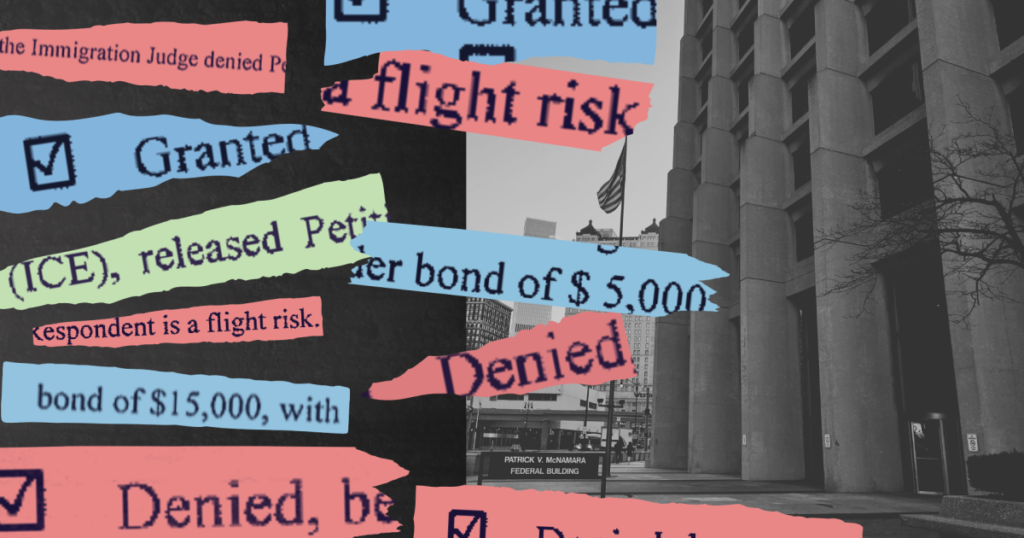
Six days later, his bond hearing arrived. Immigration Judge Ellen Karesh deemed him a “flight risk,” noting his family didn’t own property and had “minimal contacts” in the U.S.
“I don’t understand,” said Fernandez-Escalante. “Since 2023, my wife and I have been working and studying English in school, and we’ve never missed a check-in appointment.”
That month, at least 100 detained immigrants in Michigan granted habeas corpus petitions were denied bond, many for similar reasons.
“Denied, for Flight Risk”
Immigration attorneys and former judges who spoke with Michigan Public fear that current judges are no longer giving detainees a fair chance in bond hearings.
“There have certainly been rumors among immigration lawyers, backed by affidavits from former immigration judges, that there were instructions for judges to deny bonds based on flight risk in habeas corpus cases,” said Daniel Caudillo, a former immigration judge and director of the Immigration Law Clinic at Texas Tech.
“I certainly know of at least one recently removed former immigration judge who has provided an affidavit,” he added. Caudillo “was not at liberty” to share the affidavit, and Michigan Public couldn’t independently locate it.
George Pappas, a former immigration court judge in Massachusetts who was fired by the Trump administration in 2025, said detainees were routinely released in the past.
“Obviously, if the person has a criminal record, they won’t get bond,” Pappas said. “But if someone has no criminal history, has been paying taxes, raising a family, and their only civil infraction is entering the country, say, without a visa, they’re a strong candidate for bond.”
Most court documents reviewed by Michigan Public had few details on why a detainee was granted bond or why it was set at a certain amount. Bond denials often contained some information — a few paragraphs at most. In some cases, judges cited criminal charges or interactions with law enforcement.
But in several denials, immigration judges simply wrote “flight risk.”
“If you’re going to issue an order as an immigration judge, you’re obligated to explain the legal reasoning for why the person is a flight risk,” said Pappas, a critic of the Trump administration who now represents immigrants. For him, the lack of information in some orders shows that immigration judges are “rubber-stamping the denials.”
The high volume of cases may partly explain the brief explanations in denials, Caudillo said.
“I think the increase in detentions has certainly allowed judges not to be as thorough in their decision-making,” Caudillo said.
But, he said, the orders Michigan Public reviewed are “summary orders.” Judges can likely provide more detailed reasoning in response to an appeal.
Caudillo said it would be “unwise” for judges to issue two-word denials in orders mandated by federal courts, as individuals in those hearings have already shown willingness “to go to federal court to get due process.”
A “Second Round” in Federal Court
Across the country, some sitting federal judges have also expressed doubt.
“The bond hearing shows signs of a predetermined outcome,” wrote Missouri Western District Judge Douglas Harpool in a order overturning a $20,000 bond in February. Harpool called the immigration judge’s decision that the woman was a flight risk “clearly detached from the facts and any logical conclusion,” noting that she hadn’t missed any hearings and had family in the country.
The order was previously reported by Politico, which found several similar cases.
In another order, a West Virginia federal judge noted an affidavit from a former ICE attorney stating that “bond hearings are now being systematically denied based on arguments that wouldn’t have been considered sufficient weeks earlier” in an apparent “effort to override constitutional protections recognized and enforced by federal courts through habeas corpus.”
In Michigan, attorneys have challenged some high bond amounts or denials through what they call “second round habeas corpus petitions.” Some have been successful.
In one case, Michigan Western District Judge Jane M. Beckering ordered the immigration court to redo a bond hearing because the immigration judge required Venezuelan asylum seeker Juan José Soto-Medina to prove he wasn’t a flight risk.
Instead, Beckering wrote, “due process requires the government to bear the burden of proving that [Soto-Medina] is a flight risk or a danger to the community to deny bond… a majority of federal courts, including both trial and appellate courts, have adopted this position.”
Soto-Medina was granted bond on the second occasion, and the DOJ is now appealing his habeas corpus case to the Sixth Circuit Court.
The language in many bond denials reviewed by Michigan Public holds that detainees must prove they shouldn’t be detained, rather than the government. This is partly based on a 2006 precedent set by the Board of Immigration Appeals (BIA), which Beckering rejected. Like immigration courts and judges, the BIA is part of the DOJ.
“This court is not bound or required to defer to an agency’s interpretation of a law,” Beckering wrote.
The Western District Federal Court has an administrative order placing Beckering, appointed by former President Joe Biden, in charge of deciding any habeas corpus petition where the “burden of proof” in a bond hearing is the main issue. The order was signed by the court’s chief judge, a Trump appointee.
Beckering granted some requests for new bond hearings — citing her own reasoning in the Soto-Medina case.
She also denied some cases where she found detainees’ due process rights weren’t violated in the bond hearing.
“Not-So-Subtle Pressure”
Several attorneys speaking with Michigan Public believe Detroit immigration court judges are denying bond or setting high bonds in cases that would historically have been granted for lower amounts. Some see this as evidence of a policy within the court.
Court records reviewed by Michigan Public couldn’t provide a single explanation for the increase in bond denials.
“Immigration judges are ultimately executive branch employees, working under the DOJ and ultimately the attorney general,” said Daniel Caudillo, former immigration judge and director of the Texas Tech Immigration Law Clinic. “And the administration has made clear what they want the courts to be. I think now the advertising is for deportation judges, not immigration judges.”
While this may support the “illusion” of internal guidance to broadly deny bond, Caudillo said he still has “a lot of faith” that his former colleagues “apply the law very carefully” and that some will resist any “intrusion” on their independence.
“I don’t think they’d ever issue something clearly saying ‘You will decide this way or that way,’” said Lawrence Burman, who served as an immigration judge in three states for over 27 years before retiring last year. “Obviously, there are subtle ways they can communicate that, like firing people who don’t do what they like.”
NPR found that the administration fired nearly 100 immigration judges last year.
“That’s not-so-subtle pressure,” Burman said.
Translation by EPIC Translations LLC. Read in English.
—
Read More Michigan News


![Jody White’s Unconventional Michigan Supreme Court Candidacy Explored[embed]https://www.youtube.com/watch?v=8NfxFIPE4ac[/embed]](https://www.kitchentablenews.org/wp-content/uploads/2026/10/Jody-Whites-Unconventional-Michigan-Supreme-Court-Candidacy-Exploredembedhttpswwwyoutubecomwatchv8NfxFIPE4acembed.com2F842F0e2Fc7223daa43c9876b36a4e00773a42Fme-supc.png "Jody White’s Unconventional Michigan Supreme Court Candidacy Explored[embed]https://www.youtube.com/watch?v=8NfxFIPE4ac[/embed]")