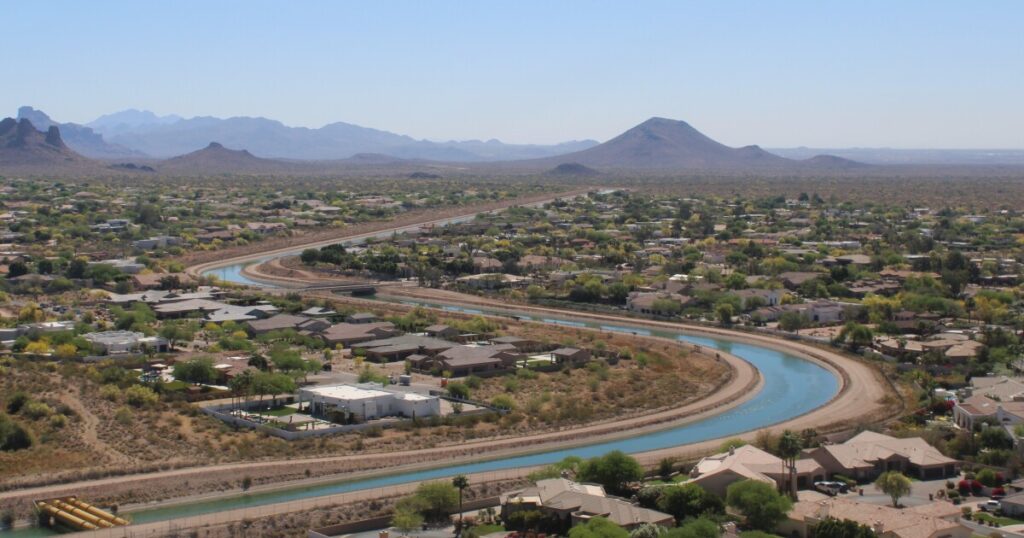
As tensions escalate over the dwindling resources of the Colorado River, a group of states is suggesting a novel solution to the ongoing stalemate: the introduction of a neutral mediator. This comes after the Upper Basin states of Colorado, Utah, Wyoming, and New Mexico failed to meet a crucial mid-February deadline for a new agreement on water sharing.
Colorado’s chief water negotiator, Becky Mitchell, expressed the urgent need to de-escalate tensions. “I really would like to see the swords laid down,” Mitchell told KJZZ. “Particularly the threats of litigation. That creates a scenario where it’s really hard to be creative.”
The ongoing dispute between the upstream states and those downstream—Arizona, California, and Nevada—centers around who should reduce water consumption in light of a severe drought exacerbated by climate change.
Water policy expert Elizabeth Koebele from the University of Nevada, Reno, noted the potential shift in strategy. “I think that other folks that are not the seven states have talked about the need for a third-party mediator for a long time,” Koebele stated. “I’m glad to see the seven states, or at least the Upper Basin states, potentially moving in that direction.”
If an agreement isn’t reached soon, the federal government may impose its own plan, prompting significant cutbacks in Arizona that local officials fear could be “devastating” (source). This situation might lead to lawsuits and a possible Supreme Court case, which all parties are keen to avoid.
Mitchell emphasized the need for collaboration, stating, “Unsettling litigation across the basin will not create more water or more certainty for anyone in any industry in any state.” Her goal is to find a way to break the deadlock and forge a deal while setting aside legal disputes.
The Upper Basin states have been reluctant to agree to permanent water reductions, citing a specific interpretation of a 1922 legal document (source). However, Mitchell acknowledged, “We have agreed, as part of the negotiation process, to set aside our litigation theories.”
Despite efforts to reach the Arizona Department of Water Resources, KJZZ reported they were unavailable for comment. However, Arizona has previously expressed a desire to avoid litigation, aligning with its Lower Basin counterparts. Earlier this year, Arizona’s lead water negotiator Tom Buschatzke highlighted the importance of avoiding legal battles as a key motivator in negotiations (source).
Koebele suggested that the looming federal deadline, coupled with an extremely dry winter (source) and potential legal challenges, might be prompting the Upper Basin states to reconsider their stance on water reductions and seek mediation as a practical solution.
The question of who would serve as mediator remains unresolved. The Upper Basin representatives believe the federal government should be involved but not as the mediator. Mitchell asserted that the choice should be a collective decision among the states.
Koebele pointed out the potential challenges in selecting a mediator, given the historical rivalries among the states. “Every organization could be — whether or not they really are — sort of framed in a biased way,” she remarked, highlighting the difficulty in finding an impartial mediator trusted by all parties involved.
Currently, there is no indication of when the negotiations will resume, as substantial discussions have been stalled since before the February deadline.
—
Read More Arizona News
![Jody White’s Unconventional Michigan Supreme Court Candidacy Explored[embed]https://www.youtube.com/watch?v=8NfxFIPE4ac[/embed]](https://www.kitchentablenews.org/wp-content/uploads/2026/10/Jody-Whites-Unconventional-Michigan-Supreme-Court-Candidacy-Exploredembedhttpswwwyoutubecomwatchv8NfxFIPE4acembed.com2F842F0e2Fc7223daa43c9876b36a4e00773a42Fme-supc.png "Jody White’s Unconventional Michigan Supreme Court Candidacy Explored[embed]https://www.youtube.com/watch?v=8NfxFIPE4ac[/embed]")