Unlocking Arizona’s Water Potential: The Role of Cloud Seeding
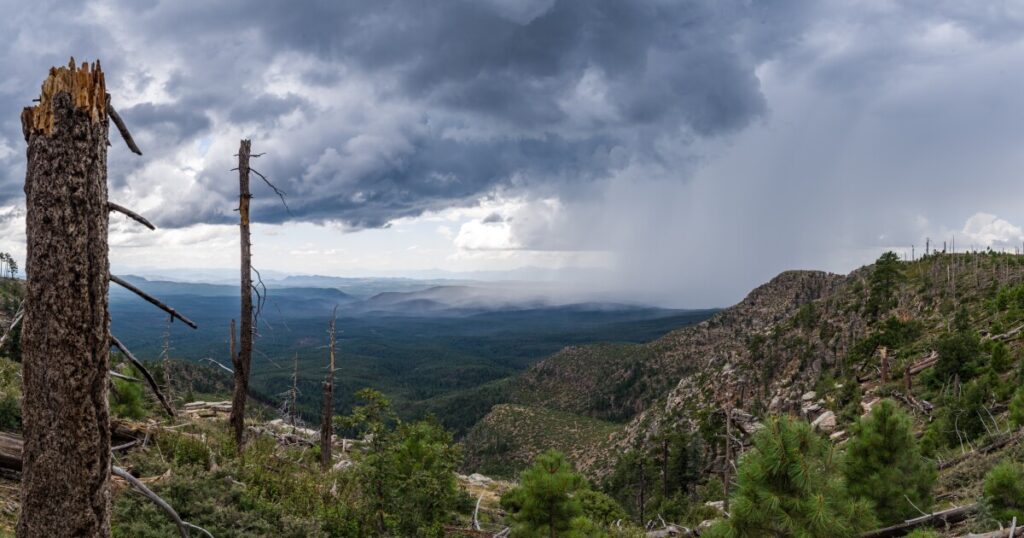
In central Arizona, nearly 50% of the surface water supply relies on the melting snowpack from the Mogollon Rim. This critical resource prompted a significant scientific field experiment over three decades ago, exploring the possibilities of cloud seeding to increase precipitation.
The project, known as the ‘1995 Arizona Program’, was conducted between January 15th and March 15th that year. During this period, a team of twenty-nine scientists from eight different institutions employed advanced technologies, including Doppler radars, an instrumented airplane, and various sensors, to study winter storm patterns over the Verde Valley and nearby mountain ranges.
One of the central focuses of the research was to examine ‘gravity waves’, which occur when air is forced to rise over mountainous regions, potentially enhancing precipitation on elevated terrain.
Throughout the experiment, aircraft released silver iodide crystals and fine common salt particles on six occasions, with an additional release from Mingus Mountain. Despite these efforts, no substantial increase in precipitation was recorded on the ground. The limited number of seeding activities might explain the lack of significant results. However, valuable data collected during the experiment reinforced scientists’ models of cloud seeding mechanisms and suggested potential for increasing precipitation during storms with high moisture levels.
Recent studies at the University of Wyoming have observed precipitation increases of 10 to 15 percent through modern cloud seeding techniques. These methods primarily use ground-based generators and drones, finding economic viability in enhancing snowpack over watersheds and ski resorts in states like Colorado and Utah.
This Earth Note was written by Diane Hope, and produced by KNAU and the Sustainable Communities Program at Northern Arizona University.
—
Read More Arizona News