
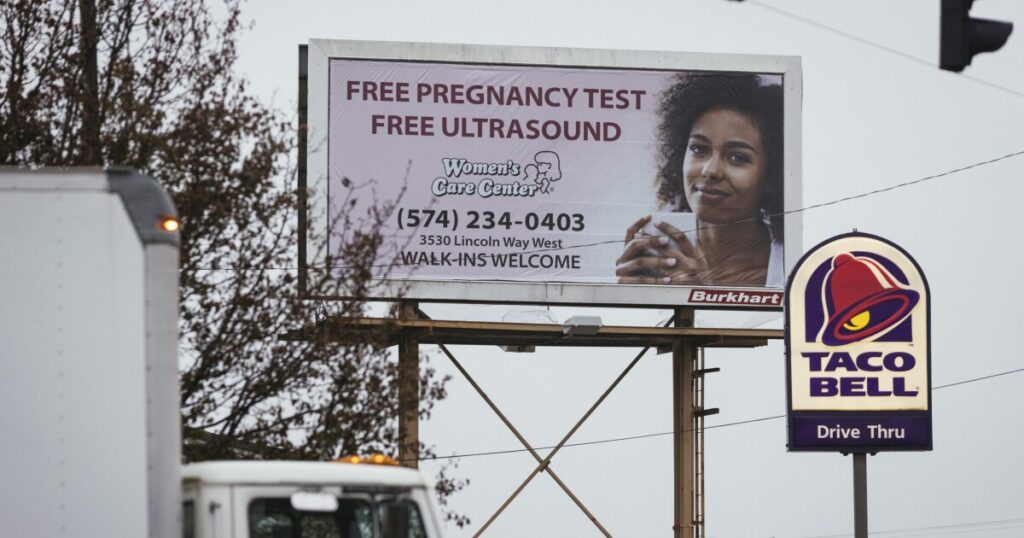
In a move coinciding with Mother’s Day, the Trump administration introduced Moms.gov, a platform aiming to assist parents facing challenging or unexpected pregnancies by linking them to crisis pregnancy centers nationwide.
Moms.gov states, “Many centers offer pregnancy tests, ultrasounds, STD/STI testing and treatment, parenting support, childbirth classes, medical referrals, and material goods like clothes and diapers — at no cost to you.”
Across the U.S., there are approximately 2,500 crisis pregnancy centers, as estimated by the Government Accountability Office. Predominantly run by Christian organizations, these centers aim to dissuade individuals from opting for abortions. The staff, often volunteers, may lack formal medical training despite sometimes wearing medical attire and using medical forms.
Free ultrasounds are a common offering at these centers, with a focus on their benefits. MyChoice Pregnancy Care Center in New York’s Hudson Valley emphasizes the importance of ultrasounds, stating, “It’s important to rule out an ectopic pregnancy or a natural miscarriage and find out how far along you are via limited ultrasound.” They encourage contact for a free ultrasound on their website.
An ectopic pregnancy, a rare complication where an embryo implants outside the uterus, poses life-threatening risks if it occurs in a fallopian tube and ruptures. However, a single ultrasound typically cannot confirm an ectopic pregnancy.
Watchdog Calls for an Investigation
Recently, the Campaign for Accountability, a nonprofit watchdog group, petitioned New York Attorney General Letitia James to investigate whether the state’s crisis pregnancy centers are misleading clients about their ability to diagnose ectopic pregnancies.
“By leading patients to believe that their services are adequate substitutes for medical diagnoses, [crisis pregnancy centers] may cause women to forgo comprehensive medical care, resulting in their suffering grievous bodily injury,” the letter, exclusively shared with NPR, states. The organization has documented 100 instances in 49 states where centers claimed they could “rule out” ectopic pregnancies.
Real-world consequences have emerged, as highlighted by cases in Texas and Massachusetts, where women were incorrectly assured by centers that their pregnancies were viable.
Michelle Kuppersmith, executive director of Campaign for Accountability, explains, “They were told that their pregnancies were viable or told that everything was fine. And then later they found themselves in the hospital with an ectopic pregnancy that was not diagnosed by the crisis pregnancy center.”
Kuppersmith suggests broader actions may follow: “We’re hoping that by continuing to expose this issue, that there will be additional attention to it, and that perhaps these centers will do the right thing and stop trying to make claims to women about things that they can’t actually do.”
“We Really Don’t Like to See That Language”
The National Institute of Family and Life Advocates (NIFLA), representing crisis pregnancy centers, concurs with the need to avoid making promises about diagnosing ectopic pregnancies. NIFLA’s Vice President of Legal Affairs, Anne O’Connor, advised in a recent webinar, “Do not advertise, ‘We can rule out an ectopic.’ We really don’t like to see that language because it is near impossible to rule out an ectopic.”
O’Connor detailed that the process requires multiple blood tests and ultrasounds, which most centers cannot provide. She suggests centers focus on offering ultrasounds with language like: “We’re doing the ultrasound to see if the fetus is in the womb where it’s supposed to be.”
NIFLA has yet to comment on this issue, despite NPR’s multiple requests for statements.
A Response to the Growth in Medication Abortion
Language used by crisis pregnancy centers often relates to abortion medication, especially since its rise following the overturn of Roe v. Wade four years ago. MyChoice Pregnancy Care Center’s website reads, “If you plan on taking abortion pills, book an ultrasound to rule out an ectopic pregnancy.”
However, Dr. Jonas Swartz, a Duke Health obstetrics and gynecology professor, notes that confirming an ectopic pregnancy is not necessary before using abortion medication. “Telemedicine abortion with medication abortion has been shown to be safe even without ultrasound,” he asserts, adding that while abortion medication won’t resolve an ectopic pregnancy, it won’t exacerbate it either.
An ectopic pregnancy typically requires several follow-up visits and potentially medical or surgical intervention.
Dr. Swartz empathizes with individuals in the early and often confusing stages of pregnancy. “Theoretically, people who would reach out to a crisis pregnancy center are in crisis — they are having an unexpected pregnancy or something going on in their pregnancy and they need help,” he says, advocating for a trained medical team in regulated facilities to provide the necessary support.
He emphasizes the importance of allocating public resources to enhance the availability of trained medical services.
Image: Crisis pregnancy centers often offer material support, such as baby clothing, to parents. Here Pamela Palumbo, CEO of Wellspring Life Ministry, is at a crisis pregnancy center in Maryland, in June 2023.
—
Read More Michigan News







![Botched Ad Mix-Up: Super PAC Error in Arizona Congressional Race[embed]https://www.youtube.com/watch?v=bEMgIlCkHz0[/embed]](https://www.kitchentablenews.org/wp-content/uploads/2026/10/Botched-Ad-Mix-Up-Super-PAC-Error-in-Arizona-Congressional-RaceembedhttpswwwyoutubecomwatchvbEMgIlCkHz0embed.com2F0e2F962Fe971102f49e7a4f2a64fd3cc60a22Fjonatha.png "Botched Ad Mix-Up: Super PAC Error in Arizona Congressional Race[embed]https://www.youtube.com/watch?v=bEMgIlCkHz0[/embed]")