
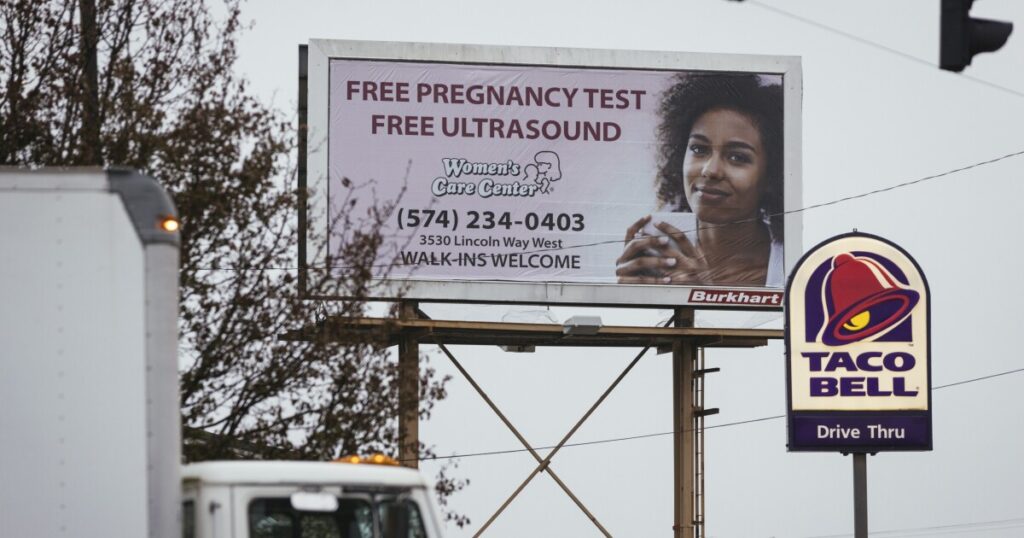
In a bid to support expectant parents, the Trump administration recently debuted Moms.gov, a resource guiding individuals to crisis pregnancy centers nationwide. These centers aim to aid those facing challenging or unexpected pregnancies.
The website states, “Many centers offer pregnancy tests, ultrasounds, STD/STI testing and treatment, parenting support, childbirth classes, medical referrals, and material goods like clothes and diapers — at no cost to you.” Across the U.S., there are approximately 2,500 of these centers, as estimated by the Government Accountability Office in 2024, many of which are rooted in Christian values and aim to dissuade individuals from seeking abortions. Staff at these centers often volunteer, with varying levels of medical training, sometimes donning medical attire and requiring clients to complete medical questionnaires.
The provision of free ultrasounds is a common service at these centers. For instance, the MyChoice Pregnancy Care Center in New York promotes, “It’s important to rule out an ectopic pregnancy or a natural miscarriage and find out how far along you are via limited ultrasound.” An ectopic pregnancy, a rare complication, occurs when an embryo implants outside the uterus, which can be life-threatening if not detected.
Watchdog Calls for Scrutiny
Recently, the Campaign for Accountability, a nonprofit watchdog group, urged New York Attorney General Leticia James to investigate whether crisis pregnancy centers in the state are misleadingly advertising their capability to diagnose ectopic pregnancies. The group’s letter, shared with NPR, warns, “By leading patients to believe that their services are adequate substitutes for medical diagnoses, [crisis pregnancy centers] may cause women to forgo comprehensive medical care, resulting in their suffering grievous bodily injury.”
The Campaign for Accountability identified 100 examples across 49 states of centers claiming to “rule out” ectopic pregnancies. The organization cites specific instances in Texas and Massachusetts where such centers failed to diagnose ectopic pregnancies, leading to serious health consequences.
Michelle Kuppersmith, executive director of the Campaign for Accountability, notes, “They were told that their pregnancies were viable or told that everything was fine. And then later they found themselves in the hospital with an ectopic pregnancy that was not diagnosed by the crisis pregnancy center.” Kuppersmith suggests that further requests for investigations may be sent to attorneys general in additional states.
Controversial Language in Marketing
The National Institute of Family and Life Advocates (NIFLA), a membership organization for crisis pregnancy centers, concurs that centers should not claim to “rule out” ectopic pregnancies. “Do not advertise, ‘We can rule out an ectopic,'” advised Anne O’Connor, NIFLA’s Vice President of Legal Affairs, during a webinar. O’Connor emphasized that diagnosing an ectopic pregnancy necessitates multiple blood tests and ultrasounds, which these centers cannot provide.
NIFLA suggests alternative phrasing such as, “We’re doing the ultrasound to see if the fetus is in the womb where it’s supposed to be.” Despite multiple attempts, NPR did not receive a response from NIFLA regarding this matter.
Medication Abortion Concerns
Crisis pregnancy center marketing often connects ectopic pregnancy discussions to medication abortion, which has increased significantly following the reversal of Roe v. Wade four years ago. For example, the MyChoice Pregnancy Care Center website advises, “If you plan on taking abortion pills, book an ultrasound to rule out an ectopic pregnancy.”
Dr. Jonas Swartz, a professor of obstetrics and gynecology at Duke Health, clarifies that obtaining an ectopic pregnancy diagnosis is not medically necessary before taking abortion medication. Swartz explains, “Telemedicine abortion with medication abortion has been shown to be safe even without ultrasound.” He further notes that while abortion medication cannot resolve an ectopic pregnancy, it also does not exacerbate it. However, ectopic pregnancies require additional medical or surgical intervention.
Dr. Swartz empathizes with patients faced with uncertainty during the initial stages of pregnancy. “Theoretically, people who would reach out to a crisis pregnancy center are in crisis — they are having an unexpected pregnancy or something going on in their pregnancy and they need help,” he states. He advocates for directing public resources towards expanding access to services provided by licensed medical professionals in regulated facilities.
—
Read More Michigan News







![Botched Ad Mix-Up: Super PAC Error in Arizona Congressional Race[embed]https://www.youtube.com/watch?v=bEMgIlCkHz0[/embed]](https://www.kitchentablenews.org/wp-content/uploads/2026/10/Botched-Ad-Mix-Up-Super-PAC-Error-in-Arizona-Congressional-RaceembedhttpswwwyoutubecomwatchvbEMgIlCkHz0embed.com2F0e2F962Fe971102f49e7a4f2a64fd3cc60a22Fjonatha.png "Botched Ad Mix-Up: Super PAC Error in Arizona Congressional Race[embed]https://www.youtube.com/watch?v=bEMgIlCkHz0[/embed]")