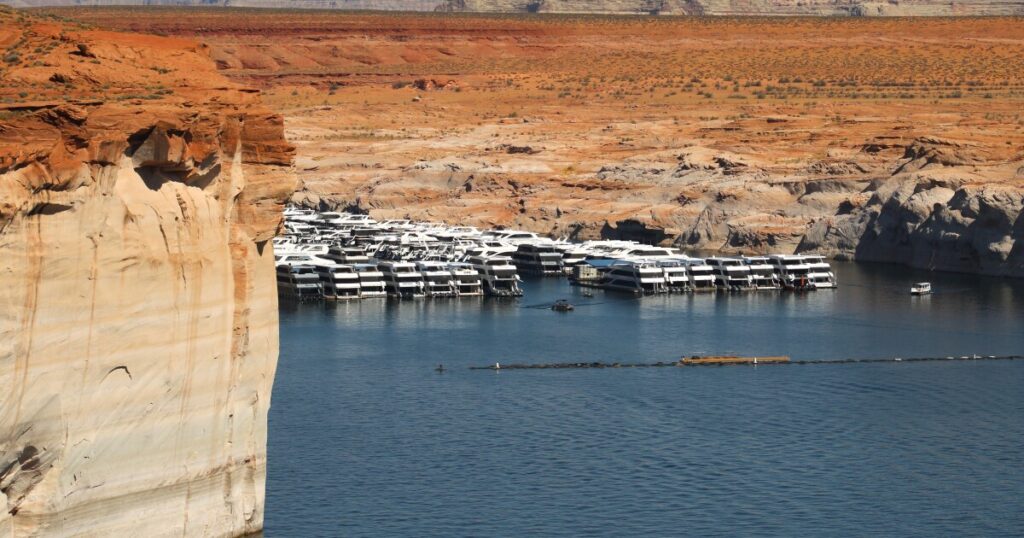
Amidst the arid landscapes of the American West, a critical water crisis looms as Lake Powell and Lake Mead, the nation’s two largest reservoirs, reach unprecedented low levels. These crucial water sources on the Colorado River, vital for cities, tribes, and agriculture, have hit their lowest marks in nearly seven decades.
This alarming situation marks the first time since May 1957 that both lakes have been so depleted, a time before Lake Powell was constructed.
Insights into this situation are detailed in a recent study by renowned Colorado River authorities. The study’s contributors argue that while Lake Powell and Lake Mead are often evaluated independently, they should be considered collectively to understand the full extent of the water crisis impacting nearly 40 million people across seven Western states.
Jack Schmidt, one of the study’s authors and head of the Center for Colorado River Studies at Utah State University, highlighted this moment as “a significant moment” in the ongoing water supply crisis. He told KJZZ, “It’s a real reminder of what a remarkably small amount of water we have left in the system. We’ve never been in this position. We are truly in uncharted territory.”
Schmidt also highlighted the lack of decisive action from river policymakers, emphasizing the need for more significant changes to manage water consumption effectively. The combination of climate change, prolonged drought, and insufficient reduction in water use has exacerbated the situation, especially for Lake Powell, which primarily relies on Rocky Mountain snowmelt.
Negotiations among the seven states relying on the river have reached a stalemate, unable to decide on water usage cuts. Without a consensus, the federal government is set to introduce its own water-sharing regulations, potentially leading to legal disputes that might escalate to the Supreme Court.
Despite minor agreements on water conservation, Schmidt notes these efforts fall short of achieving substantial, long-term reductions. He likens the situation to “a bus careening towards the edge of a cliff,” with debates over control overshadowing the urgent need to “hit the brakes” and avert disaster.
Lake Powell and Lake Mead collectively account for just under 60% of the water reserves in the Colorado River basin. Until the Colorado River is replenished by snowmelt next spring, reservoir levels are expected to continue setting new record lows daily.
—
Read More Arizona News