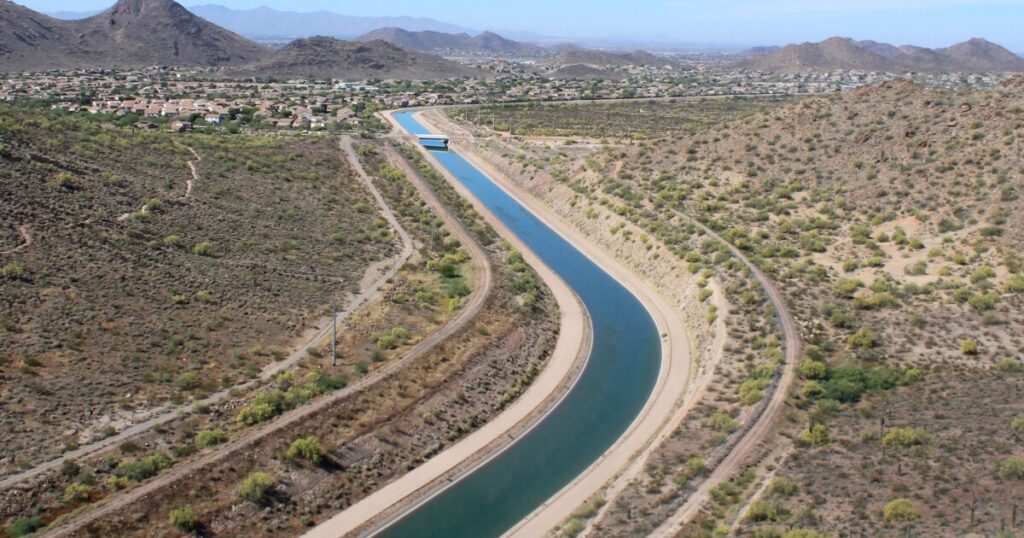
Arizona Faces Significant Water Reductions Under New Colorado River Plan
As the Colorado River faces an uncertain future, a new federal strategy could impose significant water use cutbacks for Arizona, sparking critical responses from state officials who are strategizing to mitigate these impacts.
The plan, introduced last Friday, grants the federal government authority to decrease water allocations for Arizona, California, and Nevada by as much as 40%. Although such extreme reductions would only occur under dire conditions, the persistent drought in the region makes this scenario increasingly plausible in the next decade.
The Arizona Department of Water Resources expressed concern, stating that these reductions could severely impact the state’s water users and economy. The federal proposal outlines a decade-long approach to river management, compelling policymakers to re-evaluate water-sharing regulations biennially based on current river conditions.
Details for the implementation of these cuts in 2027 and 2028 are anticipated soon, with Arizona officials hopeful that the plan will incorporate elements from a counterproposal by the Lower Basin states—Arizona, California, and Nevada. These states have offered voluntary reductions of up to 20% of their river water usage to prevent more severe federal mandates.
Governor Katie Hobbs criticized the plan, arguing it unfairly forces Arizona to shoulder the brunt of drastic water reductions. She urged federal authorities to consider the “commonsense, compromise proposal” championed by Arizona and its allies.
Gov. Hobbs stressed that implementing the Lower Basin agreement would shield Arizona from massive water reductions and promote equitable distribution of water cuts across the states. Senators Ruben Gallego and Mark Kelly echoed these concerns, warning that the new plan might unfairly burden Arizona.
Arizona’s leaders have also urged the Upper Basin states—Colorado, Utah, Wyoming, and New Mexico—to share more of the shortage burden. These states have not committed to mandatory reductions, citing existing obligations to deliver water to downstream neighbors and the natural limitations imposed by climate change and drought.
Gene Shawcroft, Utah’s chief water negotiator, remarked on the annual natural reductions the Upper Basin states experience, emphasizing the need for a system based on available water rather than demand.
The differing perspectives between the Upper and Lower Basin states have fueled ongoing negotiations, with Arizona’s Department of Water Resources describing the discussions as a process of lowering expectations for a comprehensive seven-state solution.

Despite the challenges, both federal and state officials are committed to achieving a consensus among the seven states. The federal plan allows for such a consensus to supersede existing water management strategies.
John Berggren, a water policy expert with Western Resource Advocates, noted that while the federal framework provides short-term stability, it could also serve as a new starting point for negotiations, potentially leading to a comprehensive agreement among all basin states.
As the Colorado River basin awaits more detailed guidelines for 2027 and 2028, California’s chief water negotiator, JB Hamby, emphasized that the recent federal announcement is merely a step in an ongoing negotiation process rather than a definitive plan.
—
Read More Arizona News

![Jody White’s Unconventional Michigan Supreme Court Candidacy Explored[embed]https://www.youtube.com/watch?v=8NfxFIPE4ac[/embed]](https://www.kitchentablenews.org/wp-content/uploads/2026/10/Jody-Whites-Unconventional-Michigan-Supreme-Court-Candidacy-Exploredembedhttpswwwyoutubecomwatchv8NfxFIPE4acembed.com2F842F0e2Fc7223daa43c9876b36a4e00773a42Fme-supc.png "Jody White’s Unconventional Michigan Supreme Court Candidacy Explored[embed]https://www.youtube.com/watch?v=8NfxFIPE4ac[/embed]")