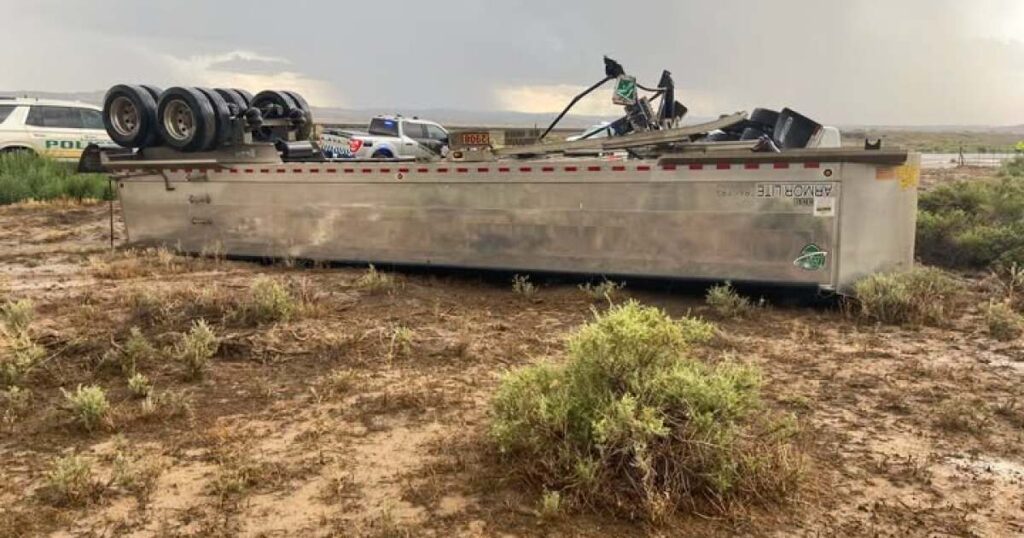
The transport of uranium ore across Navajo Nation land has come under scrutiny after a recent incident involving a transport truck. The rollover of an empty uranium transport vehicle near Black Mesa has prompted officials to reconsider the existing agreement.
Back in 2021, the Navajo Nation entered into an agreement with Energy Fuels Resources, which permits the transportation of uranium ore through their territory. An essential component of this agreement is the restriction on transport during bad weather conditions.
However, on July 21, a truck returning to the Pinyon Plain Mine in the vicinity of the Grand Canyon overturned due to hydroplaning during a heavy monsoon storm. This incident has highlighted potential shortcomings in the agreement, which primarily considered winter weather risks.
Stephen Etsitty, Director of the Navajo Nation Environmental Protection Agency, pointed out that the current agreement was designed with winter conditions in mind, not the monsoon rains. “That’s one thing that we probably have to address once we get more information from the final police reports,” Etsitty commented. He noted that transportation has been halted during winter weather previously but not for monsoon conditions.
Communication between the Navajo EPA and Energy Fuels occurs on a daily basis, ensuring regular updates on the number of trucks and expected transport schedules. Etsitty explained, “Every morning, we get a text message from the mine about how many trucks are coming and when we can expect them.”
Energy Fuels’ Curtis Moore expressed the company’s commitment to maintaining a cooperative relationship with the Navajo Nation. “Of course, inclement weather can happen any time of year,” he stated, adding that the company is open to revisiting the terms of the agreement if necessary, particularly concerning driving practices during rainy conditions.
Currently, drivers are required to adhere to several restrictions, including a curfew that mandates departing the nation by 3 p.m. on weekdays and prohibits weekend transport. These restrictions may pose challenges, especially in light of road construction along the haul route that can delay transport.
Etsitty acknowledged that roadwork has at times limited the roads to a single lane, which could lead to delays. “When there’s traffic delays, the curfew becomes more of a factor,” Etsitty said, emphasizing the need to ensure drivers remain safe while adhering to speed limits.
Bears Ears and Grand Staircase-Escalante national monuments were slashed by President Trump last month, opening them up to new mining claims.
This incident also coincides with an ongoing investigation into potential misuse of nonpublic information by two leaders of a uranium mining company related to recent changes in monument boundaries.
The investigation centers on whether two of the uranium mining company’s leaders used nonpublic information about President Trump’s cuts to a Utah monument for stock purchases.
—
Read More Arizona News

![Botched Ad Mix-Up: Super PAC Error in Arizona Congressional Race[embed]https://www.youtube.com/watch?v=bEMgIlCkHz0[/embed]](https://www.kitchentablenews.org/wp-content/uploads/2026/10/Botched-Ad-Mix-Up-Super-PAC-Error-in-Arizona-Congressional-RaceembedhttpswwwyoutubecomwatchvbEMgIlCkHz0embed.com2F0e2F962Fe971102f49e7a4f2a64fd3cc60a22Fjonatha.png "Botched Ad Mix-Up: Super PAC Error in Arizona Congressional Race[embed]https://www.youtube.com/watch?v=bEMgIlCkHz0[/embed]")