Embarking on her final year at college, Mitzie Westgate is navigating post-graduation plans. As an exercise science major, Westgate aspires to earn a Ph.D. in occupational therapy and establish a nonprofit for children with disabilities like her cousin with cerebral palsy. However, the tumult surrounding federal student loans is creating uncertainty, preventing her from finalizing her graduate school applications.
“It’s kind of up in the air whether I’ll be able to pay for college” after this year, said Westgate, a senior at the College of Charleston in South Carolina.
The tuition at her preferred institutions, such as Quinnipiac University, could exceed federal loan limits. This might force her to attend a more affordable option like Johnson & Wales University in Rhode Island, where she could save by living at home but risk fewer professional connections.
Westgate plans to apply to pricier schools and hopes for scholarships. “I’m kind of playing it by ear,” she said.
The reclassification of many graduate programs by Congress has restricted federal loans, leaving students like Westgate uncertain about relying on costlier private loans. The Grad PLUS program allowed borrowing up to full attendance costs, but the new law caps federal loans at $20,500 annually and $100,000 in total for most programs.
A lawsuit has temporarily halted these restrictions, complicating planning for the 2027-28 academic year. If the suit leads to changes, students might face more borrowing challenges. Private loans come with higher interest rates, and lenders are cautious about students’ credit scores and earning potential.
Graduate degrees in health care and psychology, including nursing and occupational therapy, are most affected. While fields like dentistry offer high earning potential, others, like social work, may struggle with student debt, according to the American Enterprise Institute.
Sallie Mae, a major private lender, advises caution with borrowing. “We will continue to maintain responsible underwriting,” stated spokesperson Rick Castellano. “But let’s also be clear: For some people, a loan is just not the answer.”
Experts warn against predatory lending practices, especially since federal protections have weakened. “There’s a lot of different ways these loans can have traps,” said Eileen Connor from the Project on Predatory Student Lending, citing hidden fees and high-interest rates.
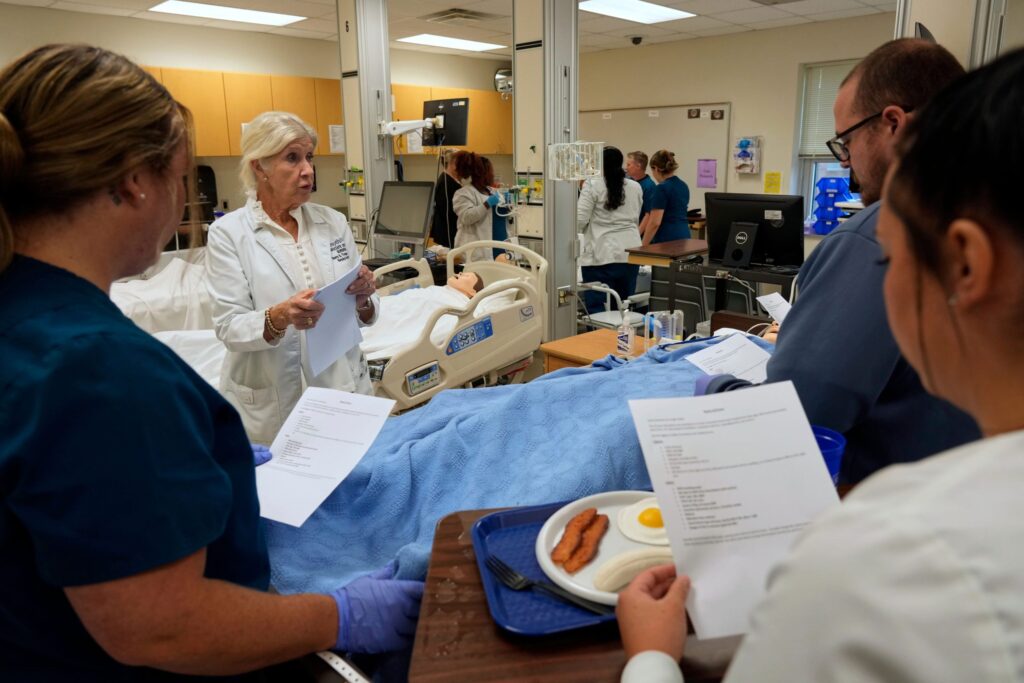
Currently enrolled students with Grad PLUS loans remain unaffected, but future restrictions worry many. Kayce Cordray, nearing completion of her nursing doctorate at Oral Roberts University, believes these limits could worsen the nursing shortage. “It truly does limit the people who can complete their degrees,” she said.
Some universities are offering low-interest loans or compiling lender lists to aid students, while others are speculated to lower tuition. However, experts like Sarah Sattelmeyer from New America remain skeptical about widespread tuition cuts.
For example, University of Pennsylvania’s master’s in educational leadership costs more than students can borrow, unlike more affordable programs at Drexel and Temple universities. “If the government will no longer cover the entire bill at Penn, it may lose students to its cheaper rivals,” noted Preston Cooper of the American Enterprise Institute.
Universities are grappling with financial aid amidst policy changes. Megan Walter from the National Association of Student Financial Aid Administrators highlights the confusion, adding, “We just want to see this ended so students and schools know what to do.”
—
Read More Kitchen Table News