Money and Politics: Arizona’s Costly Congressional Races
In Arizona’s congressional races, high spending didn’t always guarantee victory for candidates. The state’s midterm elections highlighted the intricate dance between campaign finances and electoral success, with some high-profile Republican candidates falling short despite substantial financial backing.
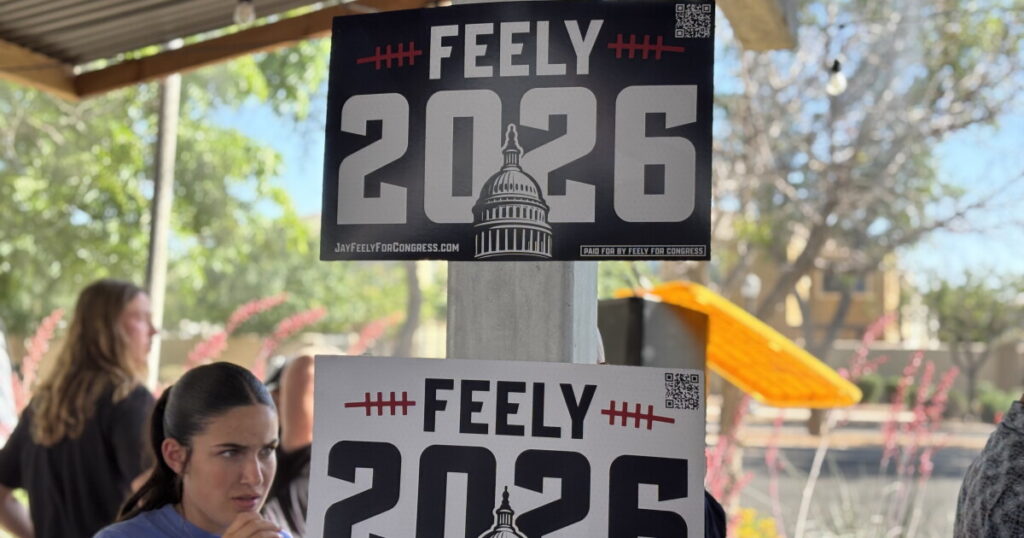
Republican efforts to elect ex-pro football player Jay Feely amounted to $27 million, approximately $187 for each vote he received. In contrast, Democrats managed to secure the seat with a $17.5 million investment.
Emergency room physician Amish Shah, spending around $103 per vote, successfully took over Rep. David Schweikert’s seat after Schweikert’s unsuccessful gubernatorial run. Shah’s victory was confirmed with a 7-point lead when the Associated Press called the race.
The analysis of spending per vote was conducted by Cronkite News, which utilized candidate fundraising data and outside spending figures from OpenSecrets, divided by reported vote totals as of November 5.
Another significant race saw Democrats flipping a district previously held by Republican Juan Ciscomani, who had received $19.6 million in support for his third-term bid. Democrat JoAnna Mendoza, a Marine veteran, won the seat with more than $26 million spent on her campaign, achieving an 8-point lead when AP declared her the winner.
Ciscomani’s campaign, which cost $142 per vote, was backed by significant contributors, including Elon Musk’s America PAC, which contributed over $500,000. Mendoza’s campaign, on the other hand, amounted to $160 per vote.
In another closely watched contest, Rep. Eli Crane, R-Oro Valley, and his supporters spent nearly double that of Jonathan Nez, the former Navajo Nation president. Crane’s campaign spent $19.2 million compared to Nez’s $10.4 million. With 10% of ballots uncounted, Crane maintained a lead by roughly 5,300 votes out of nearly 200,000 cast.
Crane’s cost per vote was $129, while Nez’s campaign, if successful, would have spent just $73 per vote. The Trump-affiliated No Going Back PAC contributed $5 million to Crane’s campaign, part of its $192 million national expenditure on Republican candidates. Nez’s campaign was primarily supported by the super PAC HMP, which invested about $1.4 million.
The importance of financial resources in political campaigns was highlighted by Ian Vandewalker of the Brennan Center for Justice, who noted, “There’s an arms race mentality or pattern that has been happening for a long time.” The 2010 Citizens United ruling by the Supreme Court facilitated unlimited spending by corporations and wealthy individuals in politics.
Feely’s campaign saw $16.2 million in super PAC support, with $9 million from the Trump-linked Safety & Affordability PAC Inc. Other backing came from PACs associated with artificial intelligence executives.
Thom Reilly from Arizona State University observed, “Outside groups are probably more willing to spend money when they know that there’s super close races, and you can kind of make an impact.” He noted that while financial spending is significant, it does not always align with voter priorities.
HMP’s $6.4 million contribution to Shah’s campaign exceeded the $5.7 million raised by his own committee. As Bela Sullivan from Issue One pointed out, “There are still limits on how much an individual can give directly to a candidate, but the same donor can give millions of dollars into a super PAC.”
Anabel Maldonado from the Environmental Defense Action Fund emphasized the importance of messaging over spending, stating, “It doesn’t matter how much money that they outspend us (by), if you don’t have the right message, you will never win the voters.”
While Safety & Affordability PAC Inc. spent $1.2 million on Ciscomani, Elon Musk’s America PAC contributed $500,000. Reilly concluded that political spending, both in Arizona and nationwide, might not necessarily reflect voter priorities.
—
Read More Arizona News