In a world increasingly concerned about pollution, there’s a new menace lurking in the air: microplastics. These tiny particles, originating from larger plastic debris, have become a focal point for researchers aiming to understand their impact on our environment and health.
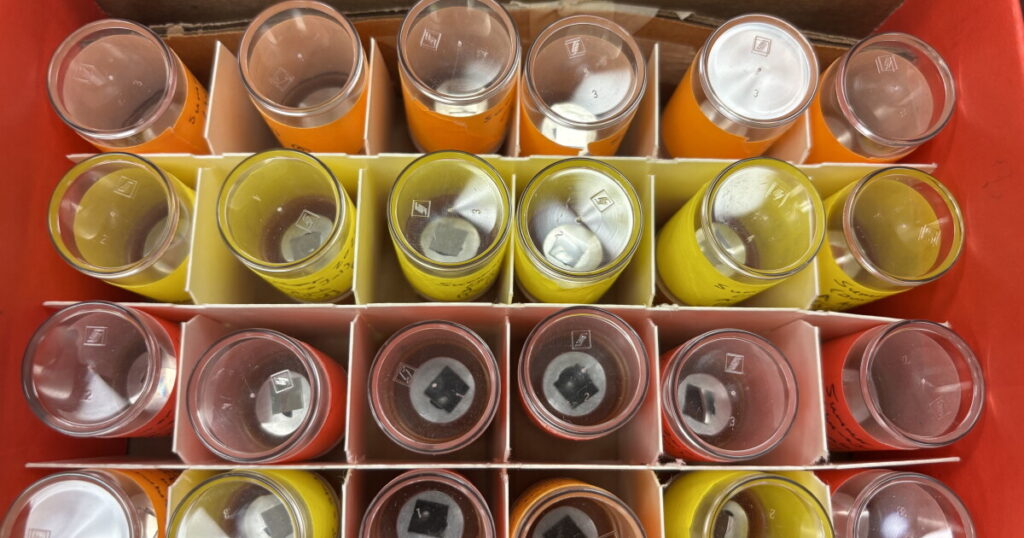
At the University of Michigan, scientists are delving into the microscopic world of airborne microplastics. Abby Ayala, an atmospheric scientist, and Kayleigh Reilly, an environmental chemist, are at the forefront of this research. Ayala noted, “Anything that’s in the atmosphere, we’re focusing on dry deposition. So the particles that are floating, land.” Their lab is a bustling hub, filled with equipment and whiteboards, embodying the spirit of active scientific inquiry.
A recent study conducted at school parking lots in southeast Michigan revealed that 1% of airborne particles were plastic. Anne McNeil, an organic and polymer chemist who co-authored the study, remarked on the varied perceptions of this statistic, saying, “I think people all react to this number differently if you tell them that 1% of all the particles in the air are plastic. For me, I’m like, ‘Oh, okay, that’s not that bad.’ Whereas other people are like, ‘Ah, I’m breathing in plastic.’”
Microplastics in the Air and Water
Microplastics are not only a problem in the air but also in aquatic environments, as they can transfer between the two. The interaction between water and air, such as when waves break on the shore, facilitates this exchange. Research has suggested that the ocean contributes some plastic to the atmosphere and vice versa, a phenomenon the University of Michigan researchers are investigating in the Great Lakes.
McNeil explained the evidence linking lake-derived particles to the air, “There was another polyethylene particle that’s like quite different. It’s got this, like, spherical morphology to it, so it’s more rounded. And when we look at the elemental mapping of that particle, we see calcium carbonate, which is a common salt that is in, like, the Great Lakes. And so, both the morphology being more like sphere-like and the salt, the presence of the salt from the lakes tells us that that particle likely also came from the lake when it was put into the air.”
The Role of Tire Particles
While lake contributions to atmospheric plastics are minor, tire particles are a predominant source. The wear and tear from tires, as they travel over roads, generate significant amounts of airborne plastic. McNeil succinctly explained, “You change the tires on your car because the tread wears down. Where do you think all that tread went, right?” These particles are broken down further by vehicles and dispersed into the air by wind.
Additionally, fibers from synthetic clothing represent a smaller, yet noteworthy, source of microplastics. Anna Schellin, an atmospheric chemist, highlighted the issue, “You ever pull out the lint trap and there’s a ton of lint on there? If you’re washing synthetic clothes, or drying synthetic clothes, rather, a lot of that is plastic material, but the lint trap is not capturing all of the lint that’s escaping the system.”
Understanding the health implications of inhaling plastic particles is a growing area of research. Studies indicate potential respiratory impacts, as some particles are small enough to penetrate the lungs and enter the bloodstream. As investigations continue, researchers at institutions like the University of Michigan aim to unveil the extent of this pollution and explore possible mitigation strategies.
—
Read More Michigan News