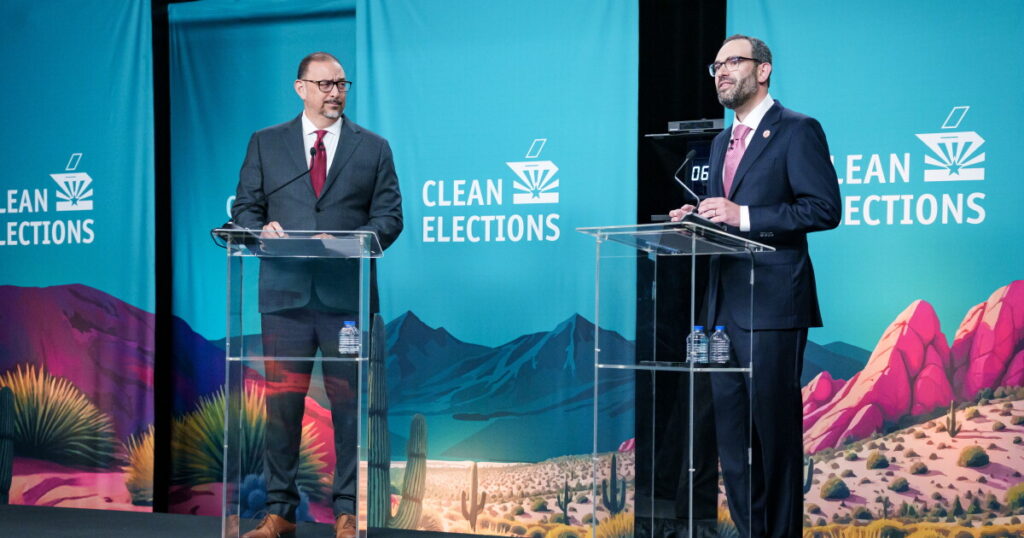
In a critical debate over the future of mail-in voting in Arizona, the candidates for secretary of state presented their visions for safeguarding voter rights. With the prominence of mail-in voting in the state, the discussion focused on potential reforms and their implications on election security and accessibility.
Republican candidate Alexander Kolodin emphasized his legislative efforts to enhance the verification process for early ballots on Election Day by introducing a photo ID requirement. This proposal aims to expedite the processing of late early ballots, which typically delay election results.
Kolodin also supports Proposition 144, which would mandate proof of identification for all ballots, including those submitted via mail. The specifics of implementation remain unspecified, raising concerns among voters.
Democratic incumbent Adrian Fontes warned that such measures could severely limit mail-in voting, a method used by over 80% of Arizonans, thereby restricting voter access. He questioned the feasibility for individuals without transportation or those with demanding schedules to reach polling sites.
Fontes argued, “If you’re living in an assisted living home and you don’t have transportation, how are you going to get to that polling place?” He highlighted the potential impact on working parents who rely on the convenience of mail-in voting.
Kolodin accused Fontes of misrepresenting Proposition 144’s implications but did not elaborate on how the ID requirement would be applied to mail voting.
During the debate, Fontes mentioned allegations from Kolodin’s primary opponent, Gina Swoboda, regarding his stance on mail-in voting. Swoboda claimed in a private meeting that Kolodin intended to target mail voting.
Kolodin Critiques Fontes’ Policies
Kolodin challenged Fontes’ previous attempts to introduce policies into the Elections Procedures Manual, arguing they could disenfranchise voters. This included a controversial proposal struck down by U.S. District Court Judge Mike Liburdi, which would have allowed state officials to exclude county votes if results were not certified timely.
Fontes defended the rule as a motivational tool for compliance, although Liburdi dismissed it as a severe infringement on voting rights.
Another legal setback for Fontes involved a failed attempt to ban offensive speech near polling stations, which a federal court found overly broad.
Allegations of Election Denialism
Throughout the debate, both candidates questioned each other’s credibility. Fontes highlighted Kolodin’s probation by the Arizona Supreme Court for challenging the 2020 election results with unsupported claims of widespread fraud.
When asked about accepting election outcomes, Fontes affirmed he would, while Kolodin’s response was less definitive: “We will win with grace.”
Contentious Personal Histories
Kolodin accused Fontes of past legal issues, referencing a college incident where Fontes pleaded guilty to a misdemeanor. Fontes acknowledged the mistake but contrasted it with Kolodin’s professional conduct as an attorney.
Kolodin further alleged Fontes had ties to the Sinaloa drug cartel, a claim Fontes rebutted by emphasizing his duty as a defense lawyer to uphold client rights.
Voter Registration and Fraud Concerns
The debate also touched on voter fraud allegations, with Fontes dismissing claims of widespread illegal voting as unfounded. Kolodin maintained that even a small number of illegal votes warrants stricter checks.
Fontes defended his office’s handling of federal crime lists for voter roll updates, citing initial data format issues from the Department of Justice that have since been resolved.
Debate on Election Efficiency
Kolodin advocated for quicker election result processing, a point of contention with Fontes, who argued that immediate results are impractical due to Arizona’s competitive races.
—
Read More Arizona News