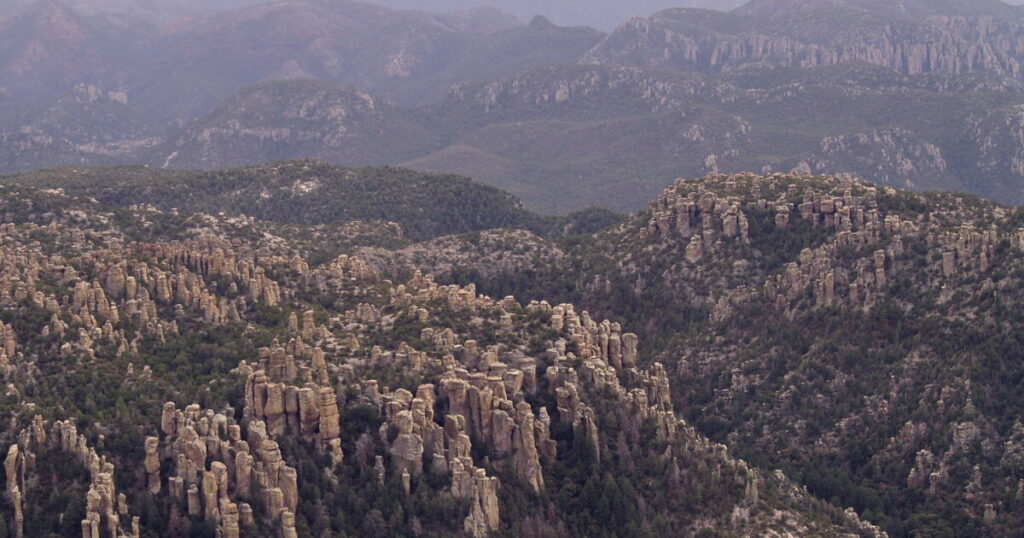
In southeastern Arizona, a remarkable expanse known as the Land of Standing-Up Rocks is on the brink of being recognized as a national park, a move that would elevate its status and draw increased attention to its unique geological formations.
The proposal to establish Chiricahua National Park is currently awaiting President Donald Trump’s signature after receiving bipartisan support in Congress. Should it pass, it will become the 64th national park in the United States.
Chiricahua’s 19-square-mile area, historically inhabited by the Chiricahua Apache tribes, was designated a national monument in the 1920s to safeguard its distinctive rock formations, the result of ancient volcanic activities.
Arizona Representative Juan Ciscomani, a Republican and sponsor of the Chiricahua National Park Act, remarked, “We’re the Grand Canyon state, so we know about this kind of landscape. It’s hard to compare anything to the Grand Canyon, but Chiricahua holds its own. This is something that really hasn’t been discovered.”
Despite the expected rise in visitors due to the new designation, National Park Service officials have not indicated whether additional staffing will be implemented. The park service has faced workforce reductions during Trump’s administration, prioritizing projects like the Lincoln Memorial Reflecting Pool over maintenance at sites such as Chiricahua.
Tribal Access and Cultural Preservation
The land, once home to the Apache tribes who resisted European settlers, retains its cultural significance. After their surrender to U.S. forces in 1886, the tribes were relocated to the San Carlos Apache reservation. The new legislation ensures tribal access for ceremonies and allows for temporary public closures to protect these cultural practices.
Though San Carlos Apache leaders have not formally addressed the park designation, their 2024 congressional testimony highlighted the importance of uninterrupted access for cultural and spiritual activities. “National parks have become so packed with tourists,” said Deputy Attorney General Justine Jimmie, noting the need for sanctuary to engage in traditional practices.
Historically referred to as the Wonderland of Rocks, the area takes its name from the surrounding Chiricahua Mountains and boasts a rich history of human habitation, from prehistoric settlers to Buffalo Soldiers stationed there post-Civil War. In 1924, President Calvin Coolidge designated it a national monument, with an expansion by Franklin D. Roosevelt in 1938. Currently, it attracts about 60,000 visitors each year.
Economic and Environmental Impact
While national monuments focus on preserving specific sites, national parks have broader objectives, including recreation and wilderness conservation. Both fall under the management of the National Park Service.
The potential upgrade to national park status, the first since West Virginia’s New River Gorge in 2021, is seen as a boon to the local economy. Willcox, Arizona, Mayor Greg Hancock anticipates increased business for local hotels, restaurants, and shops.
Chiricahua’s facilities include a visitor center, a campground, and hiking trails. However, park service officials have yet to outline any changes following the designation. The Congressional Budget Office estimates the cost of establishing the park at under $500,000, though specific allocations are not detailed.
The creation of the park was passed by the House in March through a voice vote and received unanimous consent from the Senate on September 30.
—
Read More Arizona News
![Jody White’s Unconventional Michigan Supreme Court Candidacy Explored[embed]https://www.youtube.com/watch?v=8NfxFIPE4ac[/embed]](https://www.kitchentablenews.org/wp-content/uploads/2026/10/Jody-Whites-Unconventional-Michigan-Supreme-Court-Candidacy-Exploredembedhttpswwwyoutubecomwatchv8NfxFIPE4acembed.com2F842F0e2Fc7223daa43c9876b36a4e00773a42Fme-supc.png "Jody White’s Unconventional Michigan Supreme Court Candidacy Explored[embed]https://www.youtube.com/watch?v=8NfxFIPE4ac[/embed]")