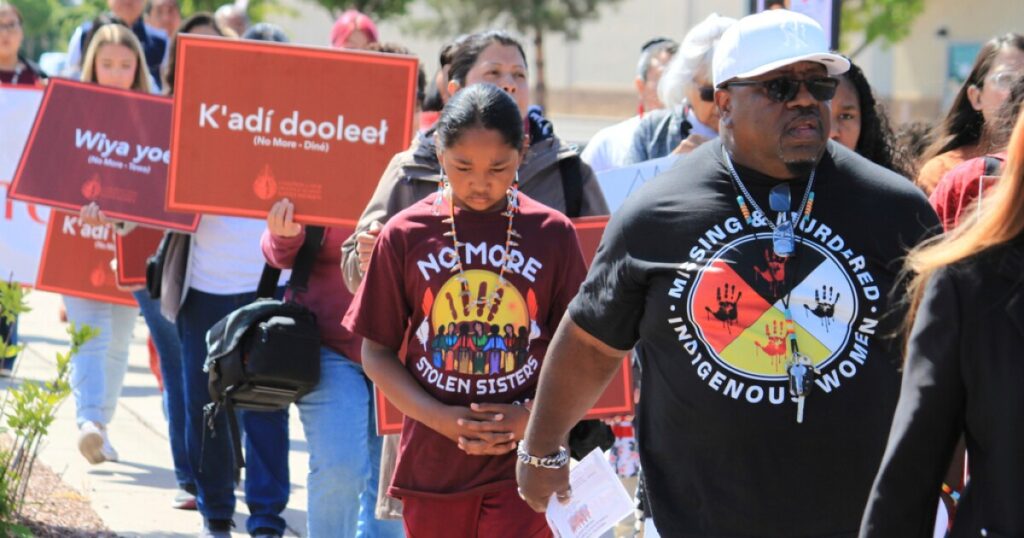
The FBI has taken a significant step in addressing violence in Native American communities by setting a minimum reward of $25,000 for unsolved cases involving missing persons or homicides in Indian Country. This initiative aims to tackle the high rates of unresolved violence affecting these communities.
With this new minimum reward, over 50 unsolved cases in tribal areas are now eligible for higher payouts. While most of these cases are from the past decade, some have remained unresolved for over 20 years, according to an analysis by the Associated Press.
However, skepticism remains among families and experts regarding whether the increased rewards will successfully encourage informants to come forward, given the prevalent fear and distrust towards federal authorities.
“Everybody’s scared in Oglala,” remarked Lisa Carlow, whose father, Patrick Carlow Sr., was discovered dead at his Pine Ridge Reservation residence in 2023. “So to me it’s like, OK, what do you guys know that you’re not saying?”
In collaboration with the U.S. Bureau of Indian Affairs, the FBI is responsible for investigating federal crimes on nearly 200 Native American reservations. By the end of 2025, the FBI’s National Crime Information Center recorded close to 1,500 active cases of missing Native Americans, though not all become federal inquiries. No universal reward minimum exists for all FBI cases.
The FBI highlighted specific cases in their announcement, including 8-year-old Maleeka Boone, likely hit by a vehicle on the Navajo Nation, and San Carlos Apache teenager Emily Pike, whose body was found after vanishing from an Arizona group home.
Potential for Increased Rewards to Spark Renewed Interest
Mary Kathryn Nagle, a Cherokee Nation of Oklahoma citizen and attorney advocating for families of missing Native Americans, emphasized that federal investigators often arrive in closely-knit communities where reluctance to speak out prevails due to fear and distrust.
She noted that larger rewards might motivate individuals to share information and demonstrate to families that their cases matter. “We have people in Indian Country who know what happened to our relatives,” she said.
Luana Ross, Bitterroot Salish and a co-director at the University of Washington’s Native Voices program, agrees that cash rewards might increase interest but also highlights that they are seldom distributed.
Ted S. Warren/AP Photo
/
AP
“It is my opinion that in reservation communities, people would be extremely reluctant to turn a friend or relative into a criminal justice system that hasn’t served them well,” she said.
Cecil Jackson, 43, was aware of the Missing and Murdered Indigenous Persons movement, but never expected personal impact. His mother, Mona Renee Vallo, was found dead after a suspected hit-and-run along Route 66 in Laguna Pueblo, New Mexico, in 2022. Vallo belonged to the Confederated Tribes and Bands of the Yakama Nation.
Jackson, who fondly recalls cultural activities with her, hopes the increased reward might spark renewed interest in the investigation, as updates from the FBI have been sparse.
“Someone knows something there,” asserted Vallo’s friend, Lisa Foster. “They have to. I mean, it’s weird that she went to work and then all of a sudden this happened to her.”
Growing Frustration as Families Await Answers
The reward for solving Carlow’s case was raised to $25,000 in July, up from $10,000. Carlow’s family describes the 73-year-old rancher as a respected figure in Oglala, who enjoyed helping others and spending time with his grandchildren. The reward increase led to more tips, but answers remain elusive.
The FBI provided no new updates on the case to The Associated Press.
“It’s so hard to get your hopes up like that and think, ‘This is it, we finally got dad’s killer.’ And then nothing comes of it,” Lisa Carlow said. Fear, she added, prevents many with potential information from contacting authorities.
Her sister, JoDee Carlow, echoed this sentiment: “I think that’s like deep-rooted within our people. It’s not just on Pine Ridge. It’s on every reservation.”
Relatives Determined to Keep Cases in the Spotlight
The FBI initially offered $5,000 for information on the deaths of Ohio brothers Matthew and Philip Reagan. After being doubled, the reward now stands at $25,000. Although not Native Americans, they were killed on the Navajo Nation and are included in the FBI’s Indian Country cases.
The brothers, en route to California, planned to visit Canyon de Chelly National Monument. Authorities believe their SUV got stuck in mud after GPS misdirection near Sawmill. They were shot while walking for help.
Matthew Reagan’s wife, Faye Wurstner-Reagan, is skeptical that the $25,000 reward will inspire anyone in the tight-knit community to come forward. “You would have to promise someone, like, actual protection,” she said. “I mean, they brutally murdered two men.”
She suggested that the FBI allocate resources towards law enforcement efforts to prevent cases from going cold and use liaisons to keep families informed.
FBI spokesperson Brooke Brennan in Phoenix acknowledged the complexities of investigating crimes in Indian Country, citing remoteness, limited resources, and extensive workloads.
Wurstner-Reagan hopes that families united by grief over missing loved ones and unresolved killings will eventually see justice. “We’re just getting forgotten, like no one is remembering any of us, and we’re just told it’s an active investigation,” she said.
Associated Press writers Felicia Fonseca in Flagstaff, Arizona, and Savannah Peters in Albuquerque, New Mexico, contributed to this report.
—
Read More Arizona News