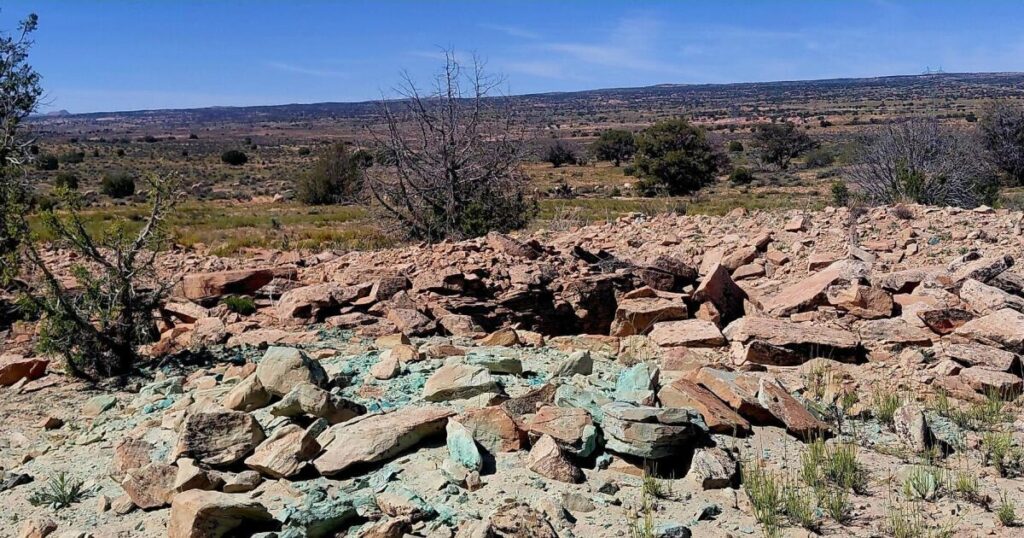
Loren Thomas has been a resident of the Coppermine area on the western Navajo Nation for over a decade. Here, beneath the salmon-hued sandstone, Thomas and his partner dedicate their lives to herding Rambouillet sheep and cultivating native crops like corn, cucumbers, radishes, and spinach.
Thomas explains, “My livelihood is totally center[ed] around the preservation of our Diné way of life, relying solely on your land and your animals and then cultivating your own food.” However, this way of life is potentially under threat due to a proposed copper mining project near the Coppermine chapter house.
The area’s history is steeped in mining, named after an open-pit copper mine operated by Coconino Copper and Chemical Co. from the 1930s until its closure and reclamation in 1968. While the economic advantages of the new mining proposal are acknowledged by Thomas, he is concerned about the environmental repercussions. “I … see the effects and the detrimental environmental impact that it will have on our land,” he notes.
Elivra Nowlin, another community member, shares Thomas’s concerns, attributing health issues in her family to past copper mining activities. “My family live[s] about a quarter of a mile away from the old copper mine,” she states, linking a history of cancer in her family to the mine.
Essential Minerals, the company exploring the Coppermine area, assures that the proposed mine would adhere to safety standards. As a subsidiary of Chakana Copper, a Canadian firm also active in Peru, they emphasize that no definitive studies link past health issues in Coppermine to mining.
Economic Opportunities and Community Concerns
Adrian Dotson, representing a Navajo-led environmental consultancy contracted by Essential Minerals, highlights potential job creation within the Coppermine chapter area. “We’ve heard from the people … that they want to maintain their way of life,” Dotson explains. A community benefits agreement, yet to be finalized, is intended to provide tangible benefits such as road maintenance and scholarships.
Dotson emphasizes the importance of community input in shaping this agreement, although critics caution that such agreements can sometimes fail to deliver. “We’re gonna take our time to build the relationships and earn that trust,” he affirms.
The transition from exploration to development in Coppermine will require support from the chapter and approvals from the Navajo Nation Resources and Development Committee. This phase involves rigorous environmental assessments and studies as per the National Environmental Policy Act (NEPA) and other regulatory bodies.
With potential operations spanning 10 to 15 years, the project could bring hundreds of jobs, according to Chakana Copper CEO David Kelley. He assures that stringent modern regulations will ensure environmental safety, including the use of a closed-loop water system and dust management.
Health and Environmental Concerns
Elvira Nowlin remains unconvinced about the effectiveness of these measures, citing concerns about dust. “Our worry is that when the wind blows — and it’s really windy in Coppermine a lot, like most days are windy — so all of that’s gonna get into our grazing land,” she warns.
Recent policy changes, such as an executive order from President Donald Trump, aim to expedite critical mineral mining permits, including copper, which was added to the list in 2025. The move has sparked debate over environmental priorities on federal lands.
Community protests occurred on May 2, ahead of a public workshop by Essential Minerals. Despite a vote against reconnaissance permits, the Navajo Nation Minerals Department eventually granted permission to proceed.
Thomas, reflecting on the lack of formal studies linking past mining to health issues, shares his observations of increased health problems since the initial mining activities, including asthma and cancer.
David Kelley reiterates the company’s commitment to addressing community concerns through open dialogue. “We understand there are a lot of concerns with the environment and with health,” he states. “We plan on addressing all of those questions every step of the way. And, you know, these [public] workshops are one way to do that.”
—
Read More Arizona News
![Jody White’s Unconventional Michigan Supreme Court Candidacy Explored[embed]https://www.youtube.com/watch?v=8NfxFIPE4ac[/embed]](https://www.kitchentablenews.org/wp-content/uploads/2026/10/Jody-Whites-Unconventional-Michigan-Supreme-Court-Candidacy-Exploredembedhttpswwwyoutubecomwatchv8NfxFIPE4acembed.com2F842F0e2Fc7223daa43c9876b36a4e00773a42Fme-supc.png "Jody White’s Unconventional Michigan Supreme Court Candidacy Explored[embed]https://www.youtube.com/watch?v=8NfxFIPE4ac[/embed]")