U.S. Homeland Security Enhances Biometric Surveillance Amid Privacy Concerns
The U.S. Department of Homeland Security (DHS) is ramping up its biometric capabilities by significantly expanding its use of iris scanning technology. This development comes as part of broader immigration enforcement strategies, which have sparked debates on privacy implications and questions about data handling practices.
Recently, DHS has awarded a no-bid contract worth $25 million to BI2 Technologies, a company specializing in iris scanning. This deal marks a substantial increase, more than fivefold, over the company’s previous contract with DHS. Despite multiple inquiries by NPR, BI2 declined to comment on their collaboration with Immigration and Customs Enforcement (ICE).
As outlined in the agency’s proposal, DHS seeks over 1,500 iris scanners and access to BI2’s mobile application, which includes a database for storing iris scans. Iris patterns, much like fingerprints, are unique identifiers.
In a statement to NPR, DHS explained that ICE employs iris recognition to “assist in accurately identifying individuals encountered during immigration enforcement and removal operations.” This technology is used to confirm the identities and backgrounds of individuals subject to enforcement actions.
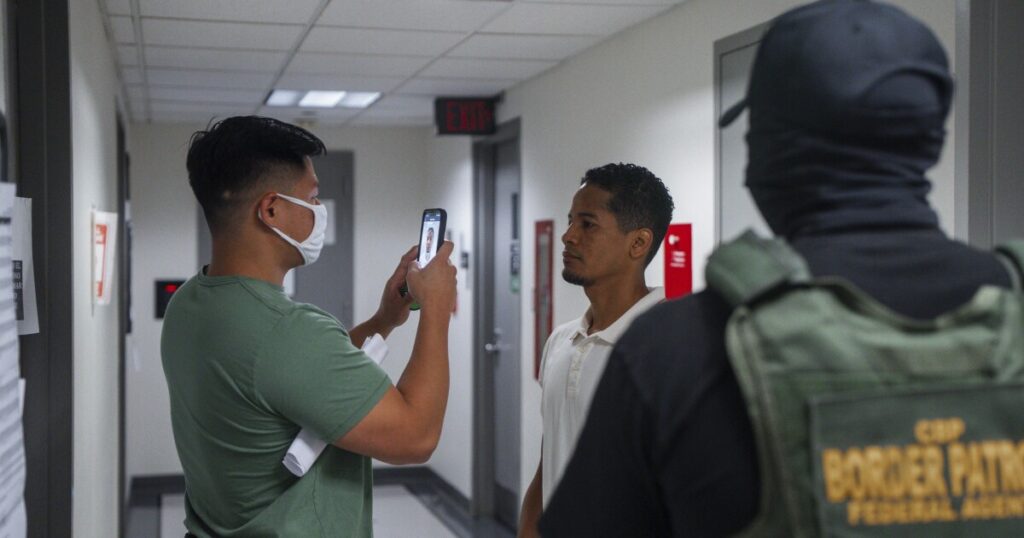
One such enforcement operation unfolded in Chicago, where Norelly Mejías Cáceres experienced a dramatic federal raid. Her apartment was surrounded by immigration officers, arriving in a Black Hawk helicopter. “We were in our room. We were sleeping. When they knocked on the door, they were pointing guns at us and they ordered us to leave,” Mejías recounted through an interpreter from the University of Chicago Immigrants’ Rights Clinic. Mejías, who later fainted during the ordeal, was reportedly photographed using a smartphone, potentially capturing her iris data.
According to Nicole Hallett, director of the Immigrants’ Rights Clinic at the University of Chicago, officers aimed to capture more than just a facial image. “There were other people who were arrested during this raid who reported having a photo taken of them and then having details about them known to the officers,” Hallett stated. She believes the officers sought an iris scan.
Iris scanning technology is not new to law enforcement; sheriffs have utilized it for decades. A video on BI2’s YouTube channel highlights its use over the past 20 years, with BI2 donating scanners to the Southwestern Border Sheriffs’ Coalition during the Trump administration.
Justin Smith of the National Sheriffs Association explained his experience using BI2’s technology during his tenure as sheriff in Larimer County, Colorado. The scanners were employed at the jail for booking, and officers used the mobile app in the field to identify individuals without identification. “They’re trying to quickly identify within a large group, ‘who do we have here?'” Smith noted, emphasizing the efficiency of the technology in identifying individuals.
However, Smith acknowledged the potential for misuse of biometric data, highlighting the need for careful consideration of its application. “It’s a balance test. It’s not a black and white, always this, never that,” he remarked, stressing the importance of responsible usage.
Concerns about the Chicago raid are echoed by Hallett, who contends, “The only way they were able to identify people was to illegally arrest them and then use this technology in order to identify them.” Cooper Quintin from the Electronic Frontier Foundation also expressed skepticism, warning of potential misuse against protesters and undocumented immigrants.
Such apprehensions are not unfounded. NPR has documented cases where ICE collected DNA from arrested individuals, including protesters exercising their First Amendment rights.
Georgetown Law’s Marianna Poyares highlighted the broader implications of biometric surveillance, questioning data collection, oversight, and potential aggregation. As DHS leverages its expanded budget to amass tools like facial recognition and location trackers, concerns about privacy and oversight remain at the forefront of the debate.
—
Read More Michigan News