Former Michigan Governors Advocate for Political Civility Amid Rising Tensions
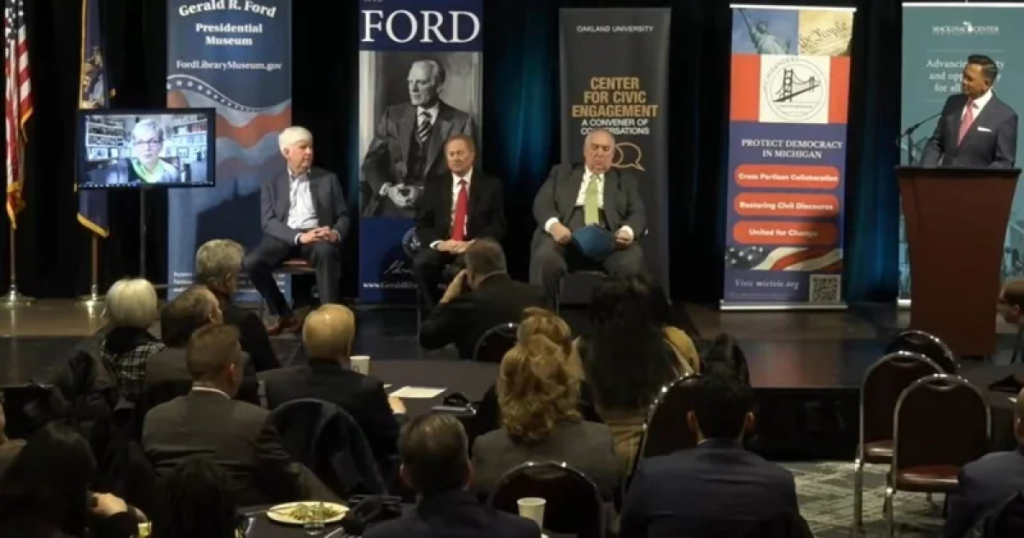
In a rare public appearance, Michigan’s four living former governors have united in a call for increased civility in the realm of politics and elections. This bipartisan gathering, comprising two Democrats and two Republicans, seeks to address growing concerns about the heightened hostility and occasional violence that have marred the political landscape.
Rick Snyder, the most recent Republican governor to step down in January 2019, expressed concern over the deteriorating political discourse. “The way you see behavior in politics, would it be acceptable in any other part of your life?” he questioned. Snyder emphasized the importance of treating political adversaries like family, saying, “The role model I’ve always had is I try to treat anyone in the political world just as if they’d been a family member sitting at my dining room table.”
Highlighting the unrest in Minneapolis, where federal immigration officers have sometimes responded violently to peaceful protests, Snyder warned that similar incidents could occur in Michigan. He noted that two protesters were fatally shot by immigration agents last month.
Former Democratic Governor Jim Blanchard, who served before the advent of social media, attributed much of today’s divisive tone to the current political climate in Washington, indirectly pointing to former President Donald Trump. “It doesn’t have to be this way – it doesn’t be this way in American society. It doesn’t,” Blanchard stated, lamenting the unchecked spread of misinformation online. “Social media and the internet are real problems because people can lie, lie, lie and get away with it,” he added.
Jennifer Granholm, also a Democrat and former Energy Secretary under President Joe Biden, joined the discussion via video link. She highlighted the role of online platforms in fostering division. “People aren’t swimming in the same pond at all. Their realities, their facts, are completely different because their sources are completely different,” she explained, noting that extreme content thrives online due to its clickability.
John Engler, who succeeded Blanchard in 1990, criticized the news media for not fully engaging in their civic duties. He suggested that television networks should collaborate to host statewide debates, saying, “Those networks have an obligation to the people of Michigan to get together now, pick a date for a debate in August right after the primary, pick another date, a second date for another date right after Labor Day before we start voting.”
The event marked the kickoff of the Michigan Civility Coalition, a campaign aimed at promoting respectful political discourse in the lead-up to the high-stakes 2026 elections. Political science professor David Dulio, who was instrumental in organizing the event, acknowledged the challenges ahead. “And we understand that,” he noted. “You know, can this effort change American culture and society where the social media algorithms affect us all in so many different ways? Certainly not at the start and maybe never.”
The coalition plans to host additional events to foster civility, reinforcing that relying solely on political dynamics to self-correct is not a viable strategy.
—
Read More Michigan News