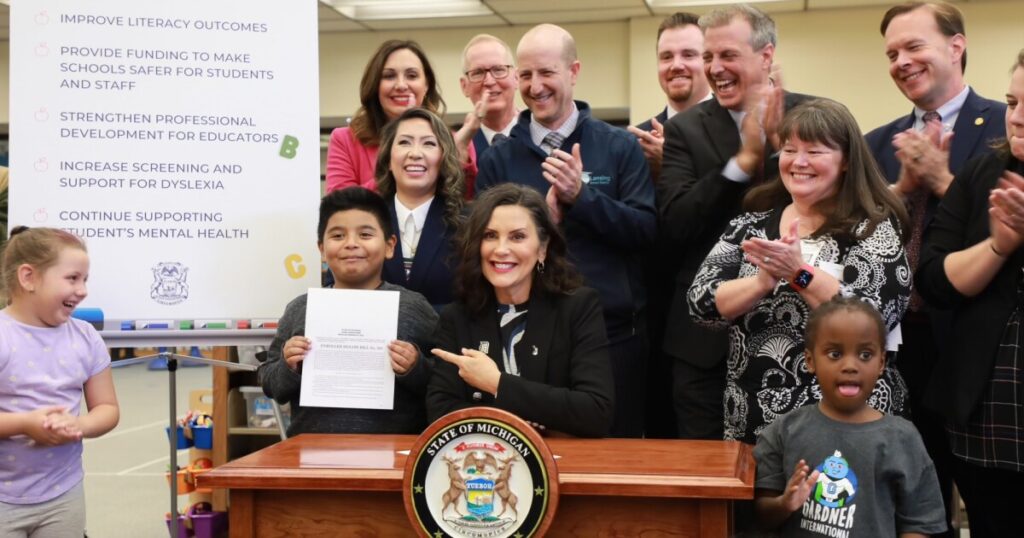
Michigan Schools Embrace New Literacy and Dyslexia Law
Michigan schools are gearing up for a significant shift in literacy education, driven by a new law designed to enhance reading skills and provide targeted support for dyslexic students. This legislation, championed by Senator Jeff Irwin (D-Ann Arbor), introduces a comprehensive framework for improving early literacy education across the state.
The newly enacted law is based on the science of reading, which emphasizes phonics and decoding as essential components for developing strong reading abilities. According to Irwin, “The new law weaves the science of reading into early elementary literacy education,” positioning phonics as a crucial element for all students, especially those exhibiting dyslexic characteristics.
The law mandates training for early literacy educators, equipping them with the skills to identify and address decoding challenges in students. Additionally, it allocates resources for assessments that evaluate children’s decoding capabilities.
Heather Weisenburger, a reading interventionist at Central Elementary, Grandville Public Schools, is already implementing several of the law’s requirements, such as universal testing and phonics instruction. She emphasizes the importance of early detection, stating, “We don’t want to wait until third grade to find out they can’t read. We want to know from the get-go.”
Weisenburger highlights that interventions alone are insufficient; ongoing support in various areas is crucial for students to make progress. “Kids can’t just get an intervention and be fixed. They also need additional support in other areas in order for them to make gains,” she explains.
Roger Bearup, Superintendent of Grandville Public Schools, acknowledges the law’s role in standardizing literacy efforts across Michigan. However, he notes concerns among some districts about the potential expectation for improvement without corresponding funding.
By the 2027-28 school year, Michigan public schools will be required to implement several initiatives, as detailed in a press release from the Michigan Department of Education. These include:
- Screening students from kindergarten to third grade for dyslexia characteristics three times annually
- Providing reading intervention to K-12 students identified through screening
- Utilizing a Multi-Tiered System of Supports (MTSS) framework for instruction
- Offering professional learning on dyslexia for teachers and instructional staff
Irwin underscores the urgency of this initiative by stating, “We’ve got a lot of kids who are falling through the cracks right now because they’re not getting their decoding skills early enough to help them in their reading journey.”
The transition to this new educational approach is expected to unfold over the next three years, allowing time for teacher training and the selection of appropriate assessments. Weisenburger expresses concern for schools yet to begin these interventions, emphasizing the need for guidance and support.
As the Michigan Department of Education reviews and approves the necessary assessments, Irwin highlights the broader impact of literacy, noting, “I think we need to recognize how reading challenges can affect kids’ discipline, attentiveness, and their ability to be successful in school.”
Ultimately, this legislation aims to ensure that literacy remains a fundamental component of Michigan’s public education system. “Reading is fundamental. If we’re going to have a free quality public education for every child in Michigan, it has to deliver on literacy,” Irwin affirms.
—
Read More Michigan News