Michigan Leaders Voice Concerns Over Medicaid Cuts Introduced by Trump Administration
Healthcare leaders and advocates in Michigan convened on Monday to express their opposition to recent reductions in Medicaid funding by the Trump administration. These cuts are part of a broader legislative package known as the “One Big Beautiful Bill Act,” which was passed last July under a federal reconciliation law.
The law, central to former President Donald Trump’s second-term agenda, implements several significant reductions in federal healthcare expenditures:
- According to the Congressional Budget Office, Medicaid spending is set to decrease by over $900 billion over the next decade. This reduction includes savings derived from stricter work requirements for eligibility.
- There are also cuts to the Children’s Health Insurance Program (CHIP), which provides low-cost health coverage to children in families who earn too much to qualify for Medicaid but cannot afford private insurance.
- Elimination of Affordable Care Act premium tax credits, which could lead to an increase in average marketplace deductibles by more than $1,000 per person in 2026, as analyzed by KFF.
- Federal reimbursement rates to medical providers are being reduced, potentially impacting hospital funding as detailed by KFF.
Proponents of these measures, as noted in a White House statement, argue that they address inefficiencies in the system by eliminating waste, fraud, and abuse, while still supporting those who need these programs the most. Conversely, critics claim the law jeopardizes public health for corporate gain, contributing to inflation, increasing medical debt, and risking hospital closures.
Reports indicate that 90,255 individuals in Michigan have lost their Medicaid or CHIP coverage, and 130,789 more have discontinued their ACA health care plans following increased premiums, as per data from Georgetown University and KFF.
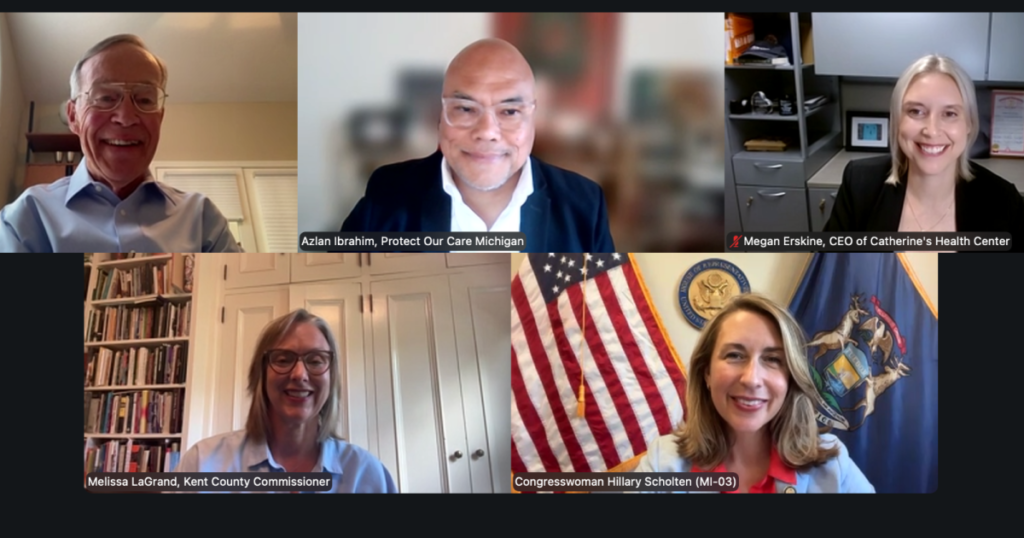
At a press conference hosted by Protect Our Care Michigan, Democratic Congresswoman Hillary Scholten (D-MI 3) addressed the crowd, sharing feedback from her constituents about the challenges posed by reduced healthcare resources.
“These are parents wondering whether they can afford to take their child to the doctor,” Scholten stated. “It’s a small business owner struggling to keep coverage for their family and their employees. It’s someone putting off a prescription or a screening because they simply cannot afford another bill. And these pressures are only going to get worse if we don’t change course.” Scholten emphasized that Congress should prioritize affordability over what she perceives as politically motivated allegations of fraud.
“There is nothing inevitable about health care becoming less affordable or less accessible. These are policy choices, and Congress can and should make different ones,” she continued.
Megan Erskine, CEO of Catherine’s Health Center, voiced concerns regarding the impending work requirements for Medicaid eligibility set to be enforced in most states by January 1, 2027. She recounted the story of a diabetic patient unable to afford insurance due to the removal of ACA premium tax credits.
“She chooses to put food on the table and keep a roof over her kids’ head at the expense of her health,” Erskine explained. “We see patients like this every single day at Catherine’s Health Center. Insured individuals do not get preventive care. They delay primary care, and that means that costs increase for all of us because they are forced to use emergency rooms.”
—
Read More Michigan News

![Botched Ad Mix-Up: Super PAC Error in Arizona Congressional Race[embed]https://www.youtube.com/watch?v=bEMgIlCkHz0[/embed]](https://www.kitchentablenews.org/wp-content/uploads/2026/10/Botched-Ad-Mix-Up-Super-PAC-Error-in-Arizona-Congressional-RaceembedhttpswwwyoutubecomwatchvbEMgIlCkHz0embed.com2F0e2F962Fe971102f49e7a4f2a64fd3cc60a22Fjonatha.png "Botched Ad Mix-Up: Super PAC Error in Arizona Congressional Race[embed]https://www.youtube.com/watch?v=bEMgIlCkHz0[/embed]")