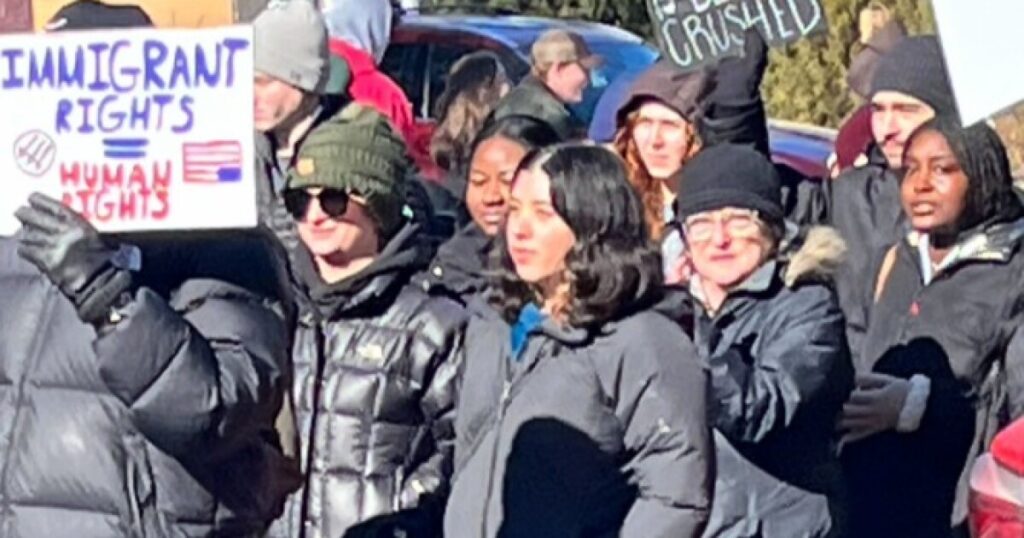
In an era of heightened tensions surrounding immigration policies, the city of Ann Arbor witnessed a significant turnout of demonstrators rallying near the University of Michigan. This local protest is part of a broader national response to the Trump administration’s actions through Immigration and Customs Enforcement (ICE).
One protester carried a sign with an unequivocal message: “ICE is better crushed.”
Elliott Paloff, a high school student, participated in the demonstration with hopes of having her concerns acknowledged. She expressed her belief that ICE operatives who engage in harmful activities against immigrants and protestors will, in time, face justice. “We’re basically having secret police that can just like take people and can kill them with no real punishment for it,” she remarked, describing the situation as “unsustainable.”
Paige Porter, a student from the University of Michigan and originally from Chicago, shared her personal experiences with the fear and disruption ICE has caused, especially in Minneapolis. “We [in Chicago] were one of the first to get the experience and see people, black, brown, people that I live with and love, be attacked and violated in their homes and communities and have their lives disrupted,” Porter explained.
The movement saw similar protests in metro Detroit and various high schools, while Minneapolis was the epicenter of calls for ICE to cease its operations in the city.
Amidst these protests, controversy surrounds the recent deaths of two individuals in Minneapolis at the hands of immigration agents. Some Trump administration officials claim that the deceased were responsible for their own demise. However, this narrative is disputed by local and state law enforcement, as well as some of the president’s allies, who argue that the federal account contradicts available evidence.
ICE maintains that its mission is to enhance national safety by targeting criminals residing illegally in the United States. Nonetheless, a recent Michigan Public report reveals that 90% of detainees at the Midwest’s largest immigration detention center have not faced criminal charges.
—
Read More Michigan News