The University of Michigan unveiled the Center for American Dialogue during a Preview Day event on April 13, inviting faculty and staff to make the center their own. Announced in 2025 by President Domenico Grasso, this initiative is poised to become a hub for tackling societal issues like polarization and eroding civic trust. Hundreds attended the event at the Lydia Mendelssohn Theatre or watched via livestream. Grasso emphasized the foundational role of respectful dialogue in democracy, noting “the necessity of the respectful and civil exchange of ideas.” The center, originally the Institute for Civil Discourse, will operate across U-M campuses and locations nationwide.
Arthur Lupia, vice president for research and innovation, presented the center’s framework, developed with faculty and staff input. “The Center for American Dialogue gives the nation a new reason to Look to Michigan,” Lupia stated. The center’s first year will feature five programs and two innovation accelerators. Programs include Certificates and Micro-Credentials to teach civic skills, Interactive Role-Playing Simulations at places like the Gerald R. Ford School of Public Policy, and “Convene with Purpose,” a speaker series aiming to solve real problems. Cooperative Extensions will promote civic dialogue in communities, and Connection-Building Games will aid collaboration.
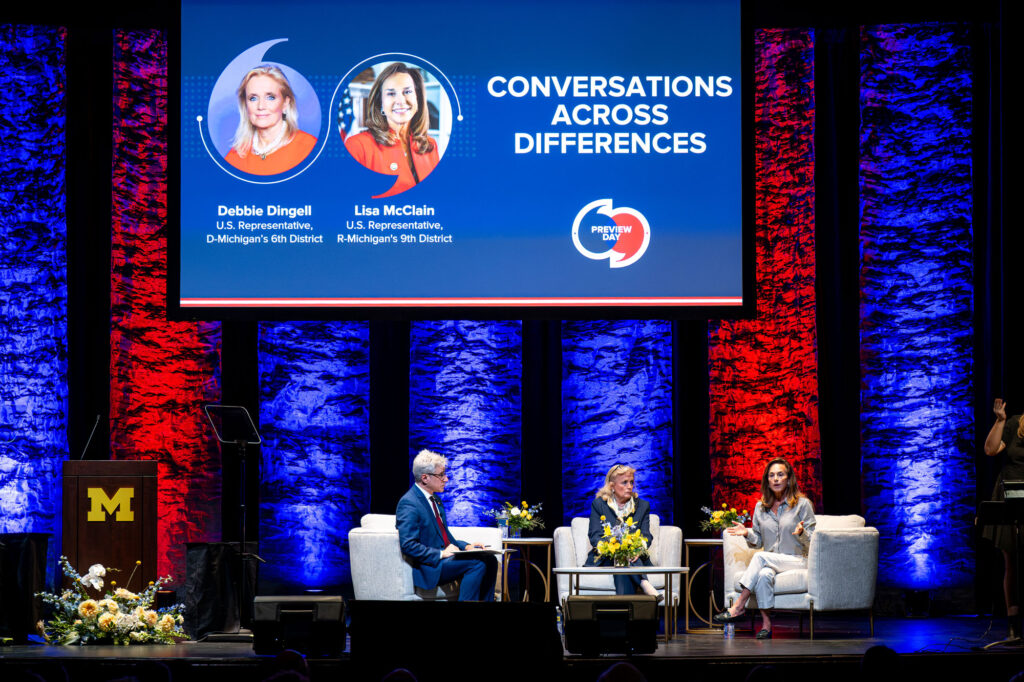
The two accelerators are the Innovation Accelerator Competition, offering funding for new ideas, and America’s Dialogue Lab, a novel approach to impact assessment. More program details will be available this spring when proposals are requested. The Preview Day event also featured U.S. Reps. Debbie Dingell and Lisa McClain discussing their ability to bridge political divides. Despite differing political affiliations, they share a respectful relationship, fostering problem-solving dialogues. “We can have very good conversations about how to solve problems because we listen to each other,” Dingell remarked.
Keynote speaker David Brooks addressed the audience, exploring historical cycles of disillusionment and cultural change. He noted that periods of disillusionment often lead to romanticism, a time ripe for societal transformation. Highlighting the role of humanism, Brooks stated, “Humanism is anything that upholds the dignity of each person.” He emphasized that universities like U-M play a crucial role in fostering intellectual conversations essential for societal repair. “America, like every one of us, grows through a process of rupture and repair,” Brooks concluded, noting the event as a step toward repair. Attendees also heard from student government leaders and enjoyed performances by the U-M Chamber Choir.
—
Read More Michigan News