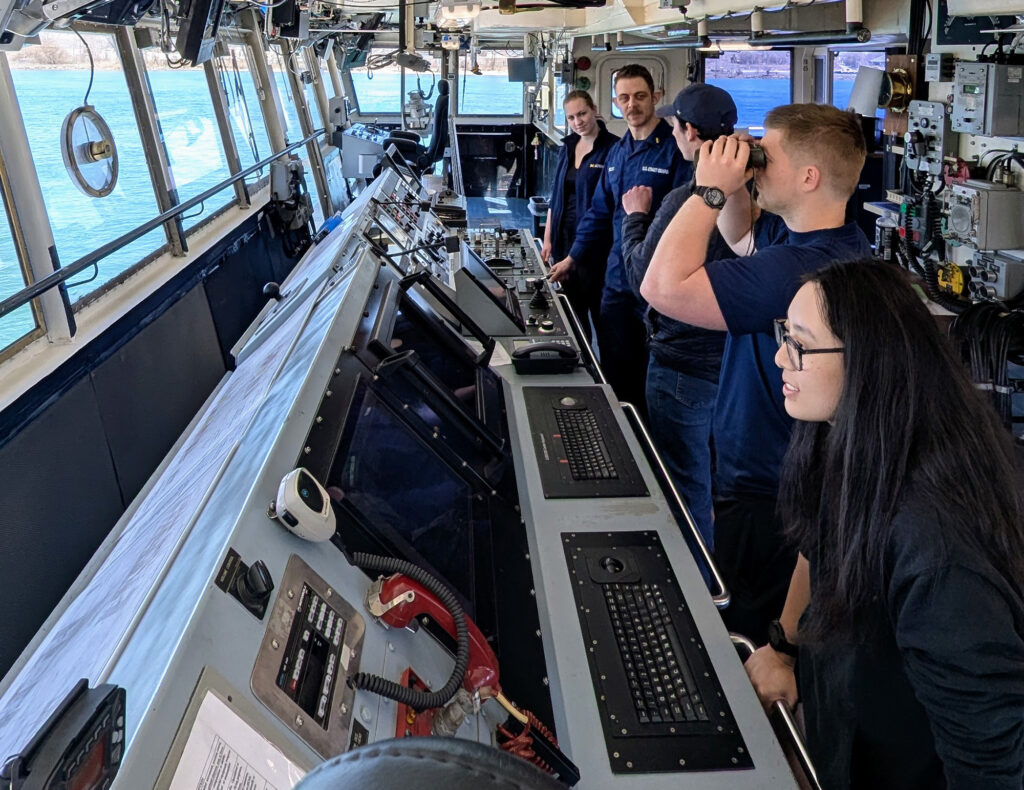
Sam Blum, a University of Michigan student, discovered a gap in Coast Guard Auxiliary University Program chapters while researching ways to engage with the U.S. Coast Guard. Noticing other schools had chapters, but none existed at U-M, located near the Great Lakes, Blum saw an opportunity. “It seemed like a missed opportunity,” remarked Blum, a senior in mechanical engineering, noting the strong local Coast Guard presence.
Blum collaborated with Professor Christian Sandvig, who shared the vision, to establish U-M’s Coast Guard Auxiliary University Program. This initiative is among a dozen nationwide and the first on the Great Lakes, set to be officially chartered this spring.

The Coast Guard Auxiliary, a volunteer branch, handles search and rescue, environmental education, and disaster response. Unlike ROTC, this program requires no post-graduation service commitment. “The nice thing about the auxiliary is that because it is volunteer, there’s no commitment,” explained Lt. Michael Jenkins, the unit’s active-duty liaison.

Participants generally fall into two categories: those passionate about environmental protection and those intrigued by maritime activities. Sandvig himself joined the auxiliary in 2022, motivated by a keen interest in boats. “I needed an outlet that allows me to spend a certain amount of my time talking and thinking about boats,” said Sandvig, a digital media professor.
John McCalmont, a junior in naval architecture and marine engineering, found the program through departmental communication, aligning with his interests. “I’ve been around the water my whole life,” McCalmont stated, emphasizing the program’s connection to his passions.
Freshman Victoria Long, aiming to become a Coast Guard officer, joined in January. She aspires to fly helicopters for search and rescue missions. “Since joining, I’m even more sure, this is absolutely what I want to do,” she shared.

Training to become a qualified auxiliary boat crew member involves extensive online coursework on Coast Guard procedures and regular Saturday sessions for practical skills. “Having to spend a couple hours clicking through what is effectively the government’s filing system is never anybody’s favorite thing,” McCalmont noted.

The program is expanding to include an environmental track, with the first student recently qualifying as a pollution responder. This allows for documentation of spills on the Great Lakes, aligning with the Coast Guard’s environmental missions. Jenkins highlighted Michigan’s strategic location within Coast Guard Sector Detroit, offering students unique experiences in icebreaking and helicopter operations.
Blum, who co-founded the unit, is set to graduate soon and emphasizes the program’s broader purpose. “There’s definitely a sense of fulfillment in getting to participate in a larger organization that is doing good work — that you are helping people,” Blum expressed. Interested individuals can learn more about the program through U-M’s Maize Pages.

—
Read More Michigan News