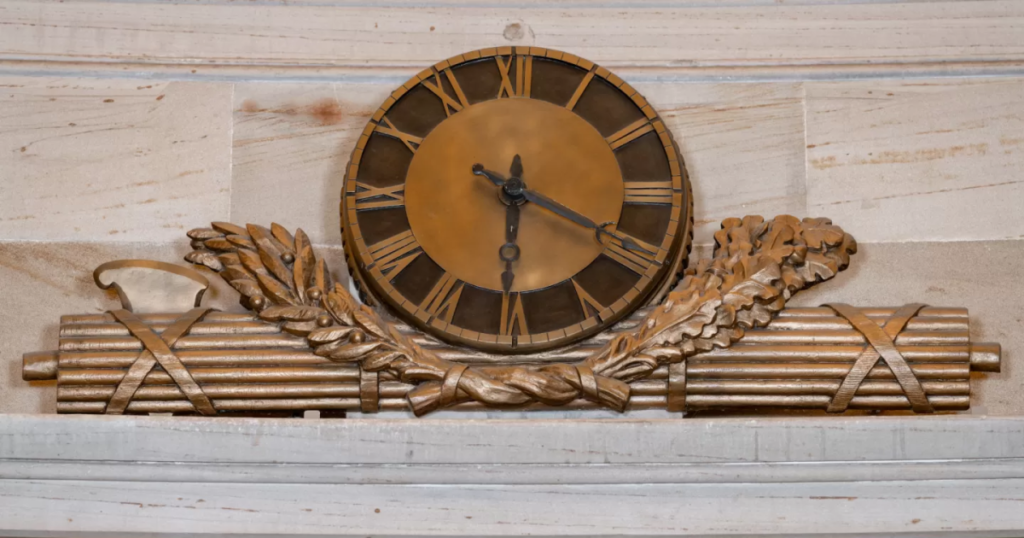
As November nears, Americans prepare for the annual clock adjustment that marks the transition from daylight saving time to standard time. This ritual occurs at 2 a.m. on Sunday, November 1, when clocks move back an hour, offering an extra hour of sleep to millions.
For decades, this time change has been a nationwide practice, with the exceptions of Hawaii and Arizona (excluding the Navajo Nation), which remain on standard time year-round. Federal law currently prevents states from adopting daylight saving time permanently, though there is interest from many states to make the switch.
Daylight saving time will resume on March 14, 2027, when clocks will “spring forward” by an hour. Modern technology ensures that most digital devices will update automatically, while manual adjustments are necessary for analog clocks.
Origins of Daylight Saving Time
The concept of daylight saving time was introduced in 1895 by New Zealand entomologist George Hudson to make use of extended daylight during summer months. During World War I, many European nations adopted it to conserve fuel, and the U.S. followed in 1918. Although the U.S. discontinued the practice nationally in 1919, it reemerged with the Uniform Time Act of 1966, signed by President Lyndon Johnson, which established the current system.
Public Opinion on Daylight Saving Time
Changing the clocks twice a year is a common grievance among Americans. A 2025 AP-NORC poll revealed that only 12% support the existing system, with 47% opposing it. Among alternative preferences, 56% favored permanent daylight saving time for longer evening light, while 42% preferred permanent standard time for brighter mornings.
The Future of Daylight Saving Time in the U.S.
The debate over daylight saving time was reignited with the introduction of The Sunshine Protection Act of 2025, aiming to make daylight saving time permanent. Although it passed the House of Representatives, it has stalled in the Senate. This legislative impasse has historical roots; a similar attempt in 1974 led to public dissatisfaction due to late winter sunrises, resulting in the law’s repeal.
The current bill has sparked tension between President Donald Trump, who supports the measure, and Senate Republicans, including Tom Cotton of Arkansas. Recently, Trump shared Cotton’s phone number online, urging his supporters to demand action on the bill.
With the Senate on break and midterm elections looming, the bill’s future remains uncertain, as any unpassed legislation must be reintroduced after elections.
CORRECTION: An earlier version of this story inaccurately stated that permanent standard time results in a later sunset; it actually leads to an earlier sunset.
—
Read More Michigan News