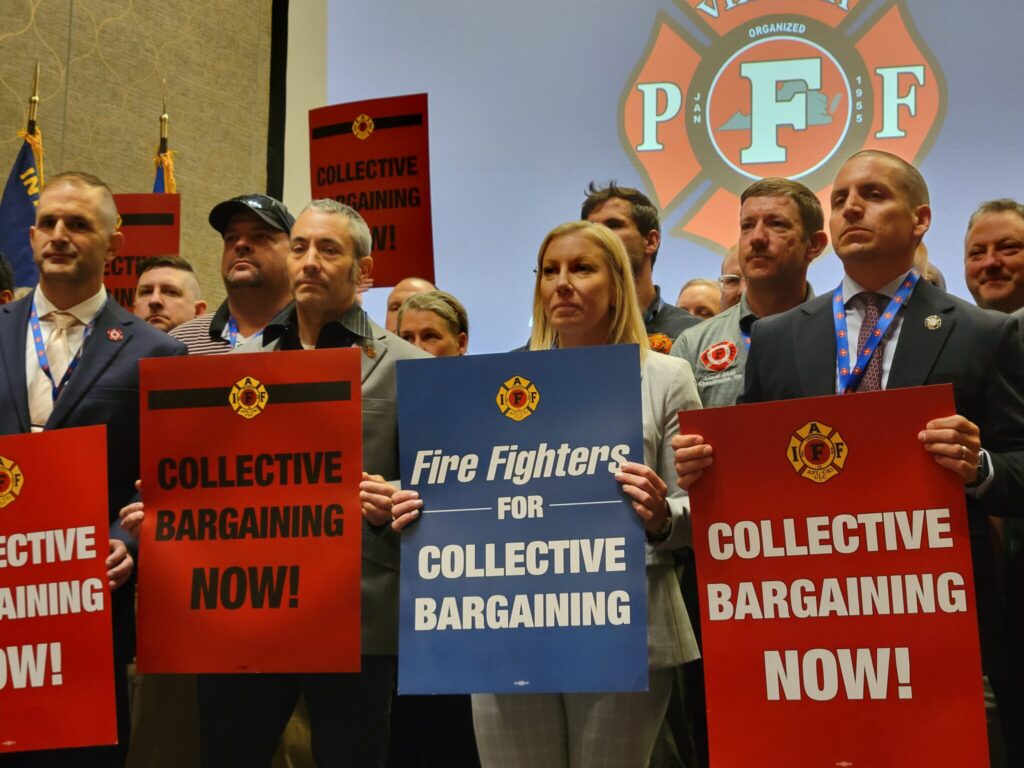
Labor union membership is on the rise in the United States, although political differences between states significantly affect this growth. Last year, over 411,000 union members were added, marking the largest annual increase since 2008, according to a study by the Illinois Economic Policy Institute and the Project for Middle Class Renewal at the University of Illinois at Urbana-Champaign. At the end of the year, more than 14.6 million American workers were union members, about 10% of the workforce.
The State of the Unions report highlights that states safeguarding collective bargaining rights added three times more union members than right-to-work states, which prohibit mandatory union membership. “What seems to be the number one driver is the state of the state,” said Robert Bruno, a study author. State politics and policies are crucial in determining union membership growth, with collective bargaining states showing rates of 14% compared to 5% in right-to-work states.
Workers in collective bargaining states earn notably more, with hourly earnings averaging $37.24 compared to $34.16 in right-to-work states, adjusted for cost of living. Despite these gains, union density is far from its peak in 1954 when over a third of American workers were unionized. Recent legislation in Southern states and federal actions by President Donald Trump have posed challenges to union expansion.
Public support for labor unions is increasing across political lines, according to Gallup polling. “More Americans are turning to unions as a bulwark against the rising cost of living,” said Frank Manzo IV, coauthor of the State of the Unions report. However, a 2025 review by the Mercatus Center suggests that powerful unions may slow job growth and reduce investment in research and development.
This year, state lawmakers passed numerous bills to enhance worker protections in 19 states, tracked by State Futures. These include bills expanding collective bargaining rights. In Illinois, rideshare and gig drivers gained the right to organize, while Washington state extended these rights to university students. Virginia’s attempt to repeal a public-sector bargaining ban faced a veto, with Gov. Abigail Spanberger calling for amendments to balance local budget processes.
—
Read More Montana News