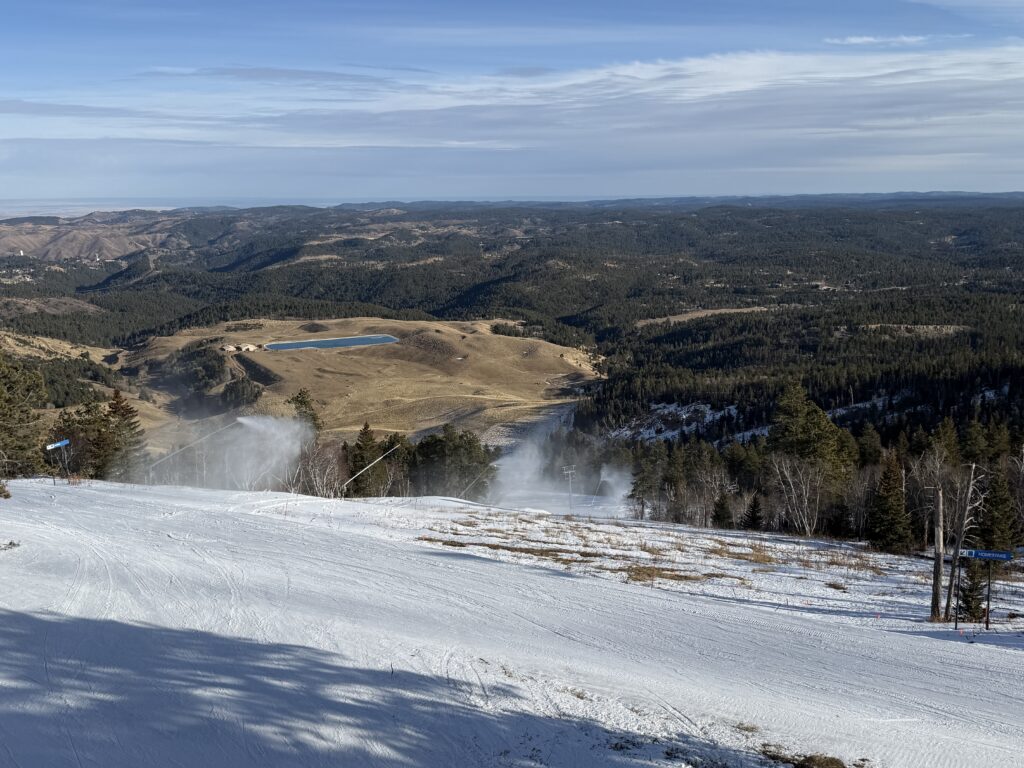

Terry Peak Ski Area’s snowmaking system in South Dakota’s northern Black Hills operates during the 2025-2026 winter season, while surrounded by dry conditions. (Courtesy of Terry Peak Ski Area)
South Dakota’s northern Black Hills encountered one of its driest, warmest winters on record, according to state climatologist Laura Edwards. The Terry Peak Ski Area, a snowy refuge amidst the dry landscape, relied heavily on its artificial snowmaking system this season. “You see a lot of top 10s across South Dakota, essentially,” Edwards stated, highlighting the winter’s unusual warmth and dryness.
Winter tourism in the Black Hills is vital, yet snowfall was notably below average, with the northern region receiving 8 feet less than usual. This shortage severely impacted businesses dependent on winter sports like skiing and snowmobiling. Business owners are now adapting to the ongoing trend of warmer winters.

In Lawrence County, encompassing the northern Black Hills, average winter temperatures have risen by 4 degrees Fahrenheit since the late 1800s, with winter precipitation decreasing by an inch, according to the National Centers for Environmental Information.
$6.5 Million Investment Keeps Ski Area Open
This winter was among the “most challenging” for Terry Peak’s marketing director, Linda Derosier, in her 38 years there. The resort invested $6.5 million to enhance its snowmaking system, tripling capacity to maintain operations. “It’s tough to remind people or get them to understand that there was snow at Terry Peak when they’re looking at brown grass in their backyard,” said Derosier.

Resorts nationwide faced closures due to insufficient cold weather for snow production, but Terry Peak’s elevation above 7,000 feet allowed for nighttime snowmaking. Derosier noted that visitors who experienced reliable conditions might return and purchase season passes.
Cross-Country Skiing, Snowmobiling Nearly Nonexistent
The absence of natural snow heavily affected Recreational Springs Resort. “No snow means no business,” said owner Brent Eslinger, who offers lodging, dining, and snowmobile rentals. The Deadwood Snocross National was canceled, alongside cross-country skiing activities, which were nearly nonexistent.
The Black Hills Nordic Ski Club, maintaining ski and snowshoe trails, groomed only three times this season compared to the usual 30 to 40. Eric Anderson, the club’s grooming coordinator, remarked, “When skiing isn’t available, people pivot to other things to do.” Without winter recreation, Eslinger emphasized the need for winter traffic to sustain operations year-round.
Economic, Visitor Impact
Winter events like Chinook Days and the Burning of the Beetle faced cancellations due to adverse weather. Visitor spending varied, with some counties like Pennington seeing gains, while others, including Custer, experienced declines. The South Dakota Tourism dashboard reported mixed outcomes across the region.
Michelle Thompson, president of the Black Hills and Badlands Tourism Association, noted that businesses reliant on snow suffered, while those offering alternative activities thrived. The Black Hills Stock Show and Rodeo in Rapid City had record attendance. Despite a minor drop in total visitor trips, spending saw a 1.7% increase.
“We feel for the businesses that rely on winter sports,” Thompson stated, acknowledging the challenges while highlighting the region’s diverse attractions.
This story was originally produced by South Dakota Searchlight, part of States Newsroom, a nonprofit news network, supported by grants and donors as a 501c(3) public charity.
—
Read More Montana News