Article Summary –
Nurses at the University of Pittsburgh Medical Center’s Magee-Womens Hospital are experiencing severe strains due to staffing shortages, compounded workloads, and lack of administrative support, prompting them to seek unionization for better working conditions. The hospital administration has resisted these unionization efforts, employing tactics to discourage organizing, while nurses report being overworked to the point of burnout, with inadequate time to provide necessary patient care. Additionally, financial decisions by the hospital, such as leasing a $50 million corporate jet amid layoffs and supply cutbacks, have exacerbated staff frustrations, highlighting the disparities between administrative priorities and employee needs.
At the University of Pittsburgh Medical Center’s Magee-Womens Hospital, registered nurse Jamie Miller and her colleagues often face 12-hour shifts without breaks due to high patient loads. Working without time for meals and being asked to cover multiple shifts is common, said Miller.
“During COVID, we were heroes, but now it feels like we are the least important team members,” stated Miller, who works in a high-risk unit dealing with life-threatening pregnancy complications like preeclampsia, hemorrhages, and infections.
The hospital delivers around 10,000 babies a year, nearly half of Allegheny County’s births. Nurses and professionals, including midwives and nurse practitioners, report needing more support to sufficiently care for patients.
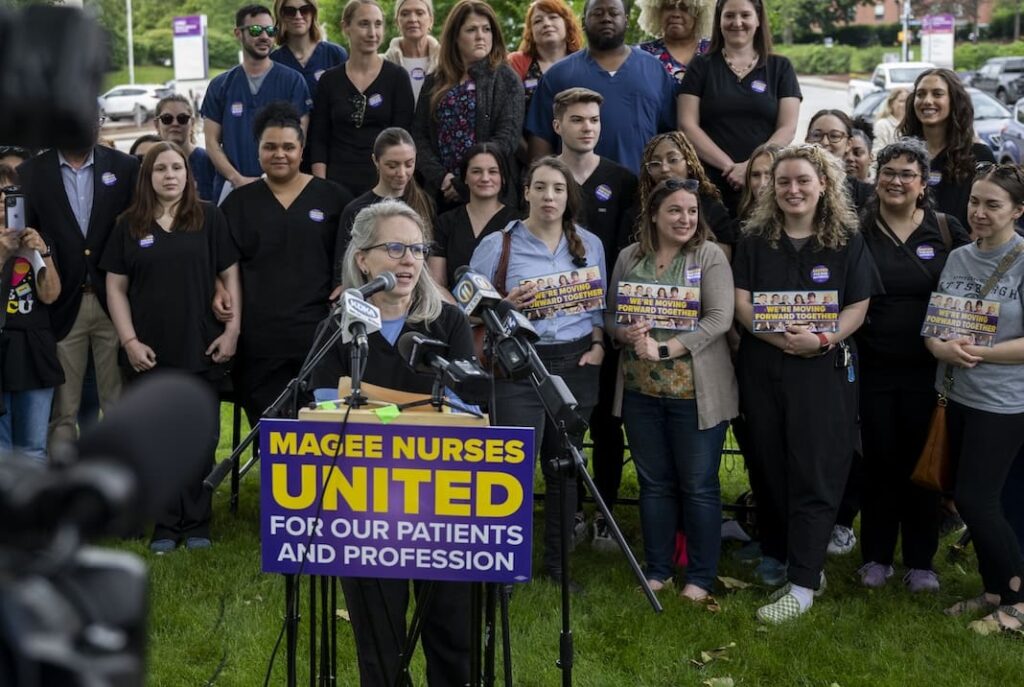
The UPMC administration’s lack of support has prompted staff to advocate for a union representing about 1,000 nurses and professionals. On May 27, they filed for a union election with the National Labor Relations Board.
UPMC did not comment on the matter.
Leading up to the election, workers urge administrators to support unionization efforts and halt anti-union activities that they’ve encountered. A year ago, when union advocacy began, the administration opposed the efforts.
‘It burns you out’
Nurses remain hopeful that most colleagues will support forming a union to address burnout and inadequate patient interaction. Miller described the need to spend more time with new mothers facing complications like hemorrhaging or preeclampsia.
“We discharge patients and suddenly have new ones, making it feel like musical nurses. It’s challenging to build rapport and ensure patient safety,” Miller explained. “We often choose between patient care and personal breaks.”
Registered nurse Jennifer Ellermeyer, with 15 years at the hospital, described being burdened with increased workloads without added support. “Nurses are the MacGyver of health care,” she said. “We’re always expected to do more with less.”
Since the pandemic, working conditions have worsened, and the nursing shortage has intensified, affecting care nationwide. A 2024 study revealed that 40% of nurses have considered leaving by 2029.

Pennsylvania faces the worst nursing shortage, with an expected deficit of over 20,000 nurses by 2026, as reported by the Hospital Healthsystem Association of Pennsylvania.
Miller noted the staffing issues precede the pandemic and have worsened, potentially due to Medicaid cuts affecting hospital funding. Medicaid reductions proposed by Congress could severely impact hospital systems operating at a loss, like UPMC, which reported a $339 million operating loss in 2024.
‘It’s so grueling and difficult’
Nurses hope a union would improve work conditions and provide necessary supplies. “They’ve made cutbacks on supplies; the new linen company is terrible,” said Miller.
Meanwhile, UPMC’s expenditure on a $50 million corporate jet and high retirement payouts to former executives highlight disparities amidst nurse layoffs.
Nurses want to continue their work without burnout. “Being at the bedside is rare now; many nurses leave within a few years due to the grueling nature,” said Miller. “The exhaustion leaves little energy for life outside work.”
—
Read More Pennsylvania News