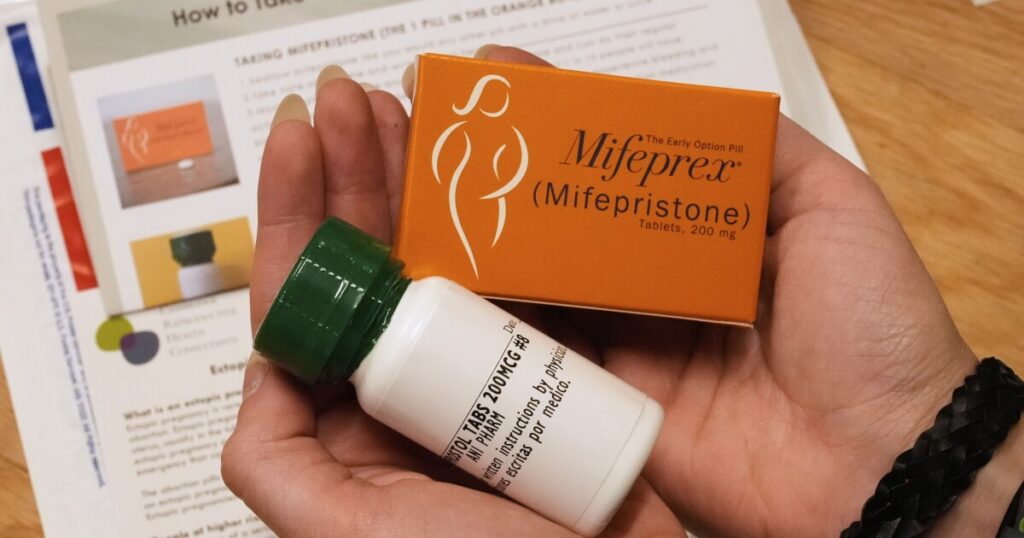
Envision a future where obtaining a medication abortion is as straightforward as purchasing a cold remedy at your local pharmacy. Such a scenario could transform reproductive health care accessibility, according to recent research. Dr. Daniel Grossman, a key researcher, suggests that this concept might soon become a tangible reality.
“It’s time that the general public understands that this could be a reality,” states Dr. Daniel Grossman, referencing a study he co-authored that appeared in the journal JAMA Internal Medicine.
Currently, medication abortion isn’t available over-the-counter, and Grossman notes the absence of relevant FDA applications. Moreover, over a dozen states have imposed complete bans on abortion, with some pursuing further legal restrictions. “There’s so much discussion about the restrictions on medication abortion that are not evidence-based,” Grossman remarks, citing extensive research supporting the safety of these medications. He believes that expanding access aligns with scientific evidence.
The Study Design
The study involved 168 individuals awaiting medication abortions, who reviewed a prototype package labeled “MiMi,” representing mifepristone and misoprostol. Participants evaluated their eligibility based on package instructions, and these self-assessments were compared to clinical evaluations.
Grossman reports, “We found that people did a really good job at self-assessing their eligibility,” noting that 88% of participants’ assessments aligned with clinical evaluations. He acknowledges the study’s limited size but believes it indicates the potential for further research into over-the-counter availability.
Growing Evidence
In a commentary accompanying the study, Dr. Sonya Borrero of the University of Pittsburgh acknowledges this research as part of a broader evidence base advocating for over-the-counter access to medication abortion. However, she warns that FDA decisions might be swayed by political and ideological factors.
Julie Maslowsky from the University of Michigan points out that the study’s scenario mirrors current clinical practices where patients often access medication abortion via telemedicine. She argues these medications could meet FDA criteria for over-the-counter approval, suggesting it would be an “incremental change” in states where abortion is legal.
The Political Moment
While the idea of over-the-counter medication abortion kits is not yet realized, political obstacles persist. Lawmakers like Sen. Josh Hawley and Sen. Bill Cassidy have voiced opposition, with Cassidy questioning the current state of medication abortion access in a Senate hearing. He expressed concerns about the normalization of procedures intended to end life.
Louisiana has taken steps to classify mifepristone as a controlled substance and criminally indicted an out-of-state physician for prescribing abortion pills via telemedicine. A court case aims to reinstate in-person requirements for mifepristone.
Amid these challenges, the FDA is reviewing mifepristone’s safety, driven by advocacy groups and political figures. As per an FDA FAQ, they aim for a comprehensive and timely study.
Given the political climate, Grossman concludes, “it’s probably not the right political moment to submit an application before the FDA” for over-the-counter approval.
“A Long Road”
Reflecting on the approval process for an over-the-counter birth control pill in 2023, Grossman notes the importance of early research in garnering interest from pharmaceutical companies and demonstrating the feasibility of such initiatives to the FDA.
Maslowsky explains that advancing to over-the-counter availability for medication abortion would require “actual use studies,” where the drug’s real-world application and outcomes are tracked. These studies are complex and costly, representing significant hurdles for future progress.
—
Read More Michigan News