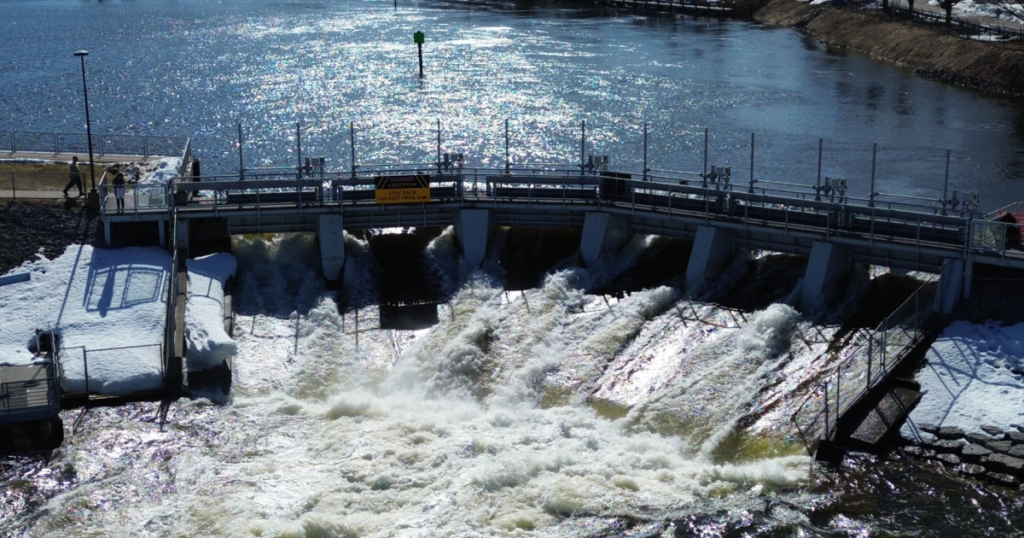
Cheboygan Lock and Dam on the Verge: A History of Warnings and Inaction
The Cheboygan Lock and Dam, a crucial infrastructure component for floodwater management, has been teetering on the brink of disaster for years. Despite numerous warnings from authorities, the necessary repairs to prevent a potential catastrophe have been largely ignored.
Records indicate that local, state, and federal officials were aware of the severe risks associated with the dam long before the current crisis. The privately-owned hydro plant linked to the dam, which plays a vital role in managing floodwaters, has languished in disrepair for decades. The facility, once part of a Charmin toilet paper mill, has changed ownership multiple times, contributing to its deterioration.
Cheboygan County Commissioner Richard Sangster expressed his concerns about the handling of the situation, stating, “I’m very concerned that this was not handled properly.” The current owner, Hom Paper XI, LLC, led by former NFL player Thomas Homco, has not commented on the issue.
Cheboygan County Sheriff Todd Ross noted, “We didn’t wait ’til the last minute. It’s privately owned. There’s only so much we can do.” Despite this, taxpayers are now shouldering the financial burden to restore the plant to functionality.
Unheeded Warnings and Regulatory Delays
The Federal Energy Regulatory Commission (FERC) has been issuing warning letters to various owners of the hydro plant for years, highlighting critical safety issues such as missing inspection records and faulty equipment essential for flood management. As early as 2019, FERC identified cracked concrete and damaged infrastructure that could compromise the dam’s ability to handle flooding.
Despite continuous warnings, including a citation for 16 safety violations in just 10 months, the plant was left unattended until a fire shut it down in September 2023. This event prompted more repair orders and further extensions from FERC.
“Safety concerns have been raised many times,” Sangster reiterated, emphasizing the potential devastation a dam failure would cause.
Complex Ownership and Regulatory Challenges
The Cheboygan dam’s history is marked by a complex web of ownership and regulatory oversight. Originally owned by utilities, the dam was sold to the state of Michigan in 1967. In 1983, Procter & Gamble acquired the hydroelectric component, only to close operations in 1990, leading to a gradual decline.
Great Lakes Tissue later took over the plant but failed to meet repair deadlines set by FERC. Ownership changed hands again, with FERC’s records showing Great Lakes Tissue as the owner well into 2025, raising questions about regulatory awareness of ownership transitions.
Efforts to Avert Disaster
As floodwaters threaten the dam, approximately 75 workers from Consumers Energy are on-site, attempting to restore the hydro plant. Bruce Straub, the incident commander, indicated that restoration efforts were showing promise.
Sharen Lange, a local business owner, highlighted the ongoing debate over the plant’s ownership, noting, “We know that it being in private hands has produced a really bad result.”
As the community braces for potential evacuation, the situation underscores the urgent need for effective management and oversight of critical infrastructure, a lesson painfully echoed from past experiences with the Midland dams.
For more detailed information, you can access the original story from Bridge Michigan.
“`
—
Read More Michigan News

![Jody White’s Unconventional Michigan Supreme Court Candidacy Explored[embed]https://www.youtube.com/watch?v=8NfxFIPE4ac[/embed]](https://www.kitchentablenews.org/wp-content/uploads/2026/10/Jody-Whites-Unconventional-Michigan-Supreme-Court-Candidacy-Exploredembedhttpswwwyoutubecomwatchv8NfxFIPE4acembed.com2F842F0e2Fc7223daa43c9876b36a4e00773a42Fme-supc.png "Jody White’s Unconventional Michigan Supreme Court Candidacy Explored[embed]https://www.youtube.com/watch?v=8NfxFIPE4ac[/embed]")