In southern Arizona, nature’s bounty is close at hand, yet remains elusive for many. A recent study highlights how barriers such as immigration enforcement, economic challenges, and systemic issues curtail access to natural spaces for Mexican immigrants and those with limited incomes.
Fiorella Carlos Chavez, an assistant professor at Arizona State University, experienced one of these barriers firsthand when she planned a birthday celebration at a local park. To her surprise, a reservation and fee were required to secure a picnic area, which she found perplexing for a public space.
“It blew my mind. This is a park, what do you mean you have to make a reservation?” Chavez, a Peruvian immigrant, remarked about the unexpected requirement.
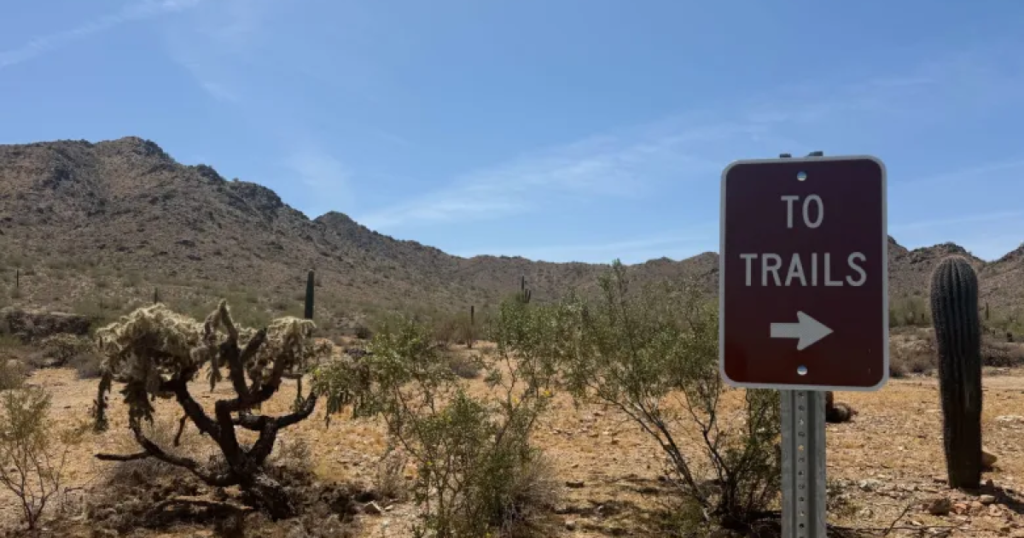
According to Rebecca Crocker, an assistant research professor at the University of Arizona, such barriers are not about distance but rather legal, economic, and structural impediments that hinder outdoor access in Tucson.
“Each of us have different natural inclinations to what feels like nature,” Crocker noted. The fear stemming from potential encounters with immigration enforcement or local wildlife like rattlesnakes can significantly affect one’s outdoor experience and health benefits.
Crocker emphasized that for many Latinos, traversing Arizona’s landscape poses risks, with heightened immigration surveillance having adverse health impacts. “Not being able to feel free to move across the landscape that they now reside in is a huge piece of why it’s so unhealthy for them,” she explained.
In fiscal year 2025, Immigration and Customs Enforcement arrests in Arizona more than tripled, as reported by Tucson nonprofit Arizona Luminaria.
Efforts to mitigate these concerns include a recent ordinance passed by the Tucson City Council, aimed at limiting federal immigration enforcement in city-owned areas, including parks.
Gary Nabhan, a research social scientist emeritus at the University of Arizona, connects the presence of the “human microbiome”—the collection of microorganisms obtained through interaction with nature—to stronger immune systems and overall health. Nabhan posits that this “hidden landscape” is crucial, as it mirrors the external environment through contact with soil and flora.
Peter James of Harvard T.H. Chan School of Public Health argues for recognizing nature as vital infrastructure, akin to utilities. “It’s not just a perk, it’s not just an amenity for the rich,” he stated. “This is vital infrastructure.”
For Latino communities, this connection to nature is deeply historical, rooted in agricultural and ranching traditions shaped by Spanish colonization and Mexican heritage. However, access remains limited not by geography but by systemic barriers, as observed in Tucson’s Latino neighborhoods.
Despite the proximity of parks, access is not guaranteed. “Proximity does not equal access,” said James, highlighting the complex layers of access issues.
Carlos Chavez further illustrated this by explaining how exhaustion and work demands in Latino communities often prevent park visits, viewing time in nature as a luxury: “Yes, I want to go to the park, but I’m too tired, I’m not going to do it, or I have something else to do from work,” she shared.
Crocker’s study underscores these barriers, noting that systemic issues like fatigue and lack of time compound individual challenges. “There’s always a deeper story there,” she said, advocating for structural solutions to promote access rather than placing the burden solely on individuals.
—
Read More Arizona News
![Jody White’s Unconventional Michigan Supreme Court Candidacy Explored[embed]https://www.youtube.com/watch?v=8NfxFIPE4ac[/embed]](https://www.kitchentablenews.org/wp-content/uploads/2026/10/Jody-Whites-Unconventional-Michigan-Supreme-Court-Candidacy-Exploredembedhttpswwwyoutubecomwatchv8NfxFIPE4acembed.com2F842F0e2Fc7223daa43c9876b36a4e00773a42Fme-supc.png "Jody White’s Unconventional Michigan Supreme Court Candidacy Explored[embed]https://www.youtube.com/watch?v=8NfxFIPE4ac[/embed]")