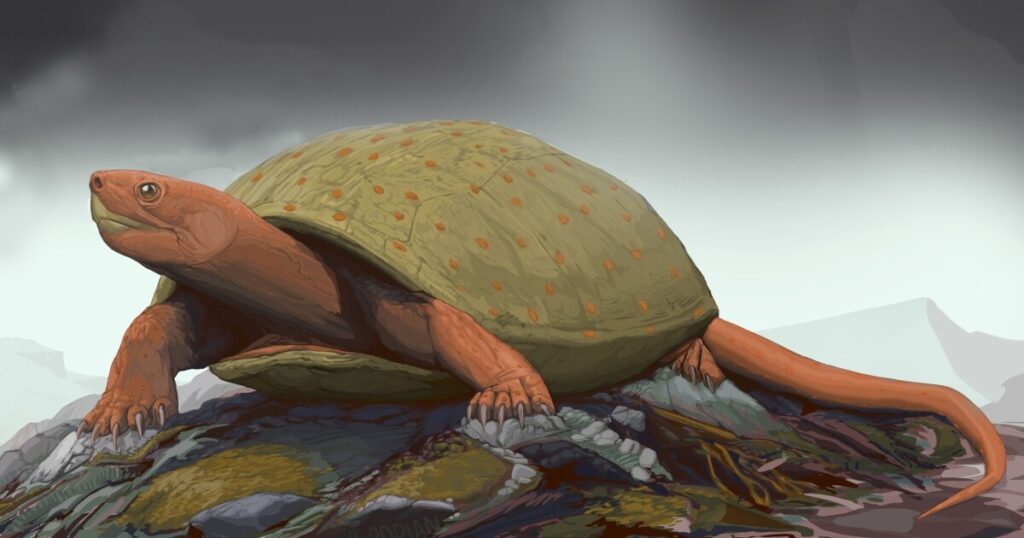
Picture yourself gliding through a prehistoric freshwater habitat in what is now western New Mexico, 90 million years ago. When your time came, you descended into the mud, joining countless others, your story waiting to be rediscovered.
Over eons, your once-living shell turned into stone, buried deep as the world transformed above. Continents drifted, dinosaurs disappeared, and eventually, new beings emerged—humans, destined to uncover your fossilized remains.
In the 1990s, amidst the fossil-rich terrain of the Zuni Basin, paleontologists unearthed a turtle shell fossil. Briefly reintroduced to daylight after millions of years, it was soon stored away in a collection, dormant once more.
Fast forward to 2023, when Brent Adrian from Arizona State University revisited the fossil. His examination revealed that this wasn’t merely any turtle fossil. It belonged to a species never seen before—a new chapter in the story of baenid turtles, a group once flourishing in ancient freshwater environments.
The newly identified species was named Edowa zuniensis, a tribute to the Zuni people and the land that had safeguarded this remarkable artifact for millennia.
Today, the tale of the Zuni turtle continues to unfold, woven into Earth’s ancient narrative and brought to life by those who discovered and preserved its legacy.
This episode of Earth Notes was brought to you in part by Pink Jeep Tours, written by Octavio Alcocer Duran, and produced by KNAU and the Sustainable Communities Program at Northern Arizona University
—
Read More Arizona News
![Jody White’s Unconventional Michigan Supreme Court Candidacy Explored[embed]https://www.youtube.com/watch?v=8NfxFIPE4ac[/embed]](https://www.kitchentablenews.org/wp-content/uploads/2026/10/Jody-Whites-Unconventional-Michigan-Supreme-Court-Candidacy-Exploredembedhttpswwwyoutubecomwatchv8NfxFIPE4acembed.com2F842F0e2Fc7223daa43c9876b36a4e00773a42Fme-supc.png "Jody White’s Unconventional Michigan Supreme Court Candidacy Explored[embed]https://www.youtube.com/watch?v=8NfxFIPE4ac[/embed]")