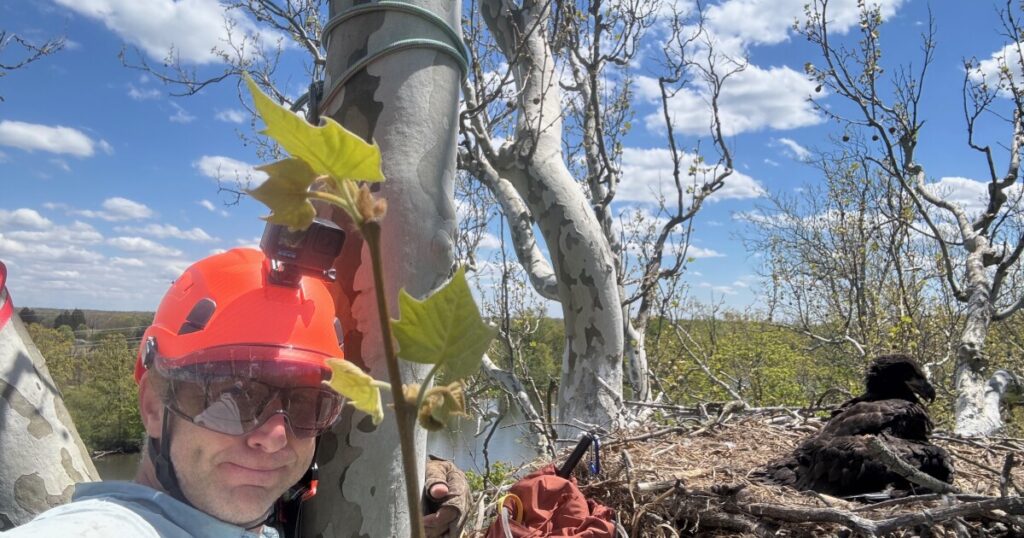
In the heart of Michigan, eagle biologists are on a unique mission to gauge the health of the environment by studying the blood of baby eagles. These majestic birds, residing at the top of the food chain, serve as a vital indicator of water quality in the region.
Biologists Bill Bowerman and Mike Wierda, both with roots in Michigan but now affiliated with universities out of state, traverse the state each spring and summer. They follow GPS coordinates to locate bald eagle nests identified through earlier aerial surveys. Despite recent challenges with federal funding, these researchers continue their work voluntarily.
“You certainly get to see a lot of, a lot of corners of Michigan you wouldn’t normally when you’re out chasing these birds,” said Wierda. Their research involves collecting and analyzing eagle blood, which can reveal contaminants such as DDT, PCBs, PFAS, and mercury. By studying nestlings, or eaglets, scientists can track environmental health across different regions and over time.
Their journey involves a meticulous search through Michigan’s forests, often leaving marked trails to find the nests. Bowerman, familiar with the terrain, navigates the woods with ease, searching for clues like eagle excrement or branches indicating a nest. Upon locating a nest, Wierda gears up with climbing equipment to reach the heights where the eaglets reside.
“When I get to the nest, the babies are great ’cause they hold their wings up as big as they can, they stand up as tall as they can and they go, ‘Aw, aw, aw,’” noted Wierda. “The eaglets, they’re adorable every time.”
However, not every expedition goes as planned. During a recent climb, the nest expected to house eaglets was found empty, much to the team’s surprise. “What a bummer. I had angry adults hanging around. We’ve got a whitewash down here. It was promising,” said Wierda. The absence of the eaglets raised several questions, with possibilities ranging from predation to starvation or even displacement by a storm.
While the disappearance of the eaglets remained unsolved, Bowerman reflected on his extensive experience, noting, “Because we could not get our federal funding, we created a nonprofit called Wings Over Water Research Institute.” This organization supports ongoing eagle research to maintain data continuity and understand the broader ecological impacts.
Their past research has documented significant issues, such as eagle losses due to bird flu, and they were the first to test eagle eggs for PFAS, as published in a 2020 paper in Environmental Pollution. As they continue their work, scientists like Bowerman and Wierda hope to unravel more environmental mysteries related to eagle health and water quality.
—
Read More Michigan News