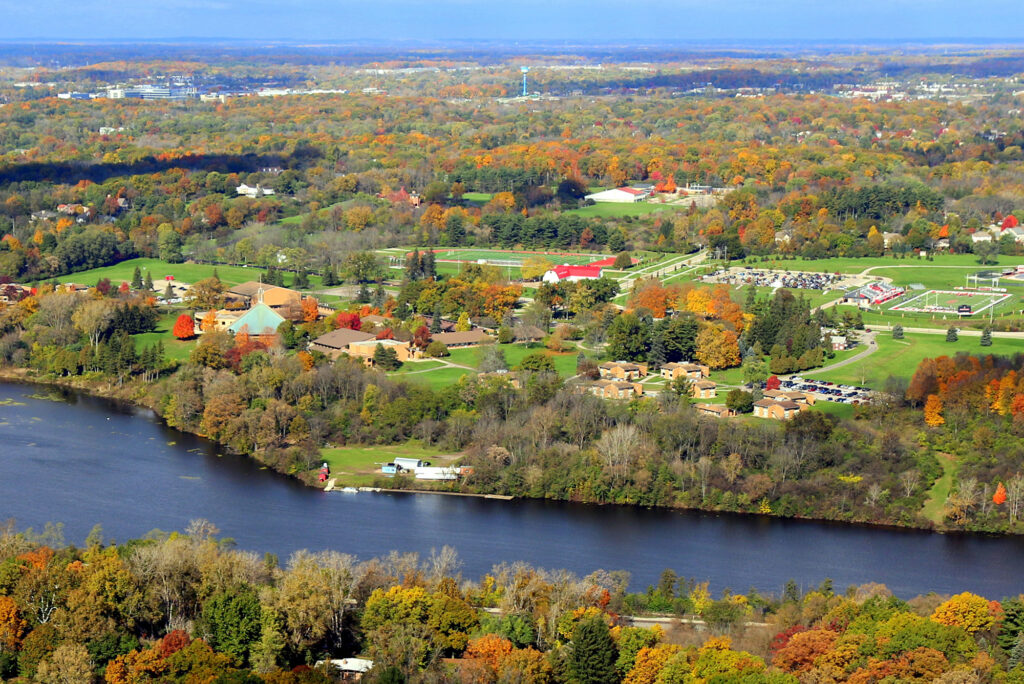
On May 21, the Board of Regents approved the acquisition of the former Concordia University campus, following a long-standing strategy of expanding the university’s reach and impact. The University of Michigan (U-M) aims to enhance its educational and societal contributions through strategic land acquisitions. The 140-acre site at 4090 Geddes Road will be purchased from Concordia for $60 million, with a closing date set for June 30, pending environmental review and due diligence.
“We do this to fulfill our mission and envision a future for the university and society,” President Domenico Grasso expressed during the regents meeting. This expansion is expected to bolster U-M’s influence in Ann Arbor and Washtenaw County.

The campus features administration buildings, classrooms, residence halls, athletic facilities, the historic Earhart manor, and a chapel. U-M leadership acknowledges no immediate plans for the property, emphasizing a forward-looking approach.
Regent Paul Brown stated, “Our job is to protect the future from the present, and that includes thinking proactively in the long term.” U-M has a history of acquiring land for future development, as seen with the main hospital site in 1919 and North Campus in 1949.
- The purchase of the hospital site in 1919, which wasn’t developed until 1925, exemplifies strategic foresight.
- North Campus, acquired in 1949, continues to expand and innovate.
Brown highlighted the university’s commitment to maintaining public access to parks and the Huron River, and enhancing athletics facilities for local schools. Future plans will involve careful evaluation and collaboration with local stakeholders.

In 2007, U-M acquired Pfizer’s 174-acre campus, transforming it into the North Campus Research Complex. Today, it thrives as a hub for research and innovation, hosting more than 3,500 faculty, staff, and students.
- The Biointerfaces Institute explores interactions between living tissue and synthetic surfaces.
- The Weil Institute and the Institute for Healthcare Policy and Innovation drive advancements in healthcare.
- The Frankel Cardiovascular Center and Rogel Cancer Center advance their fields from NCRC labs.
- Michigan Medicine’s clinical pathology space processes specimens from U-M Health and other hospitals.
Grasso noted the unique opportunity presented by Concordia officials to continue an educational mission on a site that has served students for over 60 years.
—
Read More Michigan News



![ICE Pursuit Ends in Fatal Grand Rapids Crash, Details Emerge[embed]https://www.youtube.com/watch?v=m6UY04VfQ-U[/embed]](https://www.kitchentablenews.org/wp-content/uploads/2026/10/ICE-Pursuit-Ends-in-Fatal-Grand-Rapids-Crash-Details-Emergeembedhttpswwwyoutubecomwatchvm6UY04VfQ-Uembed.com2F0d2Fef2F2fd3ad944f8596721c8fe9408c3e2Fimg-978.jpeg "ICE Pursuit Ends in Fatal Grand Rapids Crash, Details Emerge[embed]https://www.youtube.com/watch?v=m6UY04VfQ-U[/embed]")