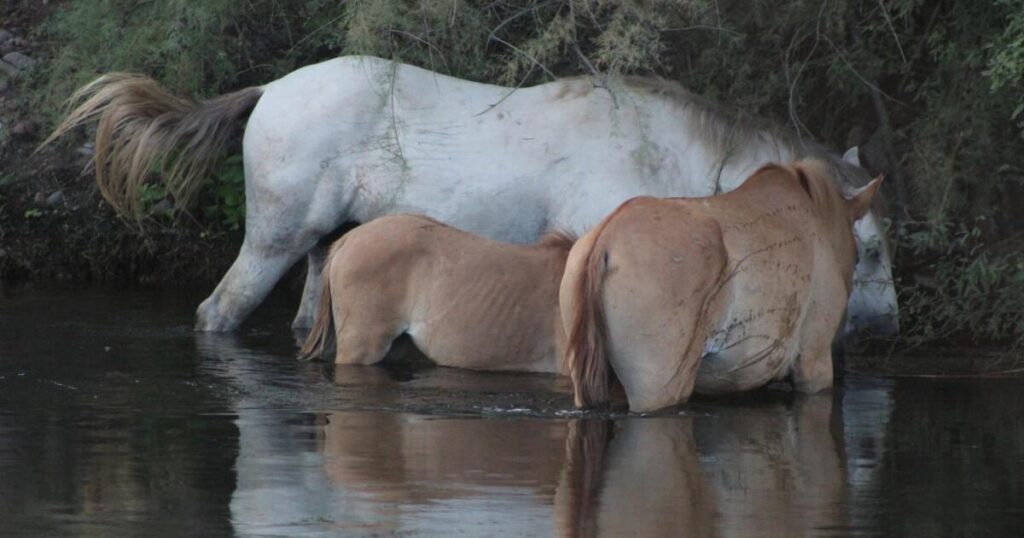
New Approach for Salt River Horse Herd Management Postpones Removals
In a significant shift for the management of the wild horse population along Arizona’s Salt River, a revised plan announced Tuesday delays the immediate removal of horses and raises the target population size. This decision comes amid ongoing concerns about the ecological impact of the horses, which are considered non-native and have been implicated in overgrazing issues.
The state’s Arizona Department of Agriculture (AZDA), responsible for managing these horses, had previously planned to relocate a portion of the herd for adoption. However, this has been paused for two years pending a genetic study aimed at understanding the herd’s long-term viability.
The Salt River Wild Horse Management Group, working under contract with the AZDA, supports the new plan, which increases the desired population from 120 to 170 horses. Simone Netherlands, President of the group, highlighted the adjustment, stating, “The end goal for the herd in the original contract was 120, and now it’s 170, so that’s a pretty significant jump up, and 170 is a much better number for keeping a viable herd that doesn’t extinct themself in the future.”
The group advocates for managing the horse population through fertility control, a strategy that has shown effectiveness but progresses slowly. From a population of 274 horses in January, the number has modestly decreased to 267.
Previously, the management plan involved removing 25 horses annually, a strategy deemed too aggressive by the management group, which feared such actions could threaten the genetic diversity and survival of the herd. “These removals were actually really threatening the genetic viability of that herd because if you don’t have enough scientific data and you remove horses and the population then gets so low that you can have the effects of inbreeding,” Netherlands explained.
The upcoming genetic study, funded by the Arizona Board of Regents and conducted by a state university, aims to provide the necessary scientific data to support informed decision-making. Chad Sampson, Executive Director of the Arizona Board of Regents, emphasized the importance of the research, stating, “Arizona’s public universities have the expertise and research capabilities to help answer important questions facing our state. The Salt River Horses are an important part of Arizona’s heritage, and this Regents’ Grant will provide the research and data needed to support science-based decisions about the herd’s long-term health and the ecosystem they share.”
For further details about the management plan and its implications, visit KJZZ’s report and the new management plan document.
—
Read More Arizona News

![Botched Ad Mix-Up: Super PAC Error in Arizona Congressional Race[embed]https://www.youtube.com/watch?v=bEMgIlCkHz0[/embed]](https://www.kitchentablenews.org/wp-content/uploads/2026/10/Botched-Ad-Mix-Up-Super-PAC-Error-in-Arizona-Congressional-RaceembedhttpswwwyoutubecomwatchvbEMgIlCkHz0embed.com2F0e2F962Fe971102f49e7a4f2a64fd3cc60a22Fjonatha.png "Botched Ad Mix-Up: Super PAC Error in Arizona Congressional Race[embed]https://www.youtube.com/watch?v=bEMgIlCkHz0[/embed]")