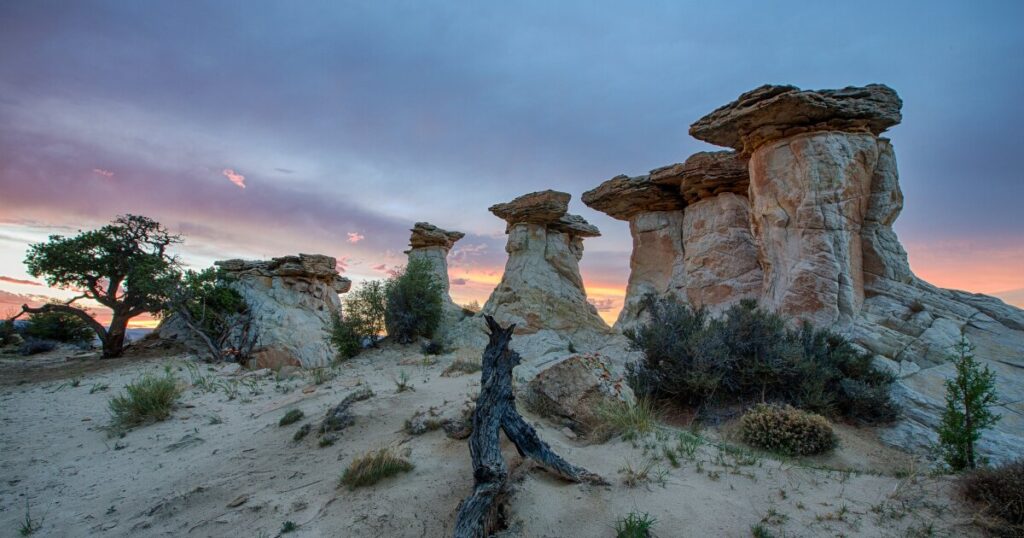
Mining Claims Emerge as Utah National Monuments Face Reduction
Recent reductions in two significant national monuments in Utah have sparked interest from mining companies, leading to new claims on lands that hold cultural importance for Native American tribes. This development has raised concerns among environmental and tribal groups, who are closely monitoring the situation.
Following the decision by President Donald Trump on July 13 to drastically reduce Bears Ears National Monument and Grand Staircase-Escalante National Monument, mining companies have moved quickly to file claims. Bears Ears saw more than a 90% reduction, while Grand Staircase was cut by about the same percentage, as per Trump’s proclamations.
In the immediate aftermath, Moab-based Kimmerle Mining filed seven claims within the original boundaries of Bears Ears, and Craig Rosequist made two claims within Grand Staircase. Despite requests, both Kimmerle Mining and Rosequist did not provide comments on their actions.
Autumn Gillard, a member of the Paiute Indian Tribe of Utah and coordinator for the Grand Staircase-Escalante Inter-Tribal Coalition, expressed deep concerns. “It’s just very unfortunate that our public lands and Native American ancestral homelands are being put up so quickly on the chopping block,” she remarked. The coalition, which includes several tribes, aims to ensure tribal involvement in decisions affecting these lands.
Gillard fears that any potential mining could damage landscapes with thousands of cultural sites, emphasizing a holistic conservation approach. She noted the alarming speed of the claims, predicting more to follow.
Brian Somers, president of the Utah Mining Association, maintains that U.S. mining regulations would ensure responsible operations. He pointed out the need for domestic mineral production, citing Kimmerle Mining’s interest in extracting minerals like uranium, vanadium, and copper to reduce reliance on foreign sources.
Somers asserted, “There are going to be areas that are inappropriate for mining, and there’s other areas that are going to be very appropriate for mining.” He emphasized the potential benefits of developing resources domestically in an environmentally friendly manner.
However, Gillard rebuffed claims that mining could be conducted safely within these monuments. She warned of significant environmental impacts not currently being considered.
In previous legal actions, Kyle Kimmerle of Kimmerle Mining challenged the restoration of these national monuments in 2021 under President Joe Biden. The U.S. Bureau of Land Management’s decision on the claims remains uncertain, given the timeline restrictions stated in Trump’s proclamations.
As the situation develops, the tension between resource extraction and cultural preservation continues to draw attention from various stakeholders.
—
Read More Arizona News

![Botched Ad Mix-Up: Super PAC Error in Arizona Congressional Race[embed]https://www.youtube.com/watch?v=bEMgIlCkHz0[/embed]](https://www.kitchentablenews.org/wp-content/uploads/2026/10/Botched-Ad-Mix-Up-Super-PAC-Error-in-Arizona-Congressional-RaceembedhttpswwwyoutubecomwatchvbEMgIlCkHz0embed.com2F0e2F962Fe971102f49e7a4f2a64fd3cc60a22Fjonatha.png "Botched Ad Mix-Up: Super PAC Error in Arizona Congressional Race[embed]https://www.youtube.com/watch?v=bEMgIlCkHz0[/embed]")