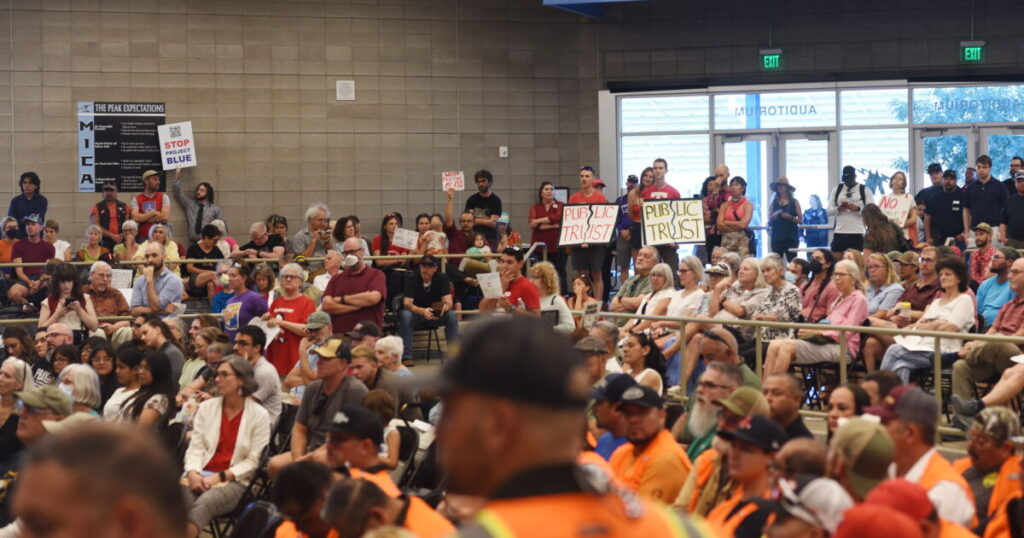
In a swift move last fall, Tucson city officials enacted a significant ordinance governing large water users without public input. This decision followed the city’s rejection of the Project Blue data center, highlighting the urgency to regulate water usage by major consumers.
For the past year, Tucson Water has engaged with a diverse coalition of 42 local organizations to refine these rules. Their collective revisions are slated for discussion at a city council hearing, marking the first opportunity for public commentary on the ordinance and its proposed amendments.
The Watershed Management Group, a key stakeholder, expressed disappointment over the minimal adoption of community suggestions in the current revisions, citing a lack of public involvement in shaping the ordinance.
A city spokesperson emphasized the diversity of opinions in stakeholder processes, stating, “in any well-represented stakeholder process, a variety of opinions/options will be furnished to the group for consideration. Typically, a stakeholder group forwards items with consensus support for consideration.”
Councilmember Miranda Schubert praised the closing of a loophole that previously allowed water-intensive industries excessive consumption without oversight. However, she, alongside the Watershed Management Group, advocates for a lower threshold to define a large water user.
Threshold Debate and Industry Impact
The large water user ordinance sets a consumption threshold that prompts conservation measures for users exceeding 7.48 million gallons monthly. This threshold was established to alleviate concerns about data centers tapping into Tucson Water with minimal scrutiny.
Watershed Management’s Catlow Shipek argues that this threshold is excessively high, limiting the city’s ability to enforce conservation with many industries. “In the last year, there’s been no new large water user at the 10,000 ccf (centum cubic feet) or greater threshold,” Shipek noted, underscoring the ordinance’s inefficacy in its current form.
Schubert echoed these concerns, highlighting that many data centers would not meet the existing threshold, which was a focal point of the ordinance’s original intent.
An alternative to lower the threshold was discussed, with suggestions to reduce it to 7,500 ccf/month or even 2,500 ccf/month, aligning with standards from Phoenix and Avondale. Project Blue, under construction in Pima County, holds permits for up to 2.5 million gallons monthly, showcasing the potential gap in oversight.
Addressing Water Supply Concerns
While Tucson boasts a robust water supply, largely reliant on groundwater and the Colorado River, stakeholders worry about the long-term impacts of high consumption thresholds, especially given Arizona’s anticipated cuts in Colorado River allocations.
Shipek suggests that lowering the threshold isn’t about stifling business but ensuring new enterprises adhere to sustainable water use practices. Proposals for suspending large water applications during droughts were also discussed, although the city official clarified such measures would only apply under severe water shortages.
Conservation Measures and Loophole Closure
Under the ordinance, large users must create conservation plans and utilize reclaimed water. However, Shipek criticizes the lack of specific conservation targets, suggesting a two-to-one offset system to ensure water stewardship.
Schubert supports more defined offset requirements, expressing concern over regulatory uncertainties if guidelines are determined project-by-project by Tucson Water’s director.
Moreover, a critical revision addresses companies circumventing the threshold by distributing water usage across multiple meters. The amended ordinance will now consider total consumption, regardless of metering strategy.
For further details, refer to the document outlining the ordinance revisions in red here (DOCX).
—
Read More Arizona News



![Exploring Michigan’s Unique University Board Election System[embed]https://www.youtube.com/watch?v=[/embed]](https://www.kitchentablenews.org/wp-content/uploads/2026/09/Exploring-Michigans-Unique-University-Board-Election-Systemembedhttpswwwyoutubecomwatchvembed.com2F9b2Fbe2F9938d5fa43a2baa2cea44e05ad592Fmids-un.png "Exploring Michigan’s Unique University Board Election System[embed]https://www.youtube.com/watch?v=[/embed]")