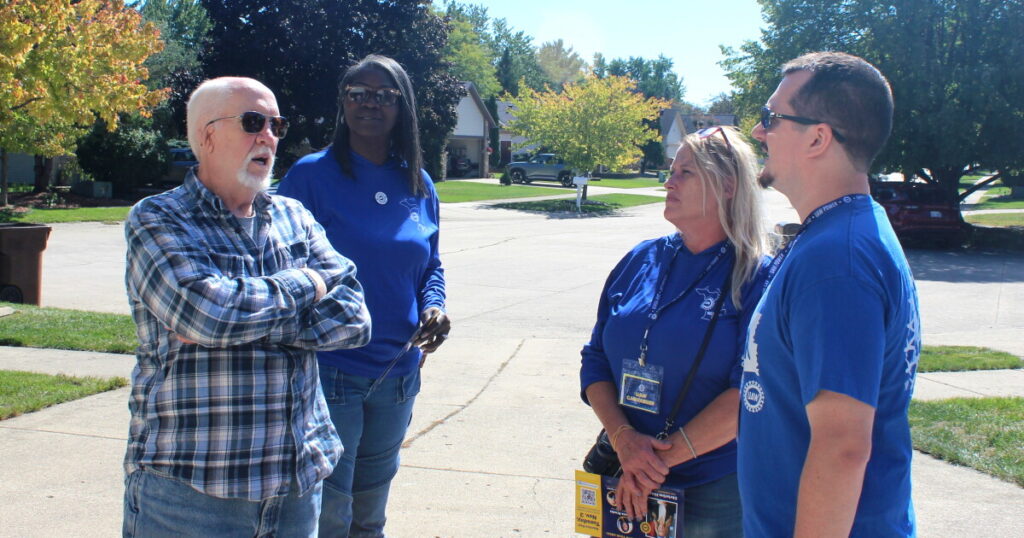
In the northern suburbs of Detroit, the United Auto Workers (UAW) are making concerted efforts to reinvigorate their political influence in Michigan, a critical battleground state. As UAW canvassers approached Walter Usakowski, a retired member who worked at Ford’s Sterling Axle Plant for over 45 years, he confirmed his support for the union-endorsed Democratic candidates in the upcoming midterm elections, though he remains uncertain about the voting tendencies of many of his former colleagues.
The UAW is grappling with internal divisions over which political party aligns best with working-class interests, compounded by a history of corruption scandals and dwindling membership. Despite traditionally backing Democrats, the union’s membership has shown a split, with many supporting Republican President Donald Trump.
Internal Challenges Amidst Political Canvassing
On a recent canvassing event in Macomb County, where Trump secured a significant victory in 2024, UAW members, predominantly retirees, expressed varied opinions on whether Democrats or Republicans would best tackle the cost of living. JJ Jewell of the UAW’s Community Action Program noted, “Even if this election goes fantastically, that’s not mission accomplished. That means we’re 1% of the way done.”
Betty Anderson, another UAW member, voiced her frustration with colleagues who supported Trump, feeling they were abandoning working-class ideals. This division mirrors broader national political rifts, with union voters split between Trump and Democratic nominee Kamala Harris in 2024.
Rebuilding Trust with Transparent Leadership
The UAW is striving to rebuild trust following a corruption probe that implicated several of its officials. Elected in 2023, UAW President Shawn Fain has focused on transparency and has achieved notable labor dispute victories, boosting member confidence. As Usakowski observed, “I think the UAW members now are starting to fall a little more in line.”
In its political endorsements, the UAW has shown unpredictability, backing progressive Democrat Abdul El-Sayed over more established candidates. El-Sayed’s support for universal healthcare and opposition to corporate influence resonated with the union’s leadership.
Republican opponent, former U.S. Rep. Mike Rogers, is focusing on his opposition to federal regulations requiring increased electric vehicle production, a point of concern for some autoworkers.
Mobilizing Voters to Maintain Relevance
To remain politically influential, the UAW is intensifying efforts to galvanize its base. “You don’t win campaigns off of your endorsements,” says Robert Bruno of the University of Illinois Urbana-Champaign. “You win campaigns at the door, or at the bar, or at the union hall.”
Despite a drop from over 600,000 members in the 1980s to about 350,000 today, the UAW remains the largest union in Michigan. It is focusing on mobilizing voters, with a significant number participating in early voting during the state’s primary elections. As Fain emphasized during a Lansing event, the union is prioritizing member-driven directions, particularly on issues like affordability.
“We are as active as we can be right now,” Fain stated, underscoring the union’s commitment to reinvigorating its political clout.
—
Read More Michigan News