Michigan Senate Candidates Share Divergent Plans at Economic Forum
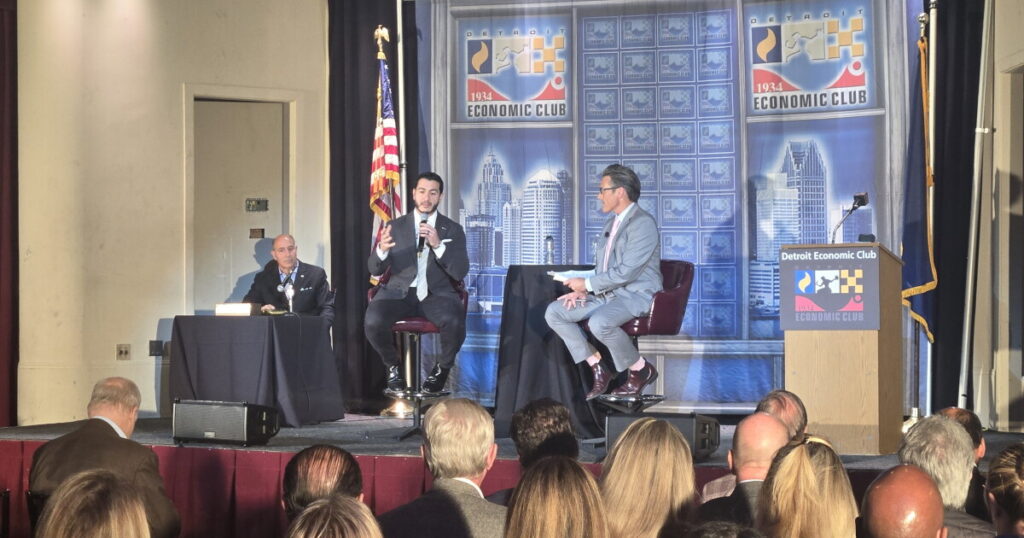
At the Detroit Economic Club, the major party candidates for Michigan’s open U.S. Senate seat showcased their distinct visions for the state’s future, highlighting stark differences in their approaches to healthcare and economic policy. Republican Mike Rogers and Democrat Abdul El-Sayed each presented their strategies aimed at addressing the state’s most pressing issues.
The forum revealed some common ground between the candidates, notably their shared criticism of free trade agreements, which they argue have resulted in the loss of manufacturing jobs in Michigan. Both candidates also agreed that President Donald Trump’s trade war with Canada has negatively impacted the state’s economy.
Rogers proposed a plan to stimulate Michigan’s economy by cutting taxes and enhancing the role of skilled trades in education. He emphasized the financial advantages of skilled trades over traditional college degrees, stating, “If you look at wages for new college graduates versus wages for the skilled trades, man, skilled trades is winning that fight all day long.”
Using Detroit as a model, Rogers suggested revitalizing vacant lots through a revamped land bank, facilitating easier construction processes, and involving students in building projects as apprentices.
El-Sayed, while agreeing on the need to cut through bureaucratic red tape, also advocated for regulating short-term rental platforms like Airbnb and Vrbo to address housing shortages.
On economic inclusivity, El-Sayed argued for reforms ensuring equitable benefits across society, rather than favoring the affluent. He illustrated his point by highlighting the dominance of major corporations in the tech market, stating, “We need to actually start standing up to monopolies and oligopolies and start regulating them so we can get back to a system where there is competitiveness in a market.”
Regarding support for small businesses, El-Sayed proposed reducing employer-side payroll taxes to encourage hiring, especially in an era increasingly influenced by AI advancements. He has also advocated for eliminating the payroll tax cap to ensure that high-income earners contribute more substantially to social programs.
Healthcare emerged as a major point of divergence. El-Sayed promoted his “Medicare for All” initiative, likening current healthcare premiums to an indirect tax. He argued for a system offering cheaper and more robust coverage through government oversight rather than private insurers.
Conversely, Rogers emphasized the importance of price transparency to lower healthcare costs, warning against drastic changes to the current system without considering potential repercussions. “This is a huge problem if we do this because people haven’t thought about the consequences. So let’s do something different before we break the whole thing,” Rogers said.
While both candidates addressed similar topics, they did so individually without directly debating each other. Their next encounter is scheduled for a televised debate on WXYZ-TV Detroit, where they will face off head-to-head.
—
Read More Michigan News