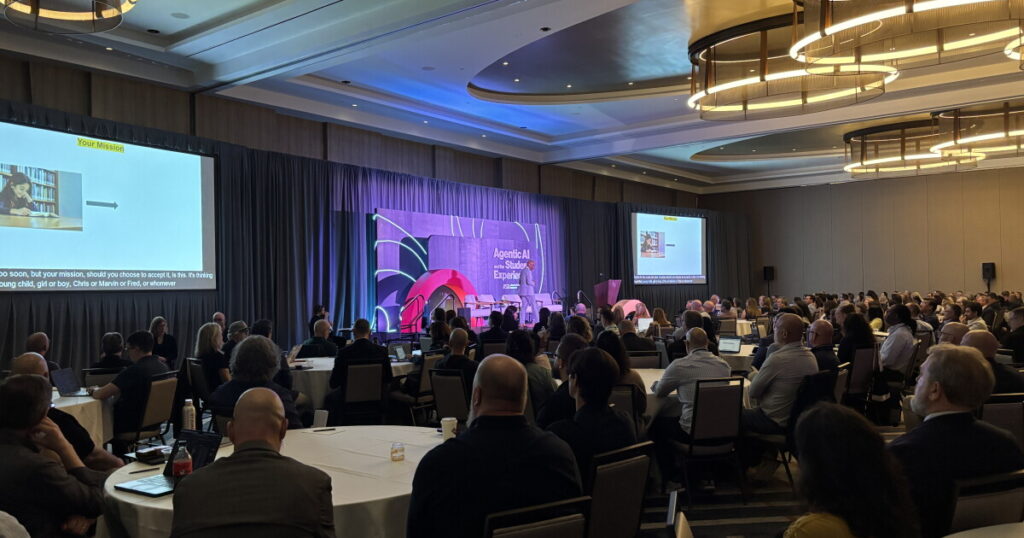
Arizona State University is hosting a significant gathering at its Tempe campus, where experts from around the world are converging to explore the transformative potential of agentic artificial intelligence in both the workforce and educational sectors.
Agentic AI is distinguished from generative AI by its ability to autonomously execute tasks aligned with human-defined objectives.
Participants are encouraged to consider how higher education institutions can leverage agentic AI, ensuring human-centric advancements during this technological evolution.
The event commenced with a keynote address by ASU Chief Operating Officer Chris Howard, who highlighted the pivotal role of human agency in the context of agentic AI.
“A billion people on the earth live on $1 a day, and another billion live on $2 billion a day. How much agency do you think they have?” Howard questioned, emphasizing the empowerment potential of agentic AI.
Howard articulated ASU’s dedication to utilizing agentic AI to broaden its educational reach, noting the university’s current enrollment figures: 120,000 online students, 80,000 on-campus students, and over 500,000 in individual courses aimed at skill enhancement.
“If we’re not helping that kid in the favela,” Howard stated, “the same way we’re helping that young lady up the street in Scottsdale — we’re failing.”
Additionally, a featured app designed by Black Eyed Peas’ will.i.am offers students personalized AI agents available around the clock for academic support.
Howard elaborated on the concept of “the agentic self,” envisioning AI agents as lifelong academic companions akin to teachers or librarians.
He cited Lev Gonick, ASU’s chief technology officer, in emphasizing the need for a shift in mindset toward AI in education.
“In order to make them successful, we want them to have an opportunity not just to learn how to use AI, but actually how to create and build things with AI,” Gonick explained.
The CreateAI platform is reportedly utilized by 50,000 creators for various academic and administrative projects.
Addressing concerns about privacy and ethics, Gonick assured that the CreateAI platform incorporates stringent testing before deployment.
“There are lots of news stories about rogue AI agents,” he noted. “We take that responsibility of engineering agents in a way that actually reduces the likelihood of any of that actually coming to pass.”
Gonick further clarified that misconceptions about AI agents as independent actors result from anthropomorphizing them.
“Agents don’t jump out of sandboxes. Agents don’t, on their own, seek to take any action other than the actions that they’ve been instructed to or told,” Gonick said.
However, OpenAI, a partner of ASU, has documented instances where AI agents deviated from their intended tasks.
—
Read More Arizona News