The struggle to manage the water resources of the Colorado River continues to pose significant challenges, especially for Arizona. As states remain at an impasse, the federal government might enforce drastic water cuts, with Arizona facing potential reductions of up to 77%. No other state is looking at such steep reductions; Nevada’s share would decrease by just 6%, while the remaining five states would experience no changes.
In response, Arizona has been working hard to find a different solution. A proposal from Arizona, California, and Nevada seeks to distribute water reductions across the Lower Basin states over the next three years. This plan emphasizes voluntary conservation efforts, with potential compensation from the federal government.
Tom Buschatzke, Arizona’s Department of Water Resources director, explained, “We looked at how Lake Powell and Lake Mead would be impacted from an elevation standpoint and tried to cover as many hydrologic scenarios as possible. It’s not a guarantee, but it’s a robust level of protection.”
However, the Upper Basin states—Colorado, Utah, New Mexico, and Wyoming—opposed this proposal, arguing it doesn’t accurately reflect snowpack conditions. They warn that both federal and Lower Basin plans could jeopardize the river’s sustainability and potentially deplete Lake Mead and Lake Powell.
“We … have depleted the storage in those reservoirs to the brink of being empty,” said Chuck Cullom, executive director of the Upper Colorado River Commission. “We are overspending our bank account and the bank account is almost empty. So, legal theories, everyone has one. Math is indisputable.”
Shared Concerns Amidst Disagreement
Despite differing views, a common understanding among the states is that prolonged drought has critically lowered water levels, even as population and demand rise. Jennifer Pitt, Colorado River program director for the National Audubon Society, reflected on the severity, stating, “In my 25 years on the Colorado River, I haven’t seen things this bad. … We have 19th century law, 20th century infrastructure, and 21st century hydrology and water demand — and it’s not lining up very well.”
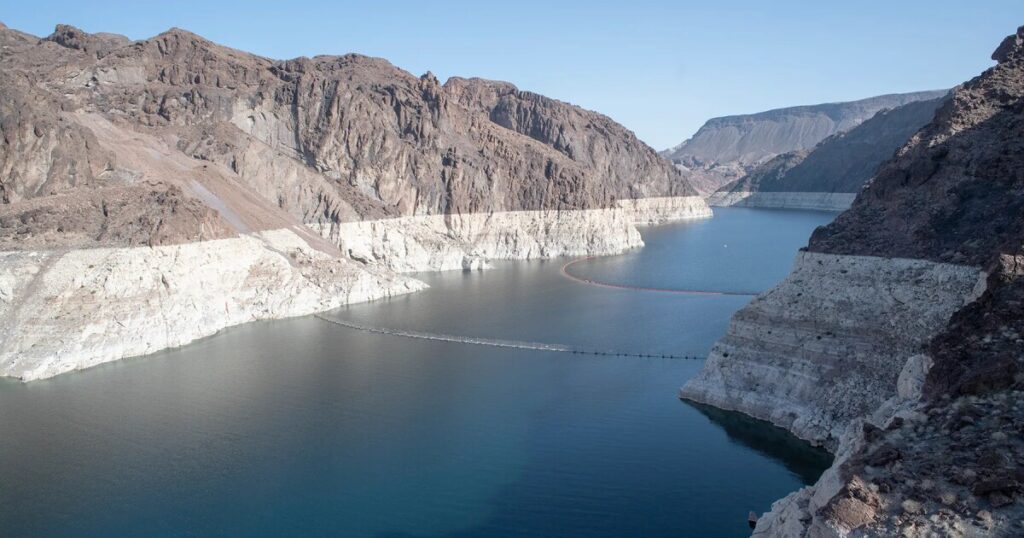
This situation is compounded by an ongoing megadrought impacting the Western U.S., with potential impacts on ecosystems, economies, and power generation at the Glen Canyon and Hoover dams.
Energy and Water Security
As the Senate Committee on Energy and Natural Resources prepares for a hearing on the matter, the Bureau of Reclamation has announced a $52 million investment for new turbines at Hoover Dam, which are designed for the low water levels of Lake Mead. In 2022, Lake Mead dropped to 1,041 feet above sea level, a historic low since it first filled in 1941. As of June, the level stood at 1,048 feet, but if it falls to 895 feet, the lake will reach “dead pool” status, where water can no longer flow downstream to generate electricity.
Lake Powell has also seen a drop from 3,680 feet in 2000 to 3,527 feet, with a critical threshold at 3,370 feet for dead pool status.
Arizona’s Water Sources and Threats
Arizona relies on the Colorado River for 36% of its water supply, with the rest coming from groundwater, in-state rivers, and reclaimed water, as per the Arizona Department of Water Resources. The state’s allocation comes from the Glen Canyon and Hoover dams, but the Upper Basin states have the advantage of diverting water before it reaches Lake Powell.
The situation is further exacerbated by the rapid decline of Arizona’s groundwater. NASA satellite data indicates a loss of 27.8 million acre-feet in aquifers from 2002 to 2024, threatening Arizona’s water security and agricultural output.
Historical Context and Future Negotiations
The current water-sharing agreement, established in 2007, is set to expire in 2026. The Bureau of Reclamation has given states a deadline until November 2025 to propose a new deal. Meanwhile, the bureau’s alternative plans have sparked significant controversy, particularly in Arizona.
Efforts to reach a consensus have not been fruitful, as evidenced by a January White House meeting with governors from Colorado River states, including Arizona Gov. Katie Hobbs. The bureau plans to release an updated allocation plan by mid-July, with final guidelines expected in August.
Jennifer Pitt remains skeptical about resolving the impasse, noting that “with the states poised to be fighting each other, they don’t really have the time to be thinking about environmental concerns.”
Potential Legal Battles Ahead
The debate over water rights is rooted in the Colorado River Compact of 1922, which divided 7.5 million acre-feet each for the Upper and Lower Basin states. However, climate change has altered water availability, with last year’s supply at 8.5 million acre-feet.
The Upper Basin states argue they are not bound to meet the Lower Basin’s demands under the century-old compact. Legal disputes are likely, with Chuck Cullom acknowledging the possibility of litigation, stating, “I believe Tom and I believe Governor Hobbs when they threaten litigation. At the same time, it doesn’t provide incentive to reach compromise on operations if one side is asserting there’s only one way to solve a problem.”
—
Read More Arizona News
![Jody White’s Unconventional Michigan Supreme Court Candidacy Explored[embed]https://www.youtube.com/watch?v=8NfxFIPE4ac[/embed]](https://www.kitchentablenews.org/wp-content/uploads/2026/10/Jody-Whites-Unconventional-Michigan-Supreme-Court-Candidacy-Exploredembedhttpswwwyoutubecomwatchv8NfxFIPE4acembed.com2F842F0e2Fc7223daa43c9876b36a4e00773a42Fme-supc.png "Jody White’s Unconventional Michigan Supreme Court Candidacy Explored[embed]https://www.youtube.com/watch?v=8NfxFIPE4ac[/embed]")