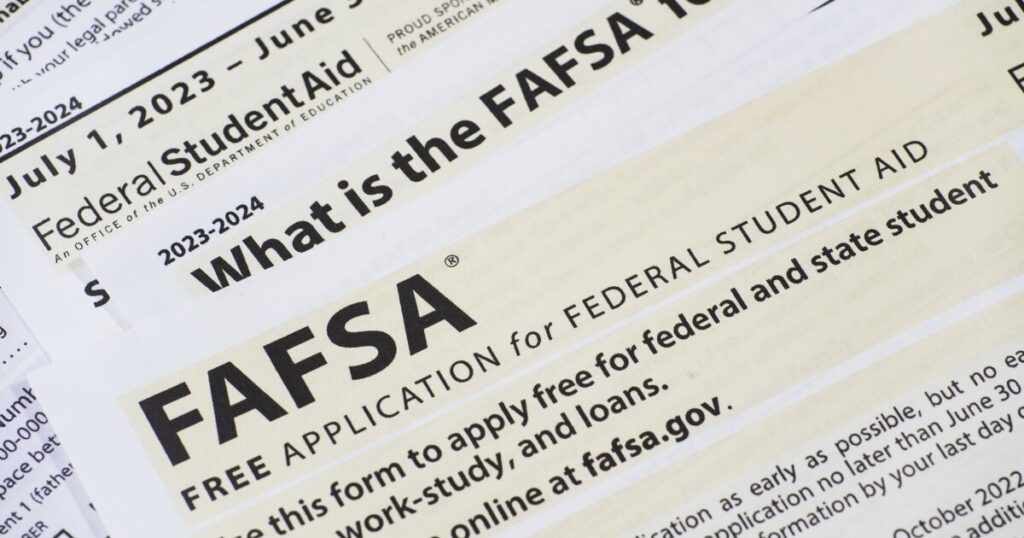
As the academic year draws to a close, many high school seniors are gearing up for college and tackling the crucial task of financing their education. A significant step in this process is completing the Free Application for Federal Student Aid (FAFSA). While historically challenging, more students are now engaging with FAFSA, particularly in Arizona, where completion rates have surged nearly 20%.
Bill DeBaun, the senior director of data and strategic initiatives at the National College Attainment Network, sheds light on this positive trend. DeBaun noted, “Arizona has had one of the strongest bounce-back performances in terms of the number of FAFSAs completed statewide for the class of 2026.” Despite this, Arizona’s completion rate of approximately 41.5% still trails about 14 percentage points behind the national average.
Understanding why students hesitate to fill out the FAFSA is essential. DeBaun explained that while the process has become more streamlined, students often face uncertainties about their post-high school plans and affordability concerns. Additionally, the form’s complexity can be daunting without guidance.
Another layer of complexity arises for students from mixed-immigration status families, who might fear sharing personal information with the government. DeBaun emphasized, “Data submitted through the FAFSA is only supposed to be used to determine and award federal financial aid,” but acknowledged the inability to guarantee data protection for these families.
To support these students, advisors are encouraged to discuss the risks and benefits of FAFSA submission on a case-by-case basis. Despite potential risks, FAFSA completion remains the gateway to accessing essential federal financial aid.
The rollout of a simplified FAFSA form, although initially fraught with issues, has contributed to increasing completion rates. DeBaun remarked on the improvements since the class of 2024’s difficulties, highlighting the record-high submission rates for the class of 2026.
Arizona’s success in boosting FAFSA completion can be attributed to coordinated efforts by educational bodies and non-profits, such as Education Forward Arizona. Initiatives like the “50-by-Fall” challenge and revitalized College Goal Sunday campaigns have provided students and families with the necessary support and resources.
Throughout the U.S., some states have implemented universal FAFSA policies, mandating form completion as a graduation requirement. These policies have propelled states to the top of the FAFSA completion leaderboard, with a majority of the leading states enforcing such requirements.
The impact of these increasing completion rates is significant. “Historically, there’s been a very tight association between FAFSA completion and immediate college enrollment,” DeBaun stated. With more students accessing federal aid, pathways to education and training post-high school become more attainable, particularly for those from low-income backgrounds.
To listen to the full conversation, visit the original KJZZ’s The Show.
—
Read More Arizona News