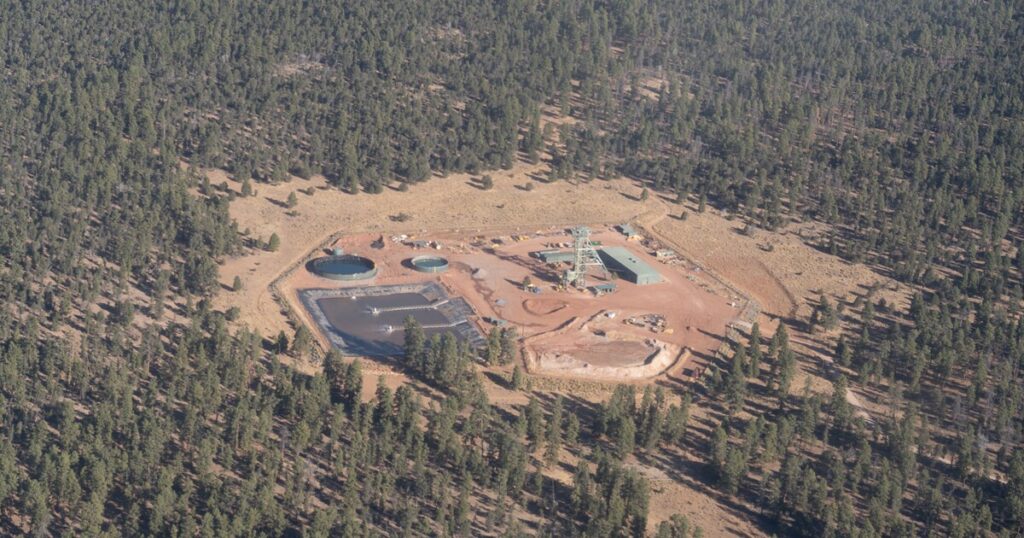
Near the iconic Grand Canyon lies a uranium mine whose owner is seeking permission to increase arsenic levels in the groundwater beneath the facility. This request has sparked controversy, with two scientists raising objections and calling for a more thorough investigation.
Energy Fuels Resources, the company behind the Pinyon Plain Mine, has submitted a proposal to the Arizona Department of Environmental Quality (ADEQ) to amend a water quality permit. The amendment would raise the allowable arsenic level from 0.05 mg/L to 0.055 mg/L. Energy Fuels claims that the elevated arsenic levels result from natural occurrences, not mining activities.
The mine is located near the South Rim of the Grand Canyon and Red Butte, a site of spiritual significance to the Havasupai Tribe. The tribe, relying on an aquifer deep underground as their sole drinking water source, opposes the mine’s operations. Read more about their opposition here.
Background to the Proposal
Energy Fuels first noticed the higher arsenic levels in January 2026 and attributed them to a natural phenomenon. According to the company’s application, the widening cone of depression in the Coconino aquifer is drawing groundwater with naturally high arsenic concentrations toward the monitoring well. Curtis Moore, the company’s senior vice president, mentions that the mine’s proximity to minerals like uranium and copper contributes to the arsenic levels, stating, “It’s not surprising that there are elevated levels of arsenic next to this ore body.”
Scientific Opposition
Contrary to Energy Fuels’ claims, retired scientist Brad Esser and David Kreamer, professor emeritus at the University of Nevada, Las Vegas, argue for a more comprehensive analysis before any permit amendments are approved. Esser, who has expertise in groundwater science, criticized the company’s explanation as a hypothesis, suggesting that the mine’s operations could be affecting arsenic levels through factors like oxygen-rich groundwater.
Esser, in his technical comment to ADEQ, emphasized, “It sets the wrong incentive,” suggesting that the focus should be on understanding high contamination levels rather than simply adjusting permit thresholds. The Grand Canyon Trust, a conservation nonprofit opposing the mine, sought Esser’s input on the matter, although not compensating him for his comment.
Regulatory and Environmental Concerns
Despite the scientists’ concerns, ADEQ’s internal assessment aligns with Energy Fuels’ explanation. The agency’s conclusion is based on site-specific hydrogeological data, indicating that high-arsenic groundwater naturally flows towards the mine, thus supporting Energy Fuels’ request.
Esser remains apprehensive about the potential long-term impact on the Havasupai Tribe’s drinking water, warning that contamination could take decades to manifest. However, Moore reassures that the aquifers involved are isolated and not connected to broader groundwater systems.
ADEQ is nearing the end of its evaluation process for the permit amendment and is expected to reach a decision by June.
—
Read More Arizona News