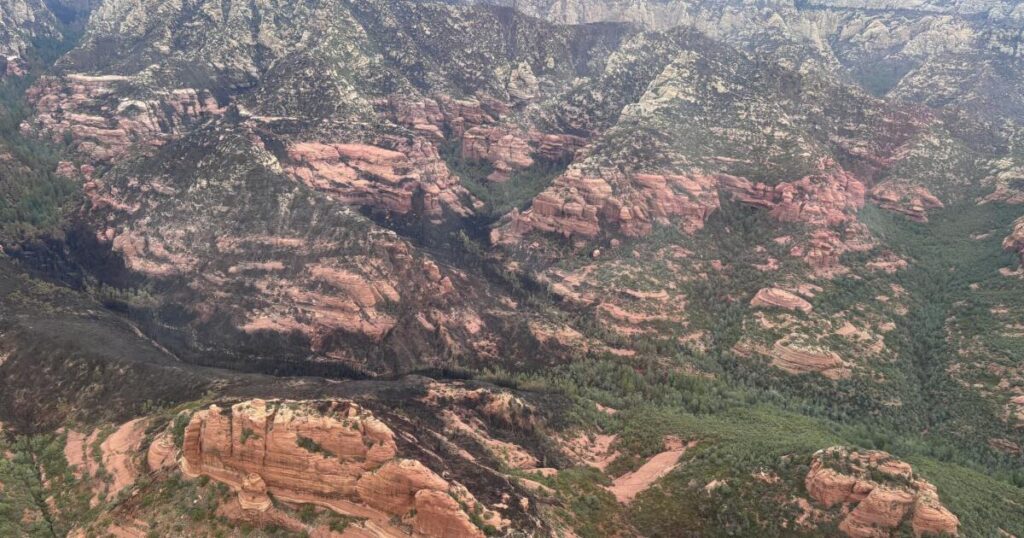
Post-Fire Impact Assessment on the Mogollon Rim and Oak Creek Canyons
After the Pocket Fire scorched 27,000 acres on the Mogollon Rim, researchers from the Burned Area Emergency Response Team have concluded their evaluation of the fire’s impact on the region, including areas along Oak Creek and north of Sedona.
The fire, while mostly low in intensity, has heightened the risk of flash flooding in these areas. U.S. Forest Service hydrologist Kelly Mott Lacroix shared insights on the team’s work with KNAU’s Adrian Skabelund.
ADRIAN SKABELUND: We’ve experienced an active monsoon season recently. Has this affected your team’s work in any way?
KELLY MOTT LACROIX: Absolutely, the monsoon season shortens our work window each day, but it also aids our assessments by providing real-time runoff data to improve our models and predictions.
SKABELUND: Does observing actual runoff allow you to make more accurate predictions?
MOTT LACROIX: Yes, witnessing the effects firsthand helps us refine our models and identify at-risk areas more precisely.
SKABELUND: Can you describe the current condition of the area following the fire?
MOTT LACROIX: The condition varies significantly, largely due to soil burn severity. We often see a ‘mosaic burn,’ where some areas exhibit high burn severity while others remain largely intact. This variation supports faster watershed recovery post-fire.
SKABELUND: Your report indicates that 65% of the area experienced low soil burn severity. How does this impact recovery?
MOTT LACROIX: A majority of the area will see relatively short-term vegetation recovery. While we won’t immediately see the return of ponderosa pine forests, grasses and shrubs will begin to regrow in less severely burned areas.
Post-fire flood risks are contingent on future rainfall patterns. While the 2014 Slide Fire resulted in minimal flooding due to a lack of storms, the current monsoon season may bring elevated flood risks to the West Fork of Oak Creek.
SKABELUND: Recent rains have turned Oak Creek black with ash. Is this common?
MOTT LACROIX: Yes, it’s a typical post-fire occurrence. Ash flows can persist throughout the monsoon season, especially given the fire’s size and the frequency of storms.
SKABELUND: Were you able to access the more remote canyon areas for assessment?
MOTT LACROIX: In West Fork, much of the channel vegetation remains, which is beneficial for recovery. However, higher burn severity was observed in the upper canyon regions.
SKABELUND: Kelly, thank you for sharing your insights.
MOTT LACROIX: My pleasure.
Additional Incident Report
The Navajo Police Department reported that a semi-truck transporting uranium overturned amidst heavy rain on U.S. 160 near Black Mesa, Navajo Nation.
—
Read More Arizona News